
Your best sales month can end with no cash to pay your suppliers.
The stock sold.
Customers paid.
Revenue looked strong.
But supplier invoices are now due.
And the cash has already gone somewhere else.
That is where accounts payable becomes dangerous.
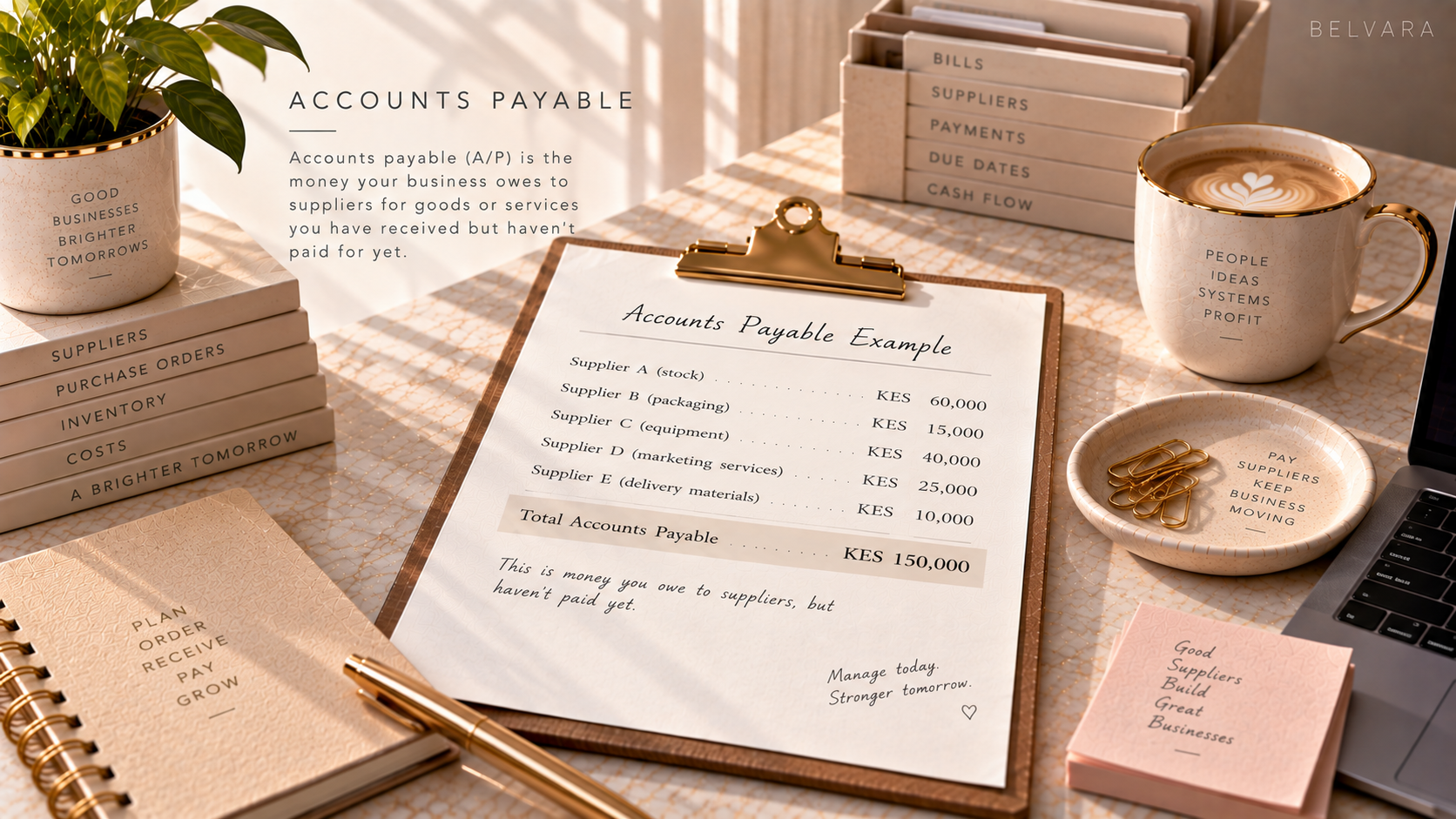
Accounts payable, often shortened to A/P, is money your business owes suppliers for goods or services already received but not yet paid for.
It is a liability.
And it can make your cash position look healthier than it really is.
Because the money came in.
But some of it was already needed somewhere else.
Belvara view: Supplier credit can make cash look stronger today because payment was pushed into tomorrow. Tomorrow still arrives.
What are accounts payable?
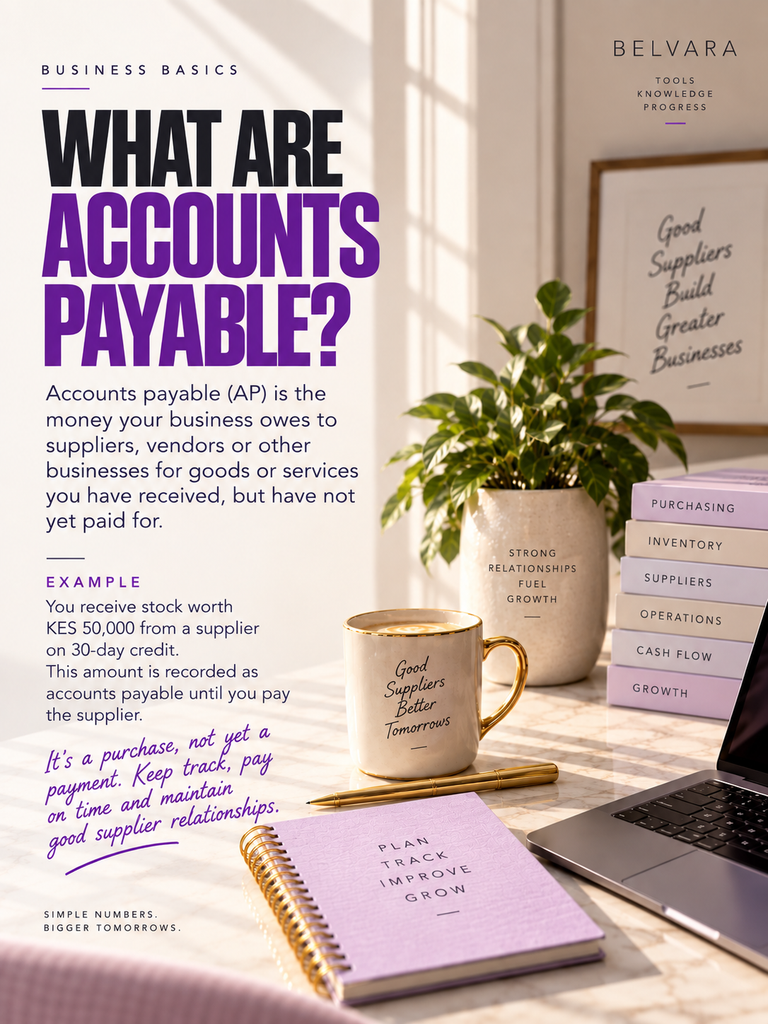
Accounts payable are amounts a business owes suppliers for goods or services already received on credit but not yet paid for.
Suppose a supplier delivers stock worth:
KES 300,000
and gives your business:
30 days to pay
You now have:
- stock or another cost recorded, depending on what was purchased
- an accounts payable balance of KES 300,000
The supplier has already delivered.
Your business has not yet paid.
That unpaid amount is a liability.
When you later pay the supplier:
- cash decreases
- accounts payable decreases
The expense or inventory purchase does not happen again.
The liability is simply settled.
A simple accounts payable example
Suppose your business owes:
- Supplier A: KES 150,000
- Supplier B: KES 80,000
- Supplier C: KES 70,000
Total accounts payable:
KES 300,000
Your bank balance is:
KES 500,000
At first glance, the business looks like it has KES 500,000 available.
But KES 300,000 is already owed to suppliers.
That leaves a much smaller operating cushion.
The bank balance tells you what is there. Accounts payable tells you what part of it is already spoken for.
Accounts payable are liabilities
Accounts payable are generally classified as current liabilities because they are usually expected to be settled within the business’s normal operating cycle or short-term payment period.
They sit on the balance sheet alongside other current liabilities such as:
- tax payable
- payroll payable
- accrued expenses
- short-term borrowings
- current portions of long-term debt
- customer-related obligations, where applicable
A/P matters because it is usually tied to near-term cash outflows.
Accounts payable vs accounts receivable
These two are opposites.
Accounts payable = you owe suppliers.
Accounts receivable = customers owe you.
| Accounts payable | Accounts receivable | |
| Who owes? | Business owes supplier | Customer owes business |
| Balance sheet type | Liability | Asset |
| Cash effect later | Cash goes out | Cash comes in |
| Main risk | Business pays late | Customer pays late |
Both can exist at the same time.
That is where working-capital pressure begins.
Your customer can owe you while your supplier is already asking to be paid
Suppose:
- You buy stock for KES 300,000
- Supplier gives you 30 days to pay
- You sell the stock for KES 500,000
- Customer gets 60 days to pay
The sale may be profitable.
But your supplier is due before the customer pays.
Now the business has to fund the gap.
You may need:
- cash reserves
- owner funding
- overdraft
- another loan
- delayed supplier payment
The problem is not profit.
The problem is timing.
Belvara view: When customers pay slower than suppliers expect payment, your business becomes the bank in the middle.
Supplier credit can help cash flow
Accounts payable are not automatically bad.
Supplier credit can improve cash flow.
Suppose you receive stock worth:
KES 500,000
today.
Your supplier gives you:
60 days to pay
If you sell the stock and collect the customer cash before day 60, the supplier has effectively helped finance the operating cycle.
That can reduce the amount of your own cash tied up in inventory.
This is one reason supplier terms can be commercially valuable.
But the benefit depends on what happens before payment is due.
If the stock does not sell, the supplier still wants to be paid.
Payment terms matter
Supplier terms can include:
- cash on delivery
- 7 days
- 14 days
- 30 days
- 45 days
- 60 days
- 90 days
- staged payments
- deposits plus balance
- negotiated credit arrangements
The longer the approved payment period, the more time the business has to generate cash before settlement.
But long terms should not become an excuse to ignore the liability.
The due date still matters.
A/P is not free money
This is where businesses get into trouble.
The supplier lets you pay later.
Cash stays in the account.
The business starts using that cash for:
- rent
- payroll
- marketing
- new stock
- owner withdrawals
- other expenses
Then the supplier invoice becomes due.
The cash is gone.
The liability remains.
Supplier credit gives you time, not extra money. Spend the time badly and the due date becomes the problem.
Accounts payable can make cash look better than it is
Suppose your business shows:
- Cash: KES 1,000,000
- Accounts payable: KES 700,000
- Payroll due: KES 150,000
- Tax payable: KES 100,000
The account holds KES 1 million.
But KES 950,000 is already tied to near-term obligations.
The business does not really have the freedom that the bank balance suggests.
This is why payable visibility matters in cash planning.
An accounts payable ageing report
An accounts payable ageing report groups supplier balances by how long they have been outstanding or when they are due.
A simple view might look like:
| Supplier | Current | 1–30 days overdue | 31–60 days | 61–90 days | 90+ days |
| Supplier A | KES 150,000 | KES 0 | KES 0 | KES 0 | KES 0 |
| Supplier B | KES 0 | KES 80,000 | KES 0 | KES 0 | KES 0 |
| Supplier C | KES 0 | KES 0 | KES 50,000 | KES 0 | KES 0 |
| Supplier D | KES 0 | KES 0 | KES 0 | KES 0 | KES 120,000 |
This helps answer:
- Who do we owe?
- How much?
- When is it due?
- What is overdue?
- Which suppliers need immediate attention?
- Where are we risking the relationship?
A single A/P total cannot answer those questions.
Overdue accounts payable are different from normal accounts payable
An invoice due next week under agreed terms is normal.
An invoice 90 days overdue is a different situation.
The number can be the same.
The risk is not.
Overdue payables can create:
- supplier pressure
- reduced credit terms
- stock delays
- cash-on-delivery requirements
- penalties
- damaged trust
- legal action
- supply interruption
That is why age matters.
Supplier relationships are financial infrastructure
A reliable supplier does more than deliver stock.
They can give the business:
- credit terms
- priority stock access
- better prices
- flexible minimum orders
- faster dispatch
- emergency support
Late payment can put those advantages at risk.
Suppose a supplier previously gave:
60-day terms
After repeated late payments, they move you to:
cash before delivery
Your business now needs cash upfront for every restock.
The payable problem just became a working-capital problem.
A supplier relationship can be worth more than the invoice balance. Lose the trust and you may lose the credit that helped the business grow.
Stretching suppliers can make cash look stronger temporarily
Suppose:
Month 1
- Accounts payable: KES 200,000
Month 2
- Accounts payable: KES 350,000
Month 3
- Accounts payable: KES 550,000
Month 4
- Accounts payable: KES 800,000
Cash may look healthier because the business has not paid suppliers as quickly.
But if payables are rising because invoices are being delayed rather than because purchases genuinely grew, the business may be financing itself by making suppliers wait.
That can hide weak cash generation.
A bigger bank balance is not impressive if it was created by not paying bills that are already due.
Accounts payable vs expenses
Accounts payable and expenses are not the same thing.
Suppose the business receives an electricity bill for:
KES 30,000
for the current month.
If the expense has been incurred but has not yet been paid:
- the business may recognise KES 30,000 expense
- and recognise a KES 30,000 liability
When payment happens later:
- cash falls
- the liability falls
The expense does not happen twice.
This is why:
expense ≠ cash payment
and:
accounts payable ≠ expense
Accounts payable vs accrued expenses
Accounts payable normally relates to supplier invoices the business has received for goods or services.
Accrued expenses are obligations for costs already incurred where the business may not yet have received the invoice.
Suppose a consultant completes work worth:
KES 50,000
before month-end.
The invoice arrives next month.
The business may need to recognise an accrued liability for the cost already incurred.
Once invoiced, the amount may move into accounts payable depending on the accounting system and treatment.
The exact workflow can vary.
The important distinction is whether the obligation has been invoiced.
Accounts payable vs debt
Accounts payable are liabilities.
But they are not usually what people mean when they say “debt”.
Debt normally refers to financing arrangements such as:
- bank loans
- overdrafts
- bonds
- formal borrowings
Accounts payable usually arises from normal trade with suppliers.
So:
Accounts payable are liabilities.
But:
Accounts payable are not the same as bank debt.
Accounts payable and working capital
Accounts payable are a major part of working capital.
A common working-capital formula is:
Working Capital = Current Assets − Current Liabilities
Payables increase current liabilities.
That reduces working capital, all else equal.
But supplier terms can also improve operating cash flow by delaying payment.
That sounds contradictory.
It is not.
The balance sheet shows the obligation.
The cash flow benefit comes from the timing of payment.
Supplier days
One useful measure is Days Payable Outstanding, often shortened to DPO.
A common formula is:
DPO = Average Accounts Payable ÷ Credit Purchases × Number of Days
Where credit purchases are not readily available, some businesses use cost of goods sold as an approximation, but that is not always precise.
Suppose:
- Average accounts payable: KES 1,000,000
- Annual credit purchases: KES 12,000,000
- Period: 365 days
DPO:
KES 1,000,000 ÷ KES 12,000,000 × 365 ≈ 30 days
That suggests the business takes around 30 days on average to pay suppliers in this simplified example.
A higher DPO is not automatically better
Paying later can preserve cash.
That does not mean the longest possible payment time is always best.
A very high DPO can mean:
- strong negotiated supplier terms
- efficient working-capital management
or:
- the business cannot pay on time
- suppliers are being stretched
- invoices are overdue
- cash flow is weak
Context decides the meaning.
A ratio cannot tell you whether you negotiated 60 days or ignored a 30-day invoice for another month.
A lower DPO is not automatically better either
Paying quickly can mean:
- strong liquidity
- good supplier relationships
- early-payment discounts
or:
- the business is giving up useful credit terms
- cash is leaving before it needs to
- working capital is being managed too conservatively
Again, the number needs context.
Early-payment discounts
Some suppliers offer discounts for faster payment.
For example:
2% discount if paid within 10 days instead of 30 days
Suppose the invoice is:
KES 500,000
A 2% discount saves:
KES 10,000
The business has a choice.
Pay earlier and save KES 10,000.
Or keep the cash longer and pay the full amount later.
Whether early payment is worthwhile depends on:
- cash availability
- alternative uses of cash
- borrowing cost
- size of discount
- supplier relationship
The best decision is not always “pay as late as possible”.
Accounts payable and inventory
For merchants, payables and inventory are often connected.
Suppose the business owes Supplier A:
KES 700,000
for inventory.
Now inspect the stock:
- KES 500,000 already sold
- KES 150,000 still moving
- KES 50,000 slow or damaged
That context matters.
If the sold stock has already produced customer cash, paying the supplier may be straightforward.
If most of the stock is still sitting, the liability may create more pressure.
Belvara view: A supplier balance means more when you can see whether the stock behind it has already turned into sales and cash.
Stock can sell and the payable can still be a problem
Suppose:
- Supplier invoice: KES 400,000
- Stock sold for: KES 650,000
The business collects:
KES 650,000 cash
Great.
But then the owner uses:
- KES 200,000 for payroll
- KES 150,000 for rent and operating costs
- KES 100,000 for new marketing
- KES 80,000 for owner withdrawals
Cash remaining:
KES 120,000
Supplier still owed:
KES 400,000
The stock sold.
The payable did not disappear.
The problem was not sales.
It was cash allocation.
Accounts payable and cash flow
Payables can improve operating cash flow temporarily because the business gets to keep cash longer.
Suppose you buy inventory for:
KES 500,000
on 60-day terms.
No cash leaves today.
That supports short-term liquidity.
But payment in 60 days reduces cash.
This is why businesses should forecast payables by due date, not just look at current bank balance.
Accounts payable and cash conversion cycle
Accounts payable is one part of the cash conversion cycle.
The cash conversion cycle looks at how long cash is tied up between:
- paying suppliers
- holding inventory
- collecting customers
A simplified version uses:
- Days Inventory Outstanding
- Days Sales Outstanding
- Days Payable Outstanding
The general idea is:
Cash Conversion Cycle = Inventory Days + Receivable Days − Payable Days
Longer supplier terms can reduce the cash conversion cycle because the business pays later.
But delayed payment outside agreed terms is not the same thing as negotiated supplier credit.
Supplier terms can finance growth
Suppose a business sells fast-moving stock.
Supplier gives:
60-day terms
Customers pay immediately.
Inventory sells in:
20 days
The business may sell the stock and collect the cash long before supplier payment is due.
That can create a strong working-capital cycle.
Now reverse it.
Supplier gives:
14-day terms
Inventory takes:
60 days to sell
The business has to fund a much larger gap.
Same product.
Different payment structure.
Revenue can grow while accounts payable gets worse
Suppose:
Month 1
- Revenue: KES 1,000,000
- Accounts payable: KES 200,000
Month 6
- Revenue: KES 2,000,000
- Accounts payable: KES 1,000,000
Revenue doubled.
Payables increased five times.
That may be normal if purchases and supplier credit expanded with growth.
Or it may mean the business is paying suppliers more slowly.
The owner needs to know which.
Growth funded by supplier balances is still growth. But the supplier is helping finance it.
Accounts payable and gross margin
Payables do not directly determine gross margin.
But the costs behind supplier invoices often do.
Suppose supplier costs increase.
If selling prices stay unchanged:
- COGS may rise
- gross profit may fall
- gross margin may fall
Meanwhile, the payable amount may also increase.
That means supplier pricing can pressure:
- profitability
- cash
- working capital
at the same time.
Accounts payable and discounts
A supplier may offer:
- bulk discounts
- early-payment discounts
- negotiated pricing
- rebates
These can reduce product cost.
But chasing discounts can create its own problem.
Suppose the business buys far more inventory than it needs just to get a lower unit cost.
Accounts payable rises.
Inventory rises.
Cash risk increases.
The discount looked attractive.
The business may now be carrying too much stock and too much supplier obligation.
More supplier credit can hide overbuying
Suppose a supplier offers:
90-day terms
The business starts ordering aggressively because payment feels far away.
Inventory grows from:
KES 500,000
to:
KES 2,000,000
Accounts payable also grows.
Sales barely move.
The business has not become stronger.
It has converted supplier credit into slow stock.
Long payment terms can make overbuying feel painless until the invoice and the dead stock meet each other.
Accounts payable and returns to suppliers
Sometimes goods are:
- damaged
- incorrect
- defective
- over-supplied
- returned under agreed terms
The payable should reflect the amount the business genuinely owes after valid credits or adjustments.
Supplier credit notes need to be recorded properly.
Otherwise the business can appear to owe more than it actually does.
Duplicate invoices are a real control problem
Suppose the same supplier invoice is entered twice.
The business may:
- overstate payables
- overstate expenses or inventory
- accidentally pay the supplier twice
This is why accounts payable controls matter.
Useful checks can include:
- supplier name
- invoice number
- invoice date
- amount
- purchase order
- goods received
- payment status
A/P is not just a bookkeeping category.
It is also a fraud and error-control area.
Paying the wrong supplier is an A/P risk
Supplier payment workflows can be vulnerable to:
- fake invoices
- changed bank details
- duplicate requests
- staff errors
- fraudulent email instructions
- incorrect M-Pesa or bank details
That makes approval and verification important.
A payment should not be trusted simply because an invoice exists.
The business should verify:
- supplier identity
- amount
- invoice
- goods or services received
- payment destination
- approval
The three-way match
Larger or more controlled businesses often compare three records before payment:
- purchase order
- goods received record
- supplier invoice
This is commonly called a three-way match.
The purpose is simple.
Did we order it?
Did we receive it?
Were we invoiced correctly?
Small businesses may use lighter controls.
The principle still matters.
The safest supplier payment is not the one that is quickest. It is the one the business can prove it actually owes.
Accounts payable by supplier
A single total hides supplier risk.
Suppose total A/P is:
KES 1,500,000
Breakdown:
- Supplier A: KES 900,000
- Supplier B: KES 300,000
- Supplier C: KES 200,000
- Supplier D: KES 100,000
Supplier A represents:
60% of total payables
That concentration matters.
If Supplier A changes terms or stops supply, the business can feel it quickly.
Supplier concentration matters
The business may rely heavily on one supplier because they offer:
- best pricing
- unique stock
- long payment terms
- reliable availability
That can be commercially useful.
It also creates dependency.
Accounts payable data can help expose how much of the business’s supplier obligations sit with one party.
Accounts payable in retail
A retailer may use A/P for:
- inventory suppliers
- packaging suppliers
- maintenance providers
- professional services
- utilities where billed later
- other supplier invoices
For product merchants, stock and supplier balances are often tightly connected.
A retailer should know not only:
How much do we owe suppliers?
but also:
- When is each amount due?
- What stock did it buy?
- Has that stock sold?
- Has customer cash been collected?
- Are any invoices disputed?
- Are any credits missing?
Accounts payable in wholesale
Wholesale can carry large supplier balances because order sizes are larger.
The business may also sell customers on credit.
That creates a timing chain:
Supplier → Business → Customer
If the supplier wants payment in 30 days and the customer pays in 60 days, the wholesaler funds the gap.
If several large customers pay late at once, supplier pressure can build quickly.
Accounts payable in a service business
Service businesses can have A/P for:
- subcontractors
- professional services
- software vendors
- office suppliers
- maintenance
- marketing agencies
- utilities
- other vendor invoices
A service business without inventory can still have significant supplier obligations.
Accounts payable in SaaS
A software business may owe vendors for:
- cloud infrastructure
- software tools
- contractors
- legal services
- marketing services
- office costs
- data providers
- other technology services
Some vendors charge automatically.
Others invoice on credit terms.
The business still needs to know what has been incurred and what remains unpaid.
What is a good accounts payable balance?
There is no universal good A/P number.
A large payable balance can be healthy when:
- purchases are growing
- supplier terms are agreed
- invoices are current
- stock is moving
- cash is available for settlement
A small A/P balance can be unhealthy if:
- invoices are overdue
- suppliers have removed credit
- the business now pays cash upfront because trust was lost
The useful questions are:
- Who do we owe?
- How much?
- When is it due?
- Is it overdue?
- Are terms agreed?
- What did the supplier provide?
- Has the related stock sold?
- Do we have cash to settle it?
- Are payables growing faster than purchases?
- Are suppliers shortening terms?
Common accounts payable mistakes
1. Treating supplier credit like extra cash
It is delayed payment, not free money.
2. Looking only at total A/P
Due dates and ageing matter.
3. Paying suppliers late without understanding the cost
You can lose terms, trust and supply.
4. Paying too early automatically
You may give up useful working-capital time without a reason.
5. Ignoring early-payment discounts
Faster payment can sometimes create worthwhile savings.
6. Overbuying because the supplier offered long terms
The liability still becomes due.
7. Mixing A/P with debt
Supplier balances are liabilities but are different from formal borrowings.
8. Ignoring duplicate invoices
A simple duplicate can become an expensive payment error.
9. Paying without verifying receipt
An invoice alone does not prove the business received what it was charged for.
10. Letting overdue balances hide inside growth
Revenue can rise while supplier pressure gets worse.
How to manage accounts payable better
Keep every supplier balance visible
Know what is owed by supplier.
Track due dates
Do not manage payables from memory.
Use ageing
Separate:
- current
- 1–30 days overdue
- 31–60 days
- 61–90 days
- 90+ days
Reconcile supplier statements
Compare your records with the supplier’s records.
Record credit notes
Returns and adjustments should reduce the correct balance.
Verify invoices before payment
Confirm:
- supplier
- amount
- invoice
- goods or services received
- payment details
Use approval controls
Higher-value payments should not depend on one person’s unchecked decision.
Compare supplier terms with customer terms
Do not accidentally create a cash gap you cannot fund.
Review early-payment opportunities
Use discounts where the economics make sense.
Forecast upcoming payments
Know what cash will be needed next week, next month and beyond.
How Belvara helps you keep accounts payable visible
Accounts payable becomes risky when supplier invoices, stock receipts, payments and due dates live in separate places.
Belvara helps keep relevant supplier, purchasing, inventory, expense and payment records closer together so the owner can see what the business owes and what sits behind each balance.
The goal is not just to know total A/P.
It is to understand the obligation before it becomes overdue.
See supplier balances beside stock
A supplier balance is easier to understand when the owner can also see the inventory it funded.
That helps answer:
- Has the stock sold?
- Is it still sitting?
- Has it been damaged or written off?
- Did the business already collect the cash?
Track what is due
A payable due in 45 days is different from one already 60 days overdue.
Keeping due dates visible helps the business prioritise cash properly.
Reconcile payments
Supplier payments should reduce the correct balances.
Keeping payment records connected reduces the risk of losing track of what is still owed.
Read payables beside receivables and cash
The strongest view is not A/P alone.
It is:
- what customers owe you
- what you owe suppliers
- what cash you actually have
- when each side is due
That is the real working-capital picture.
Belvara view: Accounts payable should answer four questions immediately: who do we owe, how much, when is it due, and did the business already turn what they supplied into cash?
Do not mistake delayed payment for financial strength
Payables can make a business look comfortable.
The cash has not left yet.
The shelves are full.
Sales are happening.
The bank account still looks good.
Then supplier invoices fall due.
If the business has already used the cash elsewhere, the comfort disappears.
Good payable management is not about paying every invoice immediately.
It is not about delaying every invoice for as long as possible either.
It is about knowing:
- what is owed
- when it is due
- what the supplier terms allow
- what cash is coming in
- which payments protect important relationships
- whether the business can settle obligations without damaging operations
A business does not become stronger by paying late. It becomes stronger by using supplier time deliberately and still being ready when payment day comes.
The takeaway
Accounts payable are amounts the business owes suppliers for goods or services already received but not yet paid for.
They are liabilities.
They can support cash flow by allowing the business to pay later.
They can also create pressure when:
- invoices become overdue
- stock moves slowly
- customer cash arrives late
- supplier balances grow too quickly
- the business spends cash that should have been reserved
The wrong question is:
“How much cash do we have?”
The better question is:
“How much of that cash still has to leave, who is waiting for it, and when?”
Because the supplier already did their part.
Accounts payable is the record of the part your business still owes.
Frequently Asked Questions About Accounts Payable
What are accounts payable in simple terms?
Accounts payable are amounts a business owes suppliers for goods or services already received but not yet paid for.
What does A/P mean?
A/P is a common abbreviation for accounts payable.
Are accounts payable liabilities?
Yes. Accounts payable are generally current liabilities.
Are accounts payable expenses?
No. Accounts payable are liabilities. An expense or asset purchase may create the payable, but the payable itself is the amount still owed.
What is the difference between accounts payable and accounts receivable?
Accounts payable are amounts the business owes suppliers. Accounts receivable are amounts customers owe the business.
What is the difference between accounts payable and debt?
Accounts payable usually arises from normal supplier credit. Debt usually refers to formal borrowing such as loans or overdrafts.
What is the difference between accounts payable and accrued expenses?
Accounts payable usually relates to supplier invoices already received. Accrued expenses may relate to costs incurred before the invoice arrives.
What is an accounts payable ageing report?
It is a report that groups unpaid supplier balances by due date or how long they have been outstanding.
Why is A/P ageing important?
It helps the business identify what is current, what is overdue and which supplier balances need attention first.
What is DPO?
DPO means Days Payable Outstanding. It estimates how long the business takes to pay suppliers on average.
Is a high DPO good?
Not automatically. It can reflect strong negotiated terms or late payment problems.
Is a low DPO good?
Not automatically. Fast payment can support relationships or discounts, but it can also use cash earlier than necessary.
Can accounts payable help cash flow?
Yes. Supplier credit allows the business to delay payment and keep cash longer.
Can high accounts payable be dangerous?
Yes. High payables can create pressure if invoices are overdue, cash is weak or stock has not generated enough cash to settle suppliers.
How do accounts payable affect working capital?
Accounts payable are current liabilities, so they reduce working capital when current liabilities are subtracted from current assets.
Should a business pay suppliers as late as possible?
Not necessarily. Payment should respect agreed terms and consider cash needs, discounts, supplier relationships and business risk.
What is a three-way match?
It is a control that compares the purchase order, goods received and supplier invoice before payment.
How does Belvara help with accounts payable?
Belvara helps keep supplier balances, purchases, inventory, expenses and payments closer together so the owner has clearer visibility over what is owed, what is due and what has already been settled.
What should I learn after accounts payable?
Useful next concepts include accounts receivable, working capital, cash conversion cycle, supplier credit, current liabilities, DPO and cash flow.
