
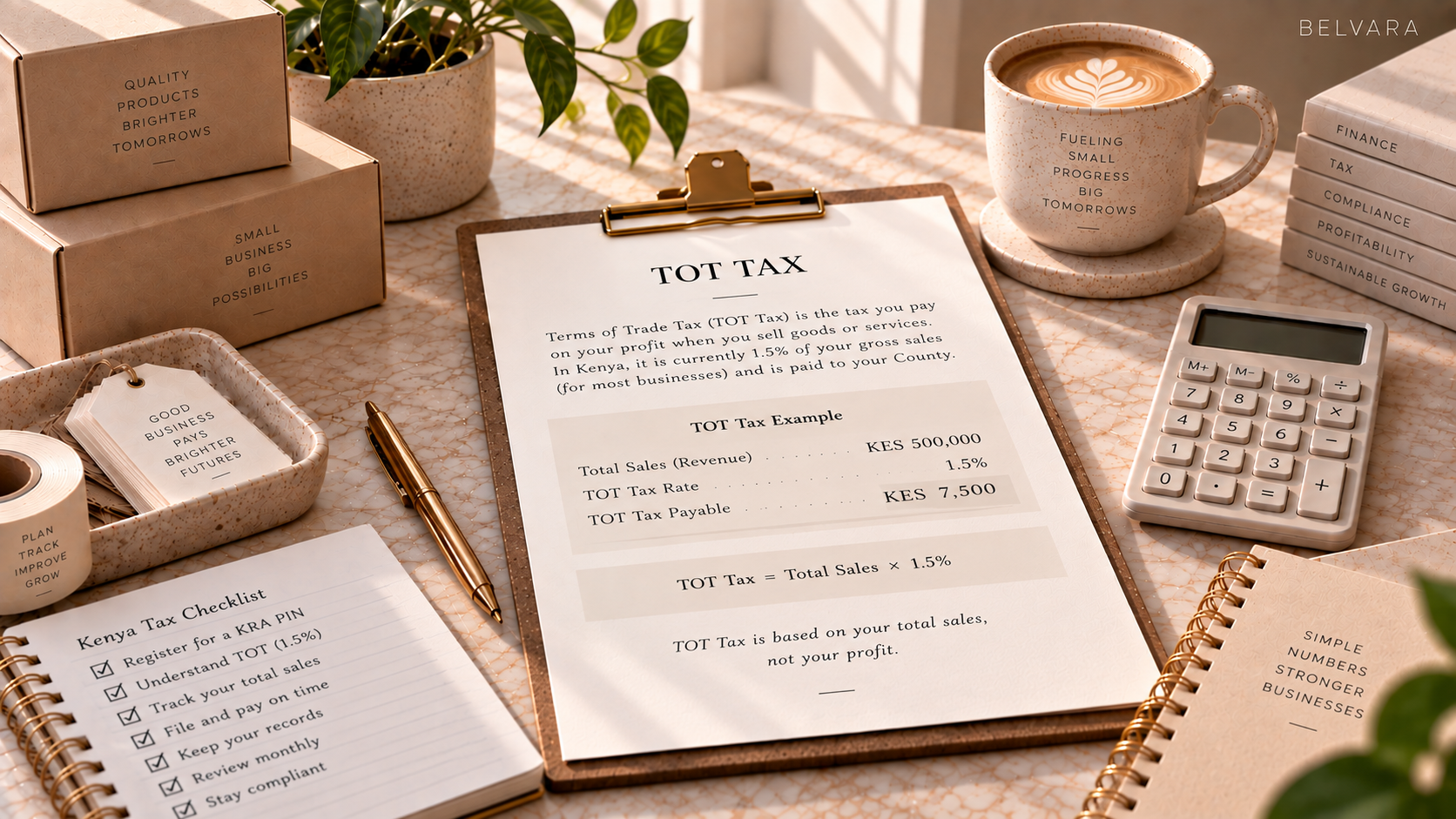
You can make a loss and still owe Turnover Tax.
That sounds wrong until you understand how TOT works.
Turnover Tax is not calculated on your profit.
It is calculated on your gross sales.
So if your business sells:
KES 500,000
In a month, KRA does not first ask:
- how much rent you paid
- how much stock cost
- how much you spent on delivery
- how much you paid staff
- whether you actually made a profit
For TOT, the starting point is the sales figure.
That is why a low-margin business can owe Turnover Tax even in a month where very little profit survived.
Belvara view: TOT is simple to calculate because it ignores most of the complexity underneath your sales. That simplicity is exactly why owners must understand what it does to thin margins.
What is Turnover Tax?
Turnover Tax, commonly called TOT, is a simplified income tax charged on the gross sales of eligible businesses in Kenya.
Under the current KRA rules, TOT generally applies to eligible resident businesses whose annual gross turnover is:
more than KES 1,000,000
but does not exceed:
KES 25,000,000
The current rate is:
1.5% of gross sales
TOT is filed and paid monthly.
What does “turnover” mean in Turnover Tax?
Turnover means the business’s gross sales or gross receipts from the relevant business activity.
It is not the same as:
- profit
- cash balance
- money in the bank
- M-Pesa balance
If the business sells KES 800,000 in a month, that sales figure is the important starting point for TOT.

What is the current Turnover Tax rate in Kenya?
The current KRA rate is:
1.5% of gross sales
That means:
TOT = Gross Sales × 1.5%
Example:
Gross sales:
KES 400,000
TOT:
KES 400,000 × 1.5% = KES 6,000
The business owes KES 6,000 in Turnover Tax for that month, subject to the applicable rules.
A simple Turnover Tax example
Suppose a business has monthly sales of:
KES 700,000
TOT rate:
1.5%
Calculation:
KES 700,000 × 1.5% = KES 10,500
Turnover Tax:
KES 10,500
The key point is that the calculation does not first deduct the business’s expenses.
Why expenses do not reduce Turnover Tax
Under the TOT regime, expenses are not deducted before calculating the tax.
That means costs such as:
- rent
- salaries
- stock losses
- delivery
- advertising
- software
- utilities
do not reduce the gross-sales base used to calculate TOT.
This makes the tax simpler.
But it can also make it painful for low-margin businesses.
TOT does not ask how hard the sale was to earn. It taxes the turnover first.
How can a loss-making business still owe TOT?
Suppose:
Sales:
KES 500,000
Business costs:
KES 495,000
Profit before TOT:
KES 5,000
TOT:
KES 500,000 × 1.5% = KES 7,500
The business made only KES 5,000 before TOT.
But its TOT is KES 7,500.
That means the tax can push the business into a loss after tax.
This is why owners should never confuse:
simple tax calculation
with:
small tax impact
Why TOT can hurt low-margin businesses more
The TOT rate is applied to sales.
So two businesses with the same sales can owe the same TOT even if their profits are completely different.
Business A
Sales:
KES 1,000,000
Profit before TOT:
KES 300,000
TOT:
KES 15,000
Business B
Sales:
KES 1,000,000
Profit before TOT:
KES 40,000
TOT:
KES 15,000
Same sales.
Same TOT.
Very different impact.
Belvara view: A tax on turnover feels small when margins are strong. The same rate can feel enormous when margins are thin.
Who qualifies for Turnover Tax in Kenya?
Under the current KRA rules, TOT generally applies to eligible resident persons or businesses whose gross or expected annual turnover is:
more than KES 1,000,000
and:
not more than KES 25,000,000
Other exclusions also apply.
The exact tax obligation should be confirmed against the current law and KRA registration status.
Does a business below KES 1 million pay TOT?
A business whose annual business turnover does not cross the applicable lower threshold is not within the normal TOT band.
But that does not automatically mean:
no tax obligations at all
The business may still have other:
- income tax
- eTIMS
- VAT
- withholding
- payroll
obligations depending on its circumstances.
Do not use the TOT threshold as a general “tax-free” threshold.
What happens above KES 25 million turnover?
Once the business is outside the current TOT turnover band, the ordinary income-tax rules become relevant instead of the TOT regime, subject to the law applying to that taxpayer.
A growing business should therefore monitor turnover before it reaches the limit.
The worst time to discover that your tax regime changed is after the year has already ended.
Does TOT apply to sole proprietors?
It can.
TOT is not limited only to incorporated companies.
An eligible resident individual carrying on business can fall within the TOT regime if the turnover and other requirements are met.
Does TOT apply to companies?
It can.
KRA’s current guidance includes eligible resident persons and corporates within the regime.
The legal form alone does not decide whether the business is under TOT.
Turnover and the nature of the income matter.
Does TOT apply to non-residents?
KRA states that Turnover Tax does not apply to non-resident taxpayers.
Non-resident businesses can have different Kenyan tax rules.
Is Turnover Tax a final tax?
KRA describes TOT as a final tax on the income subject to TOT.
That means the business does not then calculate ordinary annual income tax again on that same income under the standard regime.
However, a taxpayer can have other kinds of income or obligations that still need separate treatment.
“Final tax” does not mean:
you never file or pay anything else
It means the TOT treatment is final for the income subject to that regime.
Do TOT taxpayers file an annual income tax return?
KRA states that taxpayers do not need to make an end-of-year income-tax declaration on income that has already been subjected to TOT.
But businesses can have other tax obligations or income outside the TOT regime.
So the correct question is:
What obligations are active on this taxpayer?
not simply:
Am I on TOT?
Which income is excluded from Turnover Tax?
KRA currently identifies exclusions including:
- rental income
- management fees
- professional fees
- training fees
- income subject to final withholding tax
TOT also does not apply to non-resident taxpayers.
These exclusions matter because not every small business earning KES 1M–25M automatically belongs under TOT.
Does TOT apply to professional services?
Management, professional and training fees are excluded from the TOT regime under the current rules.
That matters for businesses such as certain:
- consultants
- professional firms
- trainers
- advisers
depending on the exact nature of their income.
Do not register under TOT simply because your turnover falls within the threshold.
The type of income matters too.
Does TOT apply to rental income?
Rental income is excluded from Turnover Tax.
Rental income has its own tax treatment.
A landlord should not assume TOT applies just because rent collections fall inside the same turnover range.
Does TOT apply to income subject to final withholding tax?
Income that is already subject to a final withholding tax is excluded from TOT.
That avoids applying TOT to income that already has a final tax treatment under the law.
Can a taxpayer opt out of Turnover Tax?
The law allows a person who would otherwise fall under TOT to elect not to be subject to TOT by giving notice in writing to the Commissioner.
If accepted under the applicable process, the ordinary provisions of the Income Tax Act apply instead.
This decision should not be made casually.
Why would a business consider opting out of TOT?
One major reason can be:
low profit margins
Because TOT ignores expenses.
A business with substantial allowable costs may find that ordinary income-tax treatment produces a very different tax result.
Other considerations can include:
- business structure
- growth
- accounting requirements
- losses
- capital expenditure
This is a tax-planning decision where professional advice can be valuable.
TOT vs normal income tax
The big difference is the tax base.
Turnover Tax
Tax is based on:
gross sales
Ordinary income tax
Tax generally works from:
taxable income or profit after allowable deductions
That difference can completely change the result.
A TOT vs profit-tax example
Suppose:
Sales:
KES 600,000
Expenses:
KES 550,000
Profit:
KES 50,000
Under TOT
1.5% of KES 600,000:
KES 9,000
Under a profit-based system
The tax calculation would start from taxable profit under the applicable rules rather than gross sales.
The final tax cannot be compared simply by applying one headline percentage.
The bases are different.
TOT is not 1.5% of profit
This is one of the most important corrections.
If your business makes:
Sales:
KES 1,000,000
Profit:
KES 100,000
TOT is not:
1.5% × KES 100,000
It is based on:
KES 1,000,000 gross sales
So:
TOT = KES 15,000
TOT is not VAT
Turnover Tax and VAT are completely different taxes.
TOT
A form of income tax based on gross turnover.
VAT
A consumption tax charged on taxable supplies under the VAT rules.
A business can be subject to both.
TOT taxes the business’s turnover. VAT is collected through taxable sales. They should never be treated as interchangeable.
Can a business pay both TOT and VAT?
Yes.
KRA states that a TOT taxpayer dealing in VAT-able supplies whose turnover reaches the VAT registration threshold is also required to register for VAT.
The current general compulsory VAT registration threshold is:
KES 5,000,000 of taxable supplies
subject to the VAT rules.
That means a growing business can have both:
- TOT
- VAT
obligations at the same time.
Why TOT plus VAT can confuse business owners
An owner might see:
- Turnover Tax due
- VAT due
and assume they are being taxed twice on the same thing.
They are different taxes with different mechanics.
TOT is an income-tax regime.
VAT is an indirect tax on taxable supplies.
The business needs to track each separately.
TOT and VAT-inclusive prices
If a business is VAT-registered, it should not casually mix VAT collections and TOT calculations.
The two taxes use different legal rules and reporting structures.
The safest process is to maintain:
- clean sales records
- correct VAT treatment
- correct TOT reporting
and use the current KRA/iTax treatment for the taxpayer’s actual facts.
TOT vs Turnover
Turnover is a business number.
Turnover Tax is a tax.
Example:
Annual turnover:
KES 12,000,000
That does not mean:
KES 12,000,000 tax
It means the business has KES 12M of relevant sales before the applicable TOT rate is considered.
TOT vs revenue
In ordinary business language, turnover and revenue are often used similarly.
But tax rules can define the exact base used for a specific obligation.
For management reporting, keep the concept simple:
sales first
Then calculate the tax according to the current tax rules.
TOT vs profit
Profit is what remains after costs and expenses.
TOT does not wait to see how much remains.
That is why profit can fall while TOT stays high if sales remain high.
TOT and gross profit
Gross profit subtracts COGS from sales.
TOT does not use gross profit as its normal base.
Example:
Sales:
KES 1,000,000
COGS:
KES 700,000
Gross profit:
KES 300,000
TOT is still based on the relevant gross sales, not the KES 300,000 gross profit.
TOT and net profit
Net profit subtracts the wider operating costs.
TOT is not calculated from net profit.
That makes it possible for:
TOT to remain stable while net profit collapses
if revenue has not changed.
TOT and margins
A 1.5% tax on turnover can consume very different shares of profit depending on margin.
Business with 30% net margin before TOT
Sales:
KES 1,000,000
Profit:
KES 300,000
TOT:
KES 15,000
Business with 3% net margin before TOT
Sales:
KES 1,000,000
Profit:
KES 30,000
TOT:
KES 15,000
The second business gives up half of that pre-TOT profit to the turnover tax.
Why TOT should affect pricing decisions
If TOT applies to the business, pricing should not ignore it.
A product can appear profitable before tax.
But the owner needs to understand what remains after:
- COGS
- operating expenses
- payment fees
- delivery support
- TOT
The answer is not automatically:
increase every price by 1.5%
Pricing requires understanding the whole cost structure.
TOT and markup
Markup tells you how much has been added to cost.
TOT is another cost of doing business under the tax regime.
A high markup does not automatically mean the business has enough profit after:
- overhead
- discounts
- delivery
- tax
TOT and profit margin
Turnover Tax reduces what remains from sales.
So if you are measuring profit after tax, the TOT cost matters.
A business with thin margins should model the impact before assuming the tax is “only 1.5%.”
A small percentage of sales can be a large percentage of profit.
TOT and break-even
Turnover Tax can raise the level of sales required to reach true after-tax break-even.
The business must generate enough contribution to cover:
- fixed costs
- other operating costs
- TOT
That is another reason the owner should not model break-even using only rent and payroll.
TOT and cash flow
TOT is a cash obligation.
The business may have made sales but still be waiting for some customers to pay.
Depending on the relevant recognition and reporting rules, the business needs to plan for the actual tax due rather than assume the cash will magically be available on the 20th.
Tax planning is part of cash planning.
TOT and M-Pesa
M-Pesa collections can help show money received.
But:
M-Pesa inflows are not automatically your TOT turnover figure
because the account may include:
- transfers
- owner funding
- loans
- customer deposits
- old balances
The business still needs proper sales records.
TOT and bank deposits
The same principle applies to bank deposits.
Money entering the bank is not automatically:
current-month sales
A bank account can receive many types of money.
Turnover should come from business sales records, supported by the required tax records.
TOT and cash sales
Cash sales still count as business sales.
A business cannot make turnover disappear by receiving payment in cash.
That is why cash sales need proper records too.
TOT and credit sales
A business may sell on credit and collect later.
That creates a difference between:
- sale
- customer payment
The bookkeeping system should keep them separate.
Do not count the original sale and later payment as two separate sales.
TOT and partial payments
If a customer pays an invoice in instalments, the business should not treat each payment as a new sale.
The underlying sale remains one commercial event.
The payment records simply show how the balance was settled.
TOT and customer deposits
Customer deposits need careful treatment.
A payment can arrive before the full sale is completed.
The business should distinguish:
- customer money received
- completed sale
- revenue
- balance still due
The correct tax timing depends on the applicable rules.
Do not classify every incoming payment as immediate turnover without checking what it represents.
TOT and refunds
Refunds should remain connected to the original sale.
The business needs clean records showing:
- original invoice
- refund
- credit note where applicable
- corrected customer balance
This matters because the sales records feeding tax reporting must remain accurate.
TOT and returns
A product return and a refund are different business events.
The return affects:
- inventory
- sales history
The refund affects:
- money
- customer balance
The records should preserve both.
TOT and cancelled orders
An order that was cancelled before becoming a completed sale should not remain mixed with completed turnover.
But if payment or invoicing already happened, the cancellation needs a clear audit trail.
Deleting the record is not good bookkeeping.
TOT and discounts
Discounts affect the amount the customer is actually charged.
A business should record:
- normal price
- discount
- final sale amount
correctly.
Inflated “before discount” figures should not be confused with actual sales.
TOT and delivery charges
Delivery can be:
- part of the business’s own sale
- a pass-through or separate service arrangement
depending on the commercial setup.
The business should record delivery consistently rather than guessing at tax time.
TOT and marketplaces
A marketplace may collect money and deduct:
- commission
- fees
- delivery
- advertising
before remitting the balance to the merchant.
The amount deposited in the merchant’s bank can therefore be lower than the underlying sales.
That is another reason:
bank deposits are not the same as turnover
TOT and Jumia-style marketplace settlements
Suppose:
Customer sales:
KES 200,000
Marketplace deductions:
KES 30,000
Net settlement:
KES 170,000
The merchant should not automatically assume KES 170,000 is the sales figure simply because that is what reached the bank.
The gross business transaction and the marketplace costs need separate records.
TOT and card payment fees
A card processor can deduct merchant fees before paying the business.
Again:
net payout is not automatically gross sales
Sales and payment-processing cost should remain separate in the books.
TOT and STK Push
STK Push is only a payment initiation method.
The payment request itself does not create turnover.
The business still needs the underlying:
- order
- sale
- invoice
- payment result
The tax record should come from the actual business transaction, not from “number of STK Pushes sent.”
TOT and PayBill or Till
PayBill and Till are payment collection methods.
They do not replace sales records.
A payment account can contain money for:
- current sales
- old balances
- deposits
- transfers
The business still needs to know which transactions represent turnover.
TOT and multiple branches
If a business has multiple branches, the owner should still know total turnover across the taxpayer’s relevant business operations.
Branch-level tracking is useful for management.
But tax eligibility is not determined by looking at each branch in isolation simply because the sales happen in different locations.
TOT and multiple sales channels
A business may sell through:
- shop
- website
- TikTok
- marketplace
Those channels should feed one complete sales picture.
Do not count only the channel that is easiest to report.
TOT and eTIMS
KRA currently states that all persons engaged in business are required to onboard onto eTIMS and issue electronic tax invoices, including taxpayers with the TOT obligation.
This applies whether or not the business is VAT-registered, subject to the current electronic-invoicing rules and special mechanisms such as buyer-initiated invoicing for qualifying small suppliers.
That means a TOT business should not rely on old advice that electronic invoicing is only for VAT taxpayers.
What is eTIMS?
eTIMS is KRA’s electronic Tax Invoice Management System.
It supports electronic invoicing and transmission of invoice data.
For a TOT business, eTIMS can strengthen the sales records that support turnover reporting.
Do businesses under KES 5 million need eTIMS?
Current KRA guidance says persons engaged in business are required to onboard eTIMS.
KRA also provides a buyer-initiated invoicing mechanism in certain cases where the supplier is a small business whose annual turnover does not exceed KES 5 million.
The current eTIMS rules should therefore be checked rather than relying on older advice that small businesses are automatically outside electronic invoicing.
Why old TOT information online can be dangerous
Kenyan TOT rules have changed over time.
Older articles and some older web pages may still mention:
- KES 50 million thresholds
- 1% rates
- other historic rules
The current KRA TOT page states:
- more than KES 1 million turnover
- up to KES 25 million
- 1.5% rate
Always check the current KRA guidance and current law before filing.
Tax advice ages quickly. A number that was correct two years ago can be an expensive mistake today.
When is Turnover Tax filed?
TOT is filed monthly.
The tax period is a calendar month.
The return and tax due must be submitted and paid:
on or before the 20th day of the following month
A monthly TOT example
Suppose August gross sales are:
KES 900,000
TOT:
KES 900,000 × 1.5% = KES 13,500
The August TOT return and payment are due by:
20 September
subject to the current filing rules.
What if there were no sales in the month?
If the TOT obligation remains active, the taxpayer should follow the current KRA filing requirement for that period, including any applicable nil return requirement.
Do not simply skip the month because sales were zero.
Active tax obligations usually still need attention.
How do you register for TOT?
KRA provides TOT registration through iTax.
The current process is handled through the taxpayer’s registration details and tax obligations.
Because tax registration screens can change, follow the current iTax workflow rather than an old screenshot.
How do you file TOT?
KRA currently provides filing through iTax and also supports simplified mobile options.
A practical workflow is:
- confirm the month’s sales
- reconcile sales records
- calculate the applicable TOT
- file the return
- generate the payment instruction
- pay by the due date
- retain evidence
The tax calculation is simple.
The hard part is making sure the sales figure is right.
How do you pay TOT?
KRA allows payment through approved payment channels after generating the appropriate payment instruction.
The exact payment channel and government PayBill details can change.
Use the current KRA/iTax payment instructions shown at the time of payment.
What happens if TOT is filed late?
KRA’s current TOT guidance states that late filing attracts a penalty of:
KES 1,000
for the late return.
Penalties can change through tax-law amendments.
Always verify the current amount if you are dealing with an actual late filing.
What happens if TOT is paid late?
KRA’s current guidance states:
- late-payment penalty: 5% of tax due
- interest on unpaid tax: 1%
Late tax becomes more expensive the longer it stays unresolved.
Why accurate sales records matter for TOT
Because expenses are not deducted, the biggest number in the calculation is:
sales
If the sales number is wrong, the tax is wrong.
Sales can be overstated by:
- duplicate invoices
- cancelled orders left active
- counting transfers as sales
- counting customer payments twice
Sales can be understated by:
- missing cash sales
- missing social-media orders
- unrecorded branch sales
- marketplace sales recorded only as net payout
How duplicate sales can overstate TOT
Suppose a KES 20,000 sale is entered twice.
The records now show:
KES 40,000 sales
Instead of:
KES 20,000
TOT can also be overstated.
The mistake may look small in the order system.
But it becomes a tax mistake too.
How missing sales can understate TOT
If a branch forgets to record:
KES 100,000
of cash sales, the reported turnover is too low.
That creates:
- inaccurate tax
- inaccurate revenue
- inaccurate profit reporting
The fix is not simply “remember at month-end.”
The business needs a reliable sales process.
Why reconciliation matters for TOT
Reconciliation helps test whether the sales records make sense against:
- M-Pesa
- bank
- cash
- marketplace settlements
- invoices
- customer balances
The goal is not to make every bank deposit equal sales.
It is to explain the difference.
TOT and bookkeeping
TOT looks easy because the formula is short.
But it still depends on bookkeeping.
The business needs reliable records of:
- sales
- refunds
- credit notes
- cancellations
- payment methods
- branches
- channels
A simple tax rate still needs clean books.
TOT and the P&L
Turnover Tax is a tax expense in the wider financial picture.
It reduces what the business ultimately keeps.
The P&L should not confuse:
- gross sales
- gross profit
- operating profit
- tax
- net profit
The business owner should be able to see the tax burden without hiding it inside “miscellaneous expenses.”
TOT and cash planning
Because TOT is due monthly, the business should set money aside during the month.
Example:
Current monthly sales:
KES 600,000
Estimated TOT:
KES 9,000
The owner can reserve that amount instead of discovering on the 20th that all available cash has already been used for stock.
Should you keep a TOT reserve?
A tax reserve can be useful.
As sales happen, the business can estimate the TOT obligation.
That money can remain visible as:
tax still to be paid
rather than being mistaken for free cash.
TOT and working capital
A growing business can have:
- strong sales
- stock purchases
- supplier bills
- payroll
- delivery costs
- TOT due
all competing for the same cash.
This is why turnover growth can create working-capital pressure.
More sales can mean more tax due even before the owner feels richer.
TOT and inventory businesses
Retailers and wholesalers should pay special attention to margins.
A product business can have:
- high sales
- high COGS
- thin net margin
Because TOT is charged on turnover, not COGS-adjusted profit, poor pricing can become more dangerous.
TOT and service businesses
Not all service businesses fall under TOT.
Remember that management, professional and training fees are excluded.
A service business should first determine whether its income is eligible before applying the rate.
TOT and restaurants
A restaurant can have large sales but also large:
- food costs
- rent
- staff costs
- wastage
That makes margin tracking essential.
The TOT percentage may look small against revenue but much larger against final profit.
TOT and online sellers
Online sellers can easily scatter sales across:
- website
- TikTok
- M-Pesa
TOT reporting needs the complete business turnover, not just website sales.
TOT and wholesalers
Wholesalers often work with high revenue and low margins.
That makes TOT especially important to model.
A 1.5% tax on turnover can represent a substantial share of net profit when margin is thin.
TOT and small manufacturers
Manufacturers can have:
- raw materials
- labour
- power
- packaging
- wastage
Again, TOT does not deduct those costs in the monthly tax calculation.
The business must understand after-tax margin.
TOT and growth
A business can cross:
- the VAT threshold
- the top of the TOT band
as it grows.
That means tax obligations can change before the owner changes anything else.
Turnover thresholds should be monitored continuously.
What happens as you approach KES 5 million?
If the business makes taxable supplies and approaches the VAT threshold, VAT registration becomes an important issue.
A TOT business can therefore become both:
- TOT registered
- VAT registered
That changes pricing, invoicing and compliance.
Do not wait until far above the threshold to think about it.
What happens as you approach KES 25 million?
The business is approaching the upper limit of the current TOT band.
At that point, the owner should prepare for the tax and accounting requirements that apply outside TOT.
That can affect:
- bookkeeping detail
- tax planning
- cash planning
- reporting
Growth should not surprise the finance system.
Can splitting the business avoid TOT thresholds?
Artificially splitting one business simply to avoid tax thresholds can create serious compliance risk.
Business structures should reflect genuine commercial reality.
Do not design fake branches, entities or payment accounts purely to hide turnover.
TOT and business structure
A business structure should be chosen for real reasons such as:
- ownership
- risk
- governance
- funding
- operations
not only to chase one tax rate.
Tax matters.
But it is only one part of business design.
How Belvara helps with Turnover Tax
Turnover Tax looks simple on paper.
The real problem is making sure the number being taxed is reliable.
Belvara helps keep the underlying business records connected.
Keep sales in one business record
Sales from:
- shop
- website
- social commerce
- branches
can be brought into a clearer operational picture.
Separate sales from payments
A customer payment does not automatically become a new sale.
That helps prevent duplicate turnover.
Separate transfers from revenue
Moving money between:
- M-Pesa
- bank
- cash accounts
should not inflate turnover.
Keep refunds and cancellations linked
Refunds, returns, cancellations and credit adjustments remain connected to the underlying sale rather than being lost in separate spreadsheets.
Track turnover against thresholds
The owner can see annual sales building toward important thresholds such as:
- TOT upper limit
- VAT registration threshold
Keep tax obligations visible
A TOT estimate can be surfaced alongside the sales that created it so the owner does not mistake all collected cash for available money.
Support eTIMS-connected records
Where applicable, tax invoicing and business sales records can stay closer together instead of becoming separate sources of truth.
Preserve the audit trail
If a transaction is corrected, the history remains traceable.
Belvara view: TOT is easy to calculate only after you know which sales are real. The hard part is making sure every shilling of turnover is counted once, correctly, and for the right period.
What should a business monitor every month under TOT?
A useful monthly review includes:
- total sales
- cancellations
- refunds
- credit notes
- branch totals
- channel totals
- VAT threshold progress
- annual turnover progress
- estimated TOT
- filing status
- payment status
This turns tax from a last-minute surprise into a routine control.
Common Turnover Tax mistakes
1. Calculating TOT on profit
TOT is based on gross sales, not profit.
2. Deducting expenses before calculating TOT
Expenses are not deducted under the TOT calculation.
3. Using the old 1% rate
Current KRA guidance uses 1.5%.
4. Using the old KES 50 million threshold
Current KRA guidance uses an upper threshold of KES 25 million.
5. Assuming every small business qualifies
Some income categories are excluded.
6. Forgetting VAT
A business can have both TOT and VAT obligations.
7. Treating every M-Pesa receipt as turnover
Payment-account inflows are not automatically sales.
8. Recording customer payments twice
The sale and later collection should not become two sales.
9. Ignoring refunds and cancellations
Sales records need proper adjustments.
10. Waiting until the 20th to calculate the tax
The business should estimate throughout the month.
11. Assuming eTIMS is only for VAT businesses
Current KRA guidance requires businesses, including TOT taxpayers, to follow the electronic-invoicing rules.
12. Ignoring profit margin because TOT looks simple
A low-margin business can feel the tax heavily.
Belvara view: The most dangerous thing about TOT is not the formula. It is believing the formula means you no longer need to understand the business underneath it.
The takeaway
Turnover Tax is a simplified Kenyan income-tax regime charged on gross sales of eligible businesses.
Under the current KRA rules:
- rate: 1.5% of gross sales
- annual turnover band: more than KES 1M and up to KES 25M
- filing: monthly
- deadline: 20th of the following month
- expenses: not deductible
- tax: final for the income subject to TOT
The most important lesson is:
You can make a loss and still owe Turnover Tax.
Because the tax is charged on sales.
Not profit.
That means the owner needs to watch:
- turnover
- margins
- cash
- VAT thresholds
- records
- filing deadlines
at the same time.
A simple tax does not mean a simple business.
Frequently Asked Questions About Turnover Tax
What is Turnover Tax in simple terms?
Turnover Tax is a tax charged on the gross sales of eligible businesses rather than on their net profit.
What is the current TOT rate in Kenya?
The current KRA rate is 1.5% of gross sales.
Who qualifies for TOT?
Generally, eligible resident businesses with annual gross turnover above KES 1 million and not exceeding KES 25 million, subject to the exclusions in law.
Is TOT calculated on profit?
No. It is calculated on gross sales.
Can expenses be deducted before calculating TOT?
No. KRA states that expenses are not deductible under TOT.
Can I owe TOT if I made a loss?
Yes. Because the tax is based on sales rather than profit.
Is TOT a final tax?
Yes, KRA describes it as a final tax on income subject to the TOT regime.
When is TOT filed?
Monthly.
When is TOT due?
On or before the 20th day of the following month.
Does TOT apply to rental income?
No. Rental income is excluded from TOT.
Does TOT apply to professional services?
Management, professional and training fees are excluded from TOT.
Does TOT apply to non-residents?
KRA states that TOT does not apply to non-resident taxpayers.
Can a business opt out of TOT?
The law allows an otherwise eligible taxpayer to elect not to be subject to TOT by notice to the Commissioner, after which the other applicable income-tax provisions apply.
Is TOT the same as VAT?
No. TOT is an income-tax regime. VAT is a separate consumption tax.
Can a business pay both VAT and TOT?
Yes. A TOT business whose taxable supplies reach the VAT registration threshold can also have a VAT obligation.
What is the VAT threshold?
The current general compulsory VAT registration threshold is KES 5 million of taxable supplies, subject to the VAT rules.
Does M-Pesa money equal turnover?
No. M-Pesa can include transfers, deposits, loans and old customer balances.
Does bank money equal turnover?
No. Bank deposits are not automatically sales.
Does TOT apply to cash sales?
Cash sales still form part of the business’s sales records.
Do TOT businesses need eTIMS?
Current KRA guidance says persons engaged in business, including taxpayers under the TOT obligation, are required to follow the eTIMS electronic-invoicing framework.
What happens if I file TOT late?
KRA’s current guidance states a KES 1,000 late-filing penalty, with separate late-payment penalties and interest.
What happens if I pay TOT late?
KRA’s current guidance states a 5% late-payment penalty and interest on unpaid tax.
Is the old 1% TOT rate still current?
No. Current KRA guidance states 1.5%.
Is the old KES 50 million upper threshold still current?
No. Current KRA guidance states an upper threshold of KES 25 million.
How does Belvara help with TOT?
Belvara helps keep sales, payment records, refunds, branches, channels and adjustments connected so turnover can be tracked more reliably, important thresholds can be monitored, and tax estimates can stay visible alongside the business activity that created them.
What should I learn after TOT?
The next useful concepts are VAT, eTIMS, income tax, gross turnover, taxable profit, tax reconciliation and cash-flow planning.
