
A business can make money on every sale and still lose money running the business.
That is the part revenue and gross profit do not show you.
You can price correctly.
You can sell above cost.
You can keep a healthy gross margin.
And then the business starts paying for itself.
Rent.
Payroll.
Software.
Marketing.
Utilities.
Administration.
Insurance.
Professional fees.
Office costs.
Branch expenses.
The sale created room.
Operating expenses decide how much of that room survives.
That is what OPEX helps you see.
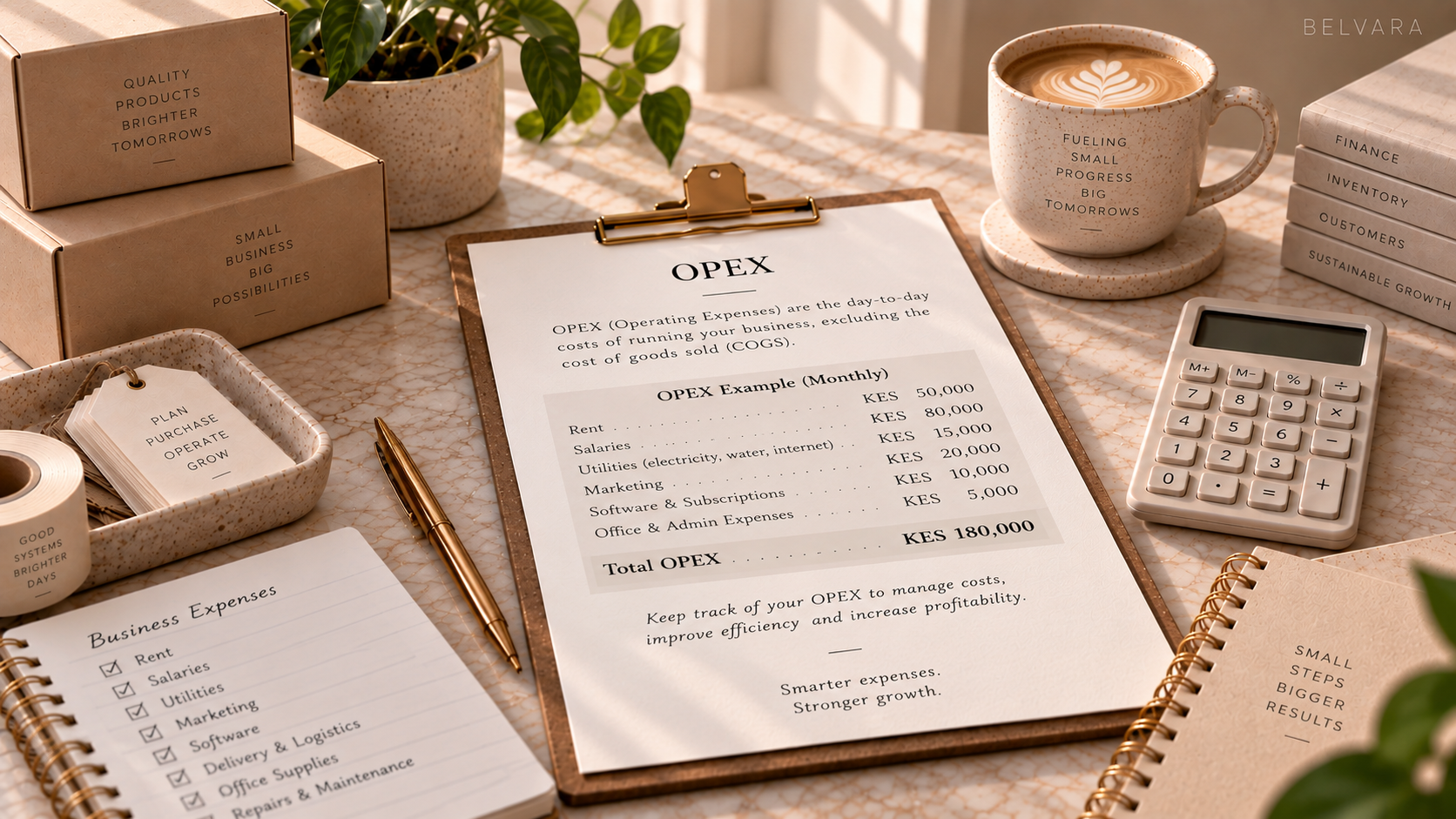
OPEX stands for operating expenses.
These are the ongoing costs of running the business that are not usually included in the direct cost of producing or buying what you sold.
A business can look profitable at the gross-profit level and still become weak because its operating expenses are too heavy for the gross profit it creates.
Belvara view: Gross profit tells you whether your sales created room. OPEX tells you how much of that room the business consumes just by operating.
What is OPEX?
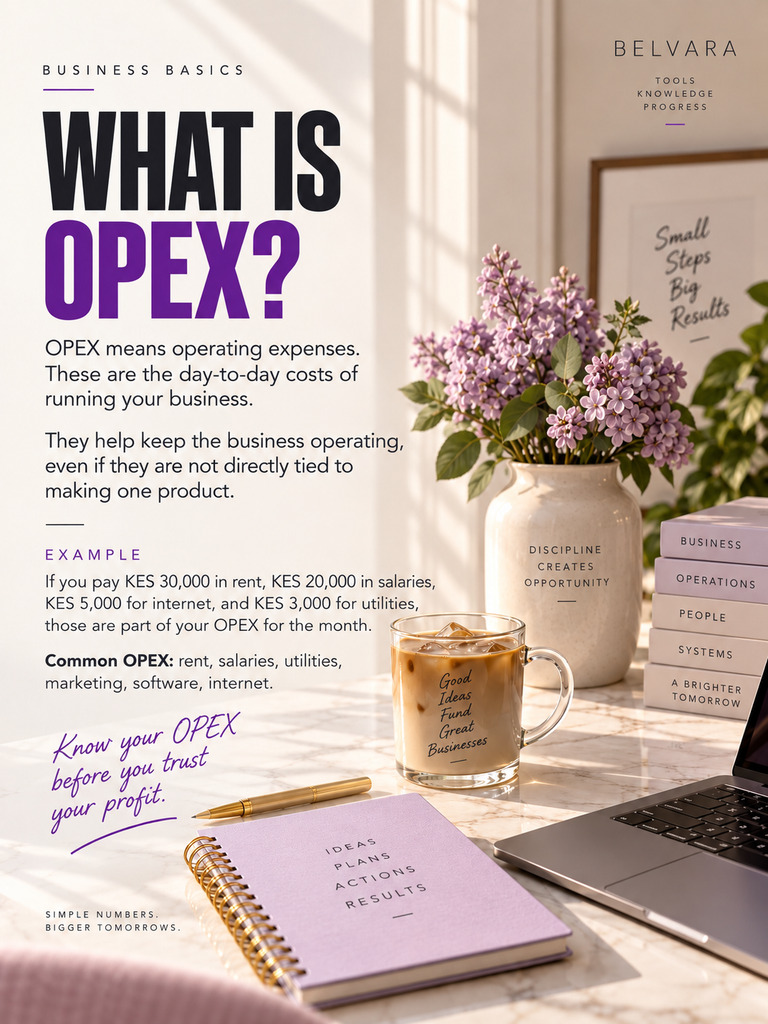
OPEX means operating expenses: the ongoing costs a business incurs to run its normal operations, excluding costs that are treated as direct cost of sales and excluding capital expenditure.
Common examples can include:
- office or shop rent
- administrative salaries
- software subscriptions
- marketing
- internet
- utilities
- insurance
- professional fees
- office supplies
- bank charges
- general administration costs
- repairs and maintenance, depending on the nature of the expenditure
- other recurring costs of operating the business
The exact classification can depend on the type of business, the nature of the cost and the accounting policy being used.
That qualification matters.
A cost is not OPEX just because money left the business.
Why OPEX matters
OPEX is where a business proves whether its gross profit is actually enough.
Suppose a business has:
- Revenue: KES 1,000,000
- Cost of goods sold: KES 600,000
- Gross profit: KES 400,000
Gross margin:
40%
That sounds healthy.
Now suppose operating expenses are:
- Rent: KES 80,000
- Payroll: KES 170,000
- Marketing: KES 60,000
- Software and internet: KES 20,000
- Other operating expenses: KES 50,000
Total OPEX:
KES 380,000
Operating profit:
KES 400,000 − KES 380,000 = KES 20,000
The business generated KES 400,000 in gross profit.
Almost all of it was consumed by the cost of running the business.
That is what OPEX makes visible.
A strong gross margin can hide a business that is expensive to keep alive.
OPEX in the income statement
A simplified income statement can look like this:
| Item | Amount |
| Revenue | KES 1,000,000 |
| Cost of goods sold | KES 600,000 |
| Gross profit | KES 400,000 |
| Operating expenses | KES 300,000 |
| Operating profit | KES 100,000 |
The basic flow is:
Revenue − Cost of Sales = Gross Profit
Then:
Gross Profit − Operating Expenses = Operating Profit
This is simplified.
Real financial statements may include more categories and may present expenses by function or by nature.
But the management idea is clear:
Revenue tells you how much business happened.
Gross profit tells you what remained after direct cost.
OPEX tells you what it cost to operate the business around those sales.
Operating profit tells you what survived after those operating costs.
OPEX is not the same as COGS
This is one of the most important distinctions.
COGS, or cost of goods sold, is the cost directly associated with the goods sold during the period.
OPEX is the wider cost of running the business.
Suppose you sell imported kitchenware.
Costs that may form part of inventory cost and later COGS can include relevant costs of acquiring and bringing the inventory to its present location and condition.
Operating expenses might include items such as:
- shop rent
- administrative payroll
- marketing
- accounting fees
- general software subscriptions
- office internet
- head-office expenses
The classification of some costs can depend on what the cost relates to.
For example, payroll is not automatically OPEX.
Wages for staff directly involved in producing a service or manufacturing a product may be classified differently from administrative salaries.
Delivery can also be more complicated.
A delivery cost may be treated as a selling or fulfilment expense in one business and differently in another depending on the nature of the transaction and accounting policy.
The right question is not:
“Was money spent?”
It is:
“What did this cost relate to?”
Belvara view: Expense categories are not decoration. Put a cost in the wrong place and the business story changes.
OPEX is not the same as CapEx
OPEX and CapEx describe two very different kinds of spending.
OPEX is generally spending used to run the business during normal operations.
CapEx, or capital expenditure, is generally spending used to acquire, improve or extend the life of a long-term asset.
Suppose a business pays:
KES 5,000 per month for internet
That is normally an operating expense.
Now suppose the business buys:
KES 250,000 of computer equipment
That purchase would generally be capital expenditure rather than recording the entire KES 250,000 as a normal operating expense immediately.
The asset may then be expensed over time through depreciation, subject to the applicable accounting treatment.
The distinction matters because confusing OPEX and CapEx can distort profit.
If every long-term asset purchase is treated as an immediate operating expense, one month can look far worse than the underlying business economics.
If normal operating costs are incorrectly capitalised, profit can look artificially strong.
OPEX is not the same as every expense
“OPEX” is often used casually to mean “expenses”.
That is too broad.
A business can have expenses outside normal operating expenses.
Depending on the financial statement structure, these can include items such as:
- finance costs
- tax expense
- certain non-operating losses
- other expenses outside core operations
So this statement is too loose:
“OPEX is everything the business spends.”
It is not.
OPEX is about the cost of operating the business.
What are common OPEX categories?
The exact list will vary by business, but common operating-expense categories include the following.
Rent and premises costs
This may include:
- shop rent
- office rent
- warehouse rent
- service charges
- utilities
- cleaning
- security
Premises can become dangerous when the business grows into space faster than revenue grows into the cost.
A bigger shop can look like progress.
The P&L may disagree.
Payroll and staff costs
Administrative and operating payroll can be one of the largest OPEX categories.
This may include:
- salaries
- employer-related staff costs
- staff benefits
- administrative wages
- management payroll
But payroll classification depends on the role the staff member performs.
Not all labour belongs in OPEX.
Marketing and advertising
Marketing can include:
- paid social ads
- agency fees
- content production
- promotions
- influencer fees
- sponsorships
- campaign tools
The danger is treating marketing spend as successful because sales rose.
If sales rise by KES 100,000 while marketing costs rise by KES 150,000, “growth” needs a second look.
Software and subscriptions
Software costs can quietly multiply.
One subscription rarely hurts.
Ten subscriptions can.
Examples include:
- accounting software
- design tools
- ecommerce apps
- CRM tools
- communication tools
- cloud services
- productivity software
The individual monthly charge may look small.
The annual stack may not.
Professional and administrative costs
These can include:
- accounting fees
- legal fees
- consulting
- audit fees
- licences
- office supplies
- administrative services
Insurance
Depending on the business, insurance may include:
- property cover
- business cover
- vehicle-related business cover
- employee-related policies
- other operational insurance
Repairs and maintenance
Normal repairs and maintenance can often be operating expenses.
But spending that materially improves an asset or extends its useful life can require different accounting treatment.
That is why “repair” and “upgrade” should not automatically be treated as the same thing.
Fixed OPEX vs variable OPEX
Operating expenses can behave differently as sales change.
Fixed operating expenses
Fixed OPEX does not necessarily change quickly when revenue changes.
Examples can include:
- rent
- salaried administrative staff
- some software subscriptions
- insurance
- office costs
If sales fall tomorrow, rent may still be due.
That is why fixed OPEX increases operating leverage.
When revenue rises, fixed expenses can become easier to carry.
When revenue falls, they can become heavy very quickly.
Variable operating expenses
Some operating expenses move more closely with activity.
Examples may include:
- certain sales commissions
- some transaction-related costs
- some fulfilment costs
- campaign spend
- usage-based software
The exact classification still depends on the business and accounting treatment.
The management point is this:
Not every expense behaves the same way when sales move.
That matters when forecasting.
OPEX can grow faster than revenue
This is one of the most important signals to watch.
Suppose:
Month 1
- Revenue: KES 1,000,000
- Gross profit: KES 400,000
- OPEX: KES 250,000
- Operating profit: KES 150,000
Month 2
- Revenue: KES 1,200,000
- Gross profit: KES 480,000
- OPEX: KES 400,000
- Operating profit: KES 80,000
Revenue increased:
20%
Gross profit increased:
20%
OPEX increased:
60%
Operating profit fell from KES 150,000 to KES 80,000.
The business got bigger.
The operating economics got weaker.
Belvara view: Growth is not efficient just because revenue moved in the right direction. OPEX can outrun the growth and take the profit with it.
A business can cut OPEX and still make itself worse
“Reduce expenses” sounds like obvious business advice.
It is not always good advice.
Suppose you cut:
- your best salesperson
- essential customer support
- fraud controls
- inventory systems
- preventative maintenance
- high-performing marketing
- reliable fulfilment
OPEX falls.
The business may also become worse.
Cutting cost is not the same as improving efficiency.
The better question is:
“What does this expense produce, protect or enable?”
An expense can be high and still be valuable.
Another can be small and completely useless.
The goal is not the lowest OPEX. The goal is an operating structure the business can carry without cutting the muscle that makes it work.
Cheap expenses can become expensive in aggregate
Small recurring costs rarely feel urgent.
KES 1,500 here.
KES 3,000 there.
KES 8,000 somewhere else.
No single line causes panic.
Now put them together.
Suppose a business carries:
- Tool A: KES 3,000/month
- Tool B: KES 5,000/month
- Tool C: KES 4,500/month
- Tool D: KES 7,500/month
- Service E: KES 10,000/month
Total monthly cost:
KES 30,000
Annual cost:
KES 360,000
If the business earns KES 600,000 in annual net profit, those “small” subscriptions equal 60% of that profit.
Small OPEX becomes serious when it repeats.
Payroll can hide inside growth
Hiring often feels like evidence that the business is growing.
Sometimes it is.
Sometimes payroll is growing faster than the work that supports it.
Suppose:
- Revenue grows 15%
- Gross profit grows 12%
- Payroll grows 40%
The business may be building capacity ahead of future growth.
That can be deliberate.
But if the extra capacity does not turn into more output, better service, higher sales or lower failure rates, operating margin can compress.
More staff is not proof of a stronger business. The question is whether the business became productive enough to carry the payroll.
Rent can make revenue look more impressive than profit
A second branch can increase sales.
It can also add:
- rent
- staff
- electricity
- security
- inventory
- software
- management complexity
- stock losses
- local marketing
Suppose:
Branch A
- Revenue: KES 1,000,000
- Gross profit: KES 400,000
- Branch OPEX: KES 220,000
- Operating contribution before shared costs: KES 180,000
Branch B
- Revenue: KES 1,300,000
- Gross profit: KES 455,000
- Branch OPEX: KES 360,000
- Operating contribution before shared costs: KES 95,000
Branch B sells more.
Branch A leaves much more room after branch operating expenses.
Revenue awarded Branch B the trophy.
OPEX changed the result.
Marketing can increase sales and reduce profit
Imagine a business normally makes:
- Revenue: KES 1,000,000
- Gross profit: KES 400,000
- Marketing OPEX: KES 50,000
Now it runs a major campaign.
Revenue rises to:
KES 1,300,000
Gross profit rises to:
KES 500,000
Marketing spend rises to:
KES 180,000
The business gained:
KES 100,000 additional gross profit
But marketing cost increased by:
KES 130,000
That does not automatically mean the campaign failed.
It may bring repeat customers or future value.
But the business should not call the campaign profitable simply because revenue increased.
Sales can prove that marketing created demand. They do not automatically prove that marketing created profit.
OPEX and operating margin
Operating margin helps show how much revenue remains as operating profit after operating costs.
The formula is:
Operating Margin % = Operating Profit ÷ Revenue × 100
Suppose:
- Revenue: KES 2,000,000
- Gross profit: KES 800,000
- OPEX: KES 600,000
- Operating profit: KES 200,000
Operating margin:
KES 200,000 ÷ KES 2,000,000 × 100 = 10%
Now suppose revenue stays the same but OPEX rises to:
KES 700,000
Operating profit falls to:
KES 100,000
Operating margin becomes:
5%
Sales did not change.
Gross profit did not change.
OPEX cut operating margin in half.
OPEX and net profit are not the same thing
Operating profit is not necessarily final net profit.
A business may still have items below operating profit, depending on its financial structure and reporting format.
These can include:
- finance costs
- tax
- certain non-operating items
So:
Gross Profit − OPEX = Operating Profit
is useful, but operating profit is not always the bottom line.
That is why OPEX should not be confused with every cost that eventually affects net profit.
OPEX and cash flow
OPEX affects cash, but expense recognition and cash movement are not always identical in timing.
For example:
A business may pay annual insurance upfront.
Cash leaves immediately.
The accounting expense may be recognised over the period the insurance covers.
Or a business may incur an expense this month but pay the supplier next month.
That means:
OPEX and operating cash payments can be closely related without always being the same number in the same period.
This is another reason a profit-and-loss statement should not be treated as a cash statement.
OPEX per branch can expose bad growth
Total company OPEX can hide what individual locations are doing.
Suppose a three-branch business reports:
- Revenue: KES 6,000,000
- Gross profit: KES 2,400,000
- OPEX: KES 1,900,000
- Operating profit: KES 500,000
The company is profitable.
But branch-level review may show:
- Branch A is highly efficient
- Branch B is barely covering its operating costs
- Branch C is consuming profit generated elsewhere
The total can hide the problem.
A profitable company can still contain an unprofitable branch. Consolidated numbers can make weak operations look protected.
OPEX by sales channel
The same problem can happen across channels.
Suppose your business sells through:
- physical shop
- website
- Instagram and WhatsApp
- marketplace
- wholesale
Each channel may carry different operating costs.
One channel may need:
- more advertising
- dedicated staff
- commissions
- support
- software
- fulfilment
- returns handling
Another may have fewer orders but much lower operating cost.
The channel with the most revenue is not automatically the channel creating the strongest operating result.
OPEX for a retail business
Retail OPEX can include:
- shop rent
- administrative and sales payroll
- utilities
- marketing
- software
- security
- cleaning
- insurance
- office and administration expenses
Suppose:
- Revenue: KES 2,000,000
- COGS: KES 1,200,000
- Gross profit: KES 800,000
- OPEX: KES 650,000
- Operating profit: KES 150,000
Gross margin:
40%
Operating margin:
7.5%
A 40% gross margin can feel comfortable.
A 7.5% operating margin tells you how much room survived after the business operated.
OPEX for a wholesale business
A wholesale business may work with thinner gross margins and depend on volume and operating efficiency.
Suppose:
- Revenue: KES 5,000,000
- COGS: KES 4,000,000
- Gross profit: KES 1,000,000
- OPEX: KES 700,000
- Operating profit: KES 300,000
Operating margin:
6%
If OPEX rises by KES 200,000 without extra gross profit, operating profit falls to KES 100,000.
Thin-margin businesses have less room for careless operating costs.
OPEX for a service business
A service business can also underestimate OPEX.
Common operating expenses may include:
- admin payroll
- office rent
- software
- sales and marketing
- professional fees
- insurance
- general administration
But staff directly involved in delivering the service may be classified differently depending on how the business presents its costs.
That distinction matters.
If all labour is thrown into OPEX, gross margin may look artificially high.
If administrative staff are treated as direct service cost, gross margin may look artificially low.
The goal is not to force every business into one template.
The goal is consistent, meaningful classification.
OPEX for a SaaS business
A software business may have a high gross margin and still spend heavily on:
- engineering
- product
- sales
- marketing
- customer support
- administration
- cloud infrastructure, depending on classification
- software tools
Some of these costs may be classified differently depending on the company and reporting policy.
But the business lesson remains:
High gross margin gives a business room.
OPEX decides how aggressively that room is used.
A SaaS business with an 80% gross margin can still lose money if operating expenses exceed the gross profit it generates.
Is high OPEX bad?
Not automatically.
High OPEX can be rational when the spending supports:
- rapid expansion
- new branches
- stronger systems
- new staff capacity
- customer acquisition
- compliance
- product development
- better service
- future revenue
The problem is not simply “high OPEX”.
The problem is OPEX that the business cannot carry or cannot justify.
A growing company may deliberately accept lower operating profit while investing.
A mature company may be expected to convert more gross profit into operating profit.
Context matters.
What is a good OPEX ratio?
There is no universal OPEX percentage that every business should target.
Different industries have different cost structures.
A retail shop, wholesaler, logistics business, restaurant and software company can operate with very different expense profiles.
One useful internal measure is:
OPEX Ratio = Operating Expenses ÷ Revenue × 100
Suppose:
- Revenue: KES 2,000,000
- OPEX: KES 600,000
OPEX ratio:
30%
But 30% is not automatically good or bad.
You need to read it beside:
- gross margin
- operating margin
- business model
- growth stage
- fixed-cost base
- revenue trend
- cash position
- the value created by the spending
A lower OPEX ratio can be good.
It can also mean the business is underinvesting.
A higher ratio can be dangerous.
It can also reflect deliberate investment.
The percentage needs a story. Otherwise it is just a percentage.
How to control OPEX without damaging the business
Separate necessary cost from habitual cost
Some expenses exist because the business needs them.
Others exist because nobody has questioned them recently.
Review recurring expenses regularly
Subscriptions, retainers and standing charges deserve periodic review.
Recurring does not mean permanent.
Compare expense growth with gross profit growth
If OPEX is growing faster than gross profit, understand why.
Review payroll productivity
Do not ask only:
“How many people do we employ?”
Ask:
“What capacity, output, service or control does the payroll create?”
Review branches separately
Do not let a strong branch hide a weak one.
Review marketing beyond revenue
Look at whether extra sales create enough gross profit to support the extra spend.
Protect expenses that create value
The easiest cost to cut is not always the right cost to cut.
Watch fixed expenses before committing
Long-term commitments are harder to undo than variable spending.
Keep classification consistent
If the same expense moves between categories every month, trend analysis becomes unreliable.
Common OPEX mistakes
1. Calling every business payment OPEX
Not every cash outflow is an operating expense.
2. Mixing COGS and OPEX
This distorts gross profit and makes margin analysis weaker.
3. Treating CapEx as normal OPEX
Long-term asset purchases can require different accounting treatment.
4. Cutting expenses without understanding what they produce
Lower cost can create a weaker business.
5. Looking only at total OPEX
Branch, department or channel-level detail can expose where the pressure actually sits.
6. Ignoring expense growth
An expense can be acceptable at KES 20,000 and dangerous at KES 200,000.
7. Celebrating revenue growth while OPEX grows faster
Bigger is not the same as better.
8. Treating payroll as proof of growth
More staff is a cost until the capacity creates value.
9. Forgetting recurring expenses
Small monthly charges become large annual numbers.
10. Comparing OPEX ratios across unrelated businesses
A restaurant and a software company do not have the same operating structure.
How Belvara helps you keep OPEX visible
OPEX becomes difficult to manage when operating costs are spread across bank payments, M-Pesa, payroll records, branches, subscriptions, receipts and manual spreadsheets.
Belvara helps keep the records behind operating expenses closer together so the owner can see more than a month-end total.
That makes it easier to understand where the business is consuming the gross profit it creates.
See where operating costs are growing
An expense becoming expensive is often a trend before it becomes a crisis.
Keeping expense records consistently categorised makes it easier to compare periods and identify where costs are moving.
Read OPEX beside revenue and gross profit
A KES 100,000 increase in operating expenses means something different when gross profit increased by KES 500,000 than when gross profit increased by KES 20,000.
Belvara helps keep those parts of the business closer together.
Compare branches and operating areas
A company-wide profit number can hide an expensive branch or operating area.
Where relevant records are available, comparing revenue, gross profit and operating expenses gives the owner a clearer picture of what each part of the business is carrying.
Keep recurring costs from disappearing into routine
Rent, payroll, subscriptions and other recurring expenses are easy to stop noticing because they happen every month.
Keeping them visible makes them easier to review.
Belvara view: You do not control OPEX by staring at the total. You control it by knowing which costs are growing, what they support and whether the business is still strong enough to carry them.
Do not manage OPEX by fear
Expenses are not automatically the enemy.
A business with no rent, no staff, no systems, no marketing and no professional support may have very low OPEX.
It may also have very little business.
The goal is not to strip operations down until nothing is left.
The goal is to build an operating structure where every major cost has a reason.
Some expenses protect revenue.
Some create capacity.
Some reduce risk.
Some create growth.
Some are waste.
OPEX management is the work of knowing the difference.
The cheapest business is not automatically the strongest business. Efficiency is not spending less. It is getting more business value from what you spend.
The takeaway
OPEX means operating expenses.
These are the ongoing costs of running the business that are not normally treated as direct cost of sales or capital expenditure.
A simplified operating-profit calculation is:
Gross Profit − Operating Expenses = Operating Profit
That is why OPEX matters.
A business can:
- grow revenue
- keep a healthy gross margin
- sell above cost
- move more stock
and still become weaker if operating expenses consume too much of the gross profit created.
The wrong question is:
“Are our expenses high?”
The better questions are:
“Which expenses are growing?”
“What do they support?”
“Are they growing faster than the gross profit that has to carry them?”
“What is left after the business pays for being a business?”
That is where OPEX stops being a list of bills and becomes a management tool.
Frequently Asked Questions About OPEX
What does OPEX mean?
OPEX stands for operating expenses.
What is OPEX in simple terms?
OPEX is the ongoing cost of running a business, excluding costs treated as direct cost of sales and capital expenditure.
What are examples of OPEX?
Examples can include rent, administrative payroll, marketing, software, utilities, insurance, professional fees and general administration costs.
Is rent OPEX?
Business rent is commonly treated as an operating expense, although exact accounting treatment can depend on the arrangement and applicable accounting standards.
Is payroll OPEX?
Some payroll is OPEX, but not all payroll is automatically an operating expense. Classification depends on what the employees do and how the business accounts for those costs.
Is marketing OPEX?
Marketing and advertising costs are commonly treated as operating expenses.
Is software OPEX?
Recurring software subscriptions used in normal operations are commonly operating expenses. Some software-related spending can require different treatment depending on its nature.
Is electricity OPEX?
Utilities used to run an office, shop or other business premises are commonly operating expenses. Costs directly connected to production can require different classification.
Is OPEX the same as COGS?
No. COGS is the cost directly associated with goods sold. OPEX is the wider cost of running the business.
Is OPEX the same as CapEx?
No. OPEX generally relates to normal operating costs. CapEx generally relates to acquiring or improving long-term assets.
What is the difference between OPEX and operating profit?
OPEX is a category of expense. Operating profit is what remains after operating expenses are deducted from gross profit, in a simplified presentation.
Does high OPEX mean a business is bad?
No. High OPEX can reflect growth, investment or the nature of the business model. The question is whether the business can support the spending and whether it creates enough value.
Can OPEX increase while profit increases?
Yes. If gross profit grows faster than operating expenses, OPEX can rise while operating profit also rises.
Can revenue grow while OPEX makes the business less profitable?
Yes. If OPEX grows faster than gross profit, operating profit and operating margin can fall even when revenue increases.
What is the OPEX ratio?
A simple OPEX ratio is:
Operating Expenses ÷ Revenue × 100
It shows operating expenses as a percentage of revenue.
What is a good OPEX ratio?
There is no universal good OPEX ratio. It depends on industry, business model, gross margin, scale and growth stage.
How can a business reduce OPEX?
A business can review recurring costs, remove waste, improve payroll productivity, renegotiate costs, review branches and control unnecessary commitments. The goal should be efficiency, not cutting useful capacity blindly.
How does Belvara help with OPEX?
Belvara helps keep relevant operating records closer together, including expenses, payroll, branches, sales and other business records. That gives the owner better context when operating costs rise or profit starts getting squeezed.
What should I learn after OPEX?
Useful next concepts include COGS, CapEx, gross profit, operating profit, operating margin, EBITDA, cash flow and break-even point.
