
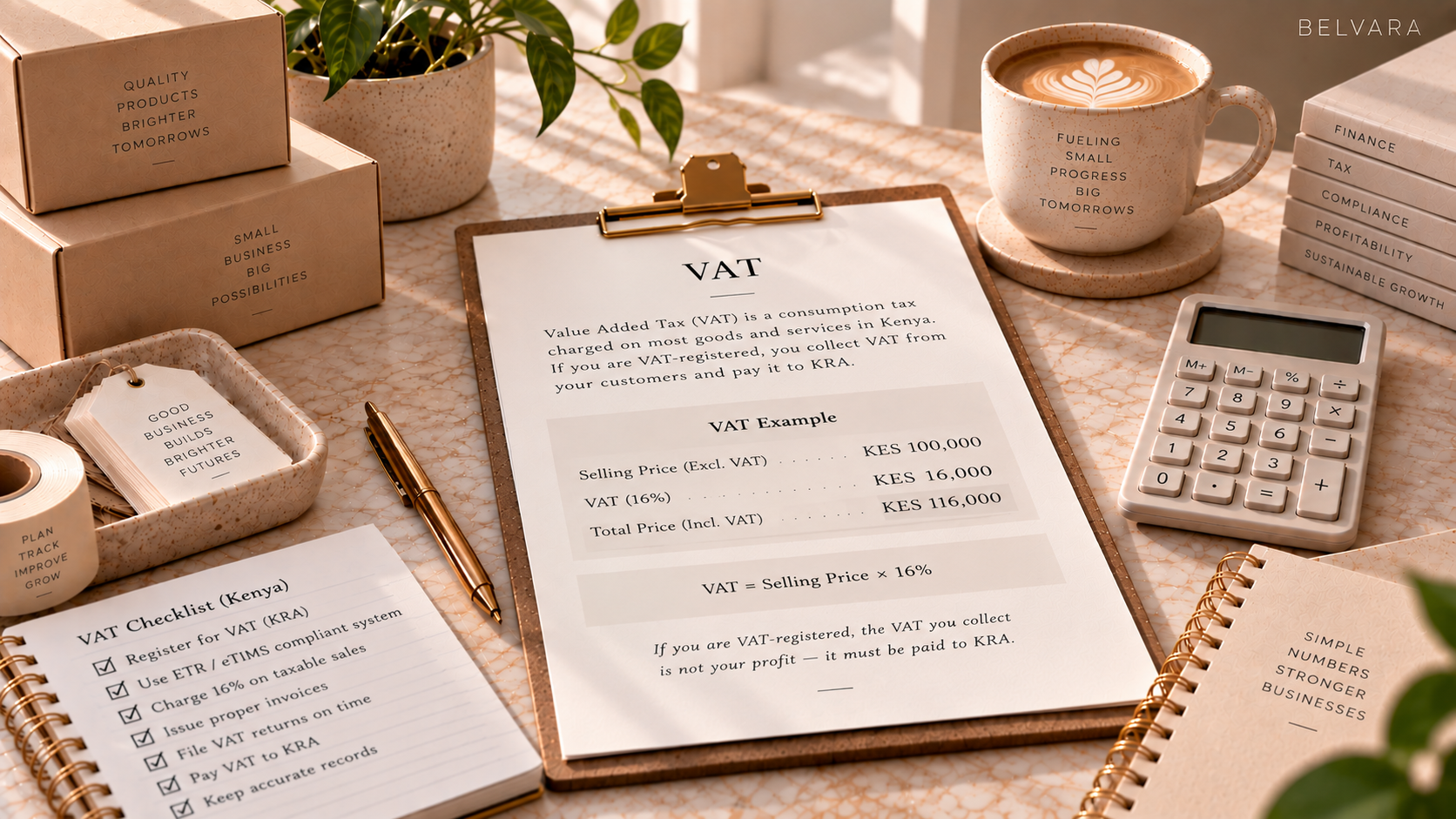
VAT can make your sales look bigger than your business really is.
If your business is VAT-registered, part of what the customer pays you is VAT you collect for KRA rather than money your business keeps.
A customer pays you:
KES 11,600
It is tempting to think:
“I made KES 11,600 in sales.”
But if that price includes VAT at 16%, the full KES 11,600 is not revenue.
The VAT portion is:
KES 1,600
The value before VAT is:
KES 10,000
That distinction matters for:
- pricing
- profit
- cash flow
- bookkeeping
- tax reporting
VAT can sit inside the same payment as your sales money while having a completely different meaning.
Belvara view: VAT can pass through your business without belonging to your business. Treating VAT like income can make both profit and cash look stronger than they really are.
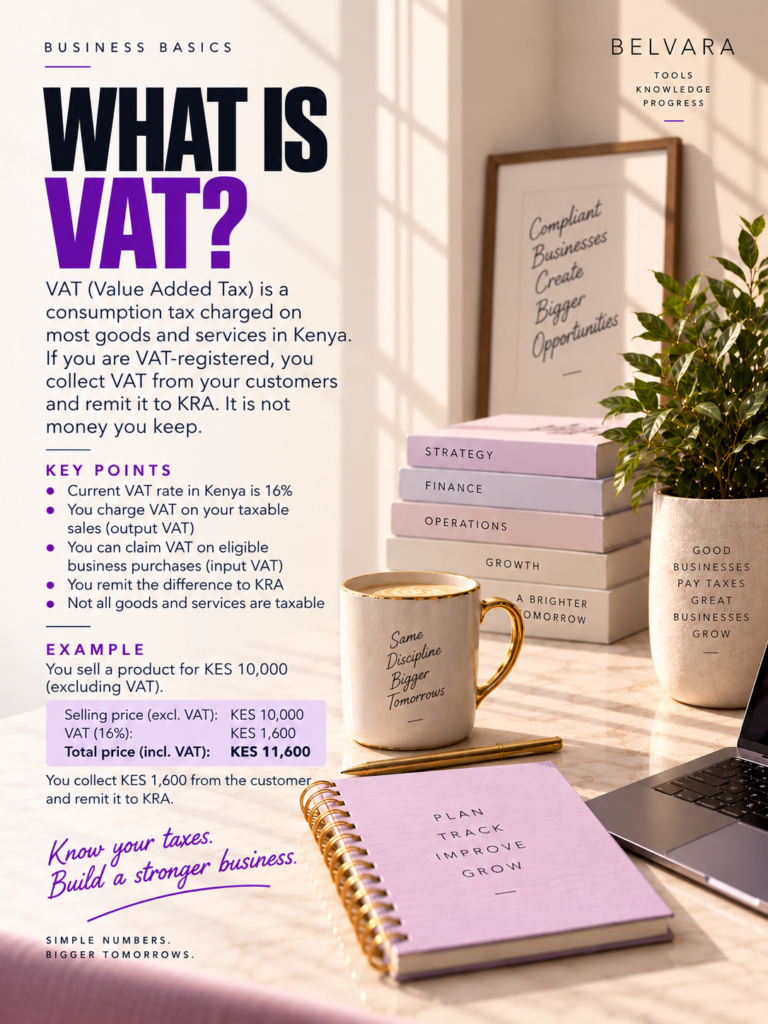
What is VAT?
VAT means Value Added Tax.
It is an indirect consumption tax charged on taxable goods and services supplied in Kenya and on certain imports.
A VAT-registered business collects VAT on taxable sales and accounts for it to the Kenya Revenue Authority (KRA).
The final consumer usually bears the tax.
The business acts as part of the collection chain.
What is the current VAT rate in Kenya?
The current general VAT rate in Kenya is:
16%
This applies to standard-rated taxable goods and services.
Kenya also has:
- 0% VAT for specified zero-rated supplies
- exempt supplies, which are not taxable supplies for VAT purposes
The VAT treatment depends on what the business is supplying.
Who must register for VAT in Kenya?
A person supplying or expecting to supply taxable goods or taxable services worth:
KES 5 million or more in a year
is generally required to register for VAT.
A business below the threshold may be allowed to register voluntarily, subject to KRA conditions.
The threshold applies to taxable supplies.
Exempt supplies do not count as taxable supplies for this purpose.
Does KES 5 million mean profit?
No.
The VAT registration threshold is based on the value of taxable supplies.
It is not based on:
- profit
- net profit
- cash in the bank
A business can have low profit and still cross the VAT registration threshold if its taxable sales are high enough.
Turnover can trigger a VAT obligation even when profit is thin.
What does VAT registration mean?
A VAT-registered business generally needs to:
- charge VAT where applicable
- issue compliant tax invoices
- keep proper VAT records
- account for output VAT
- claim eligible input VAT correctly
- file VAT returns
- pay VAT due on time
VAT registration changes both the customer-facing invoice and the bookkeeping behind it.
What is output VAT?
Output VAT is VAT charged on taxable sales.
Example:
Selling price before VAT:
KES 10,000
VAT at 16%:
KES 1,600
Customer pays:
KES 11,600
The KES 1,600 is output VAT.
What is input VAT?
Input VAT is VAT paid by a VAT-registered business on qualifying purchases or expenses used in making taxable supplies.
Example:
Business purchase before VAT:
KES 5,000
VAT at 16%:
KES 800
Total paid:
KES 5,800
The KES 800 may qualify as input VAT if the legal conditions are met.
How is VAT payable calculated?
The basic formula is:
Output VAT − Allowable Input VAT = VAT Payable
Example:
Output VAT collected:
KES 30,000
Allowable input VAT:
KES 18,000
VAT payable:
KES 12,000
This is why a business does not simply send KRA every shilling of VAT shown on sales invoices without considering allowable input VAT.
Is all input VAT automatically claimable?
No.
Input VAT must meet the legal conditions for deduction.
KRA requires valid supporting documentation and the purchase or import should relate to making taxable supplies, subject to the VAT rules and restrictions.
A VAT amount appearing on a receipt does not automatically mean the business can claim it.
Paying VAT is not the same as being entitled to deduct VAT.
What is a VAT-inclusive price?
A VAT-inclusive price already contains VAT.
Example:
Price shown to customer:
KES 11,600 VAT inclusive
At 16% VAT:
Net value:
KES 10,000
VAT:
KES 1,600
Total:
KES 11,600
How do you calculate VAT from a VAT-inclusive price?
When the general VAT rate is 16%, the VAT inside a VAT-inclusive amount can be calculated as:
VAT = VAT-inclusive price × 16 ÷ 116
Example:
VAT-inclusive price:
KES 11,600
VAT:
KES 11,600 × 16 ÷ 116 = KES 1,600
Net amount:
KES 10,000
What is a VAT-exclusive price?
A VAT-exclusive price does not yet include VAT.
Example:
Price before VAT:
KES 10,000
VAT:
KES 1,600
Final price:
KES 11,600
The business needs to make it clear whether quoted prices include or exclude VAT where relevant.
Why VAT-inclusive pricing can confuse business owners
Suppose you used to sell an item for:
KES 10,000
Then you register for VAT but keep the final customer price at:
KES 10,000 VAT inclusive
The net sales value is no longer KES 10,000.
At 16% VAT:
Net value is approximately:
KES 8,620.69
VAT is approximately:
KES 1,379.31
If your cost structure stays the same, your margin can shrink.
VAT registration can become a pricing problem before it becomes a filing problem.
Does VAT reduce profit?
VAT itself is generally not business revenue or an ordinary operating expense when accounted for correctly.
But VAT can still affect commercial performance.
For example:
- the business may absorb VAT instead of increasing customer prices
- some input VAT may not be deductible
- VAT timing can pressure cash flow
- pricing may become less competitive
So VAT can affect profit indirectly even when it is accounted for outside revenue and expenses.
Is VAT revenue?
No.
For a VAT-registered business, VAT collected on behalf of KRA should not be treated as sales revenue.
Example:
Customer pays:
KES 11,600
Net sale:
KES 10,000
VAT:
KES 1,600
Revenue is not KES 11,600 merely because KES 11,600 entered M-Pesa or the bank.
Is VAT an expense?
Not automatically.
Recoverable input VAT is generally recorded separately rather than being treated as part of the expense cost.
If input VAT is not deductible under the applicable rules, it may become part of the cost or expense depending on the transaction.
The treatment depends on the nature of the purchase and VAT rules.
VAT and profit margin
Suppose a product costs:
KES 6,000 before VAT
and is sold for:
KES 10,000 before VAT
Gross profit before other costs:
KES 4,000
If VAT is added on top, the customer pays:
KES 11,600
The VAT does not turn gross profit into:
KES 5,600
The commercial sale is still KES 10,000 before VAT.
VAT and markup
Markup should normally be analysed using VAT-exclusive commercial values when VAT is recoverable and separately accounted for.
Otherwise the business can accidentally calculate markup on tax rather than on the actual selling value.
That can distort pricing decisions.
VAT and cash flow
VAT can create a dangerous cash-flow illusion.
Suppose customers pay:
KES 1,160,000
including 16% VAT.
The business bank account sees the full amount.
But part of that money represents output VAT.
If the owner spends the entire balance as though it were free business cash, the VAT due can become a cash-flow problem later.
VAT can sit in your bank account and still already have a job.
Should a business keep VAT money separate?
The law does not mean every business must physically move VAT into a separate bank account simply because it was collected.
But operationally, the owner should know how much of the cash position relates to VAT obligations.
Some businesses choose to reserve tax cash deliberately to reduce the risk of spending it.
The important point is visibility.
VAT and M-Pesa
M-Pesa receives the full customer payment.
It does not automatically separate:
- net sale
- VAT
Example:
Customer pays through Till:
KES 11,600
The bookkeeping system must understand that the payment may represent:
- KES 10,000 sale
- KES 1,600 VAT
The payment rail and the accounting meaning are different.
VAT and STK Push
STK Push can request the full VAT-inclusive amount.
Example:
Order before VAT:
KES 20,000
VAT:
KES 3,200
STK Push amount:
KES 23,200
The payment request collects the total.
The business system still needs to split the commercial value from VAT correctly in the records.
VAT and PayBill or Till
PayBill and Till determine how the customer pays.
VAT determines the tax treatment of the sale.
A business can collect a VAT-inclusive payment through:
- Till
- PayBill
- STK Push
- bank
- card
- cash
The payment method does not change whether the underlying supply is subject to VAT.
What is a standard-rated supply?
A standard-rated supply is a taxable supply subject to the general VAT rate.
In Kenya, the current general rate is:
16%
If a registered business makes a standard-rated supply, it generally charges VAT at 16%, subject to the applicable law.
What is a zero-rated supply?
A zero-rated supply is still a taxable supply.
But the VAT rate is:
0%
This is different from an exempt supply.
A zero-rated business may still have input VAT treatment and refund consequences under the VAT rules.
What is an exempt supply?
An exempt supply is not a taxable supply for VAT purposes.
A business does not simply charge 0% VAT on an exempt supply.
That distinction matters because input VAT related to exempt supplies is generally not deductible in the same way as input VAT related to taxable supplies.
Zero-rated and exempt both look like “no VAT added” to the customer, but they are not the same thing to the business.
Zero-rated vs exempt VAT
Zero-rated
- taxable supply
- VAT rate is 0%
- related input VAT may be deductible subject to the law
Exempt
- not a taxable supply
- no output VAT charged
- related input VAT is generally not deductible
This is one of the most important VAT distinctions to get right.
Can a business choose whether something is exempt or zero-rated?
No.
The VAT treatment comes from the law.
A business cannot label a product:
“VAT exempt”
because it wants to reduce the price.
The supply must qualify under the VAT Act.
What is a tax invoice?
A tax invoice is an invoice issued by a VAT-registered person containing the required details of a taxable sale, including VAT charged where applicable.
KRA requires VAT tax invoices to be generated through compliant electronic invoicing arrangements such as eTIMS.
The invoice supports both:
- output VAT reporting by the seller
- eligible input VAT claims by the buyer
What is eTIMS?
eTIMS means Electronic Tax Invoice Management System.
It is KRA’s electronic invoicing system.
VAT-registered taxpayers are required to onboard eTIMS and issue electronic tax invoices in line with KRA requirements.
KRA has also extended electronic invoicing obligations beyond VAT-registered persons under broader eTIMS rules.
Does being below the VAT threshold mean you can ignore eTIMS?
No.
VAT registration and eTIMS are not the same obligation.
A business can be:
not VAT registered
but still have eTIMS invoicing obligations under current KRA rules.
This distinction is important.
VAT invoice vs ordinary receipt
A VAT tax invoice carries specific tax information and supports VAT reporting.
A normal payment receipt proves that money was received.
They are not automatically the same document or serve the same tax purpose.
A payment receipt proves money moved. A tax invoice explains the taxable supply behind it.
When does VAT become due?
Kenya’s VAT rules use a time of supply, sometimes called the tax point.
For many supplies, the tax point is determined by the earliest relevant event, such as:
- goods being delivered or services performed
- invoice being issued
- payment being received in whole or part
Specific situations can have additional rules.
This means VAT timing is not always the same as when the customer finally clears the balance.
VAT and customer deposits
A deposit can affect the VAT tax point because receiving payment can be one of the events that triggers the time of supply.
Businesses taking:
- booking deposits
- preorder deposits
- partial payments
should not assume VAT only matters after final payment or delivery.
The exact treatment depends on the supply and applicable VAT rules.
VAT and partial payments
Suppose a taxable order is paid in instalments.
The business needs to keep separate records for:
- total value
- VAT treatment
- payments received
- remaining balance
Partial payment does not mean the business can ignore the VAT timing rules until the customer finishes paying.
VAT and Lipa PolePole
A Lipa PolePole arrangement can spread customer payments over time.
But the payment schedule does not replace the VAT rules.
Belvara keeps these concepts separate:
- commercial amount
- VAT
- amount paid
- outstanding customer balance
- tax point
That helps the merchant see that the payment plan and the tax obligation are related but not identical.
VAT and credit sales
A customer can owe the business money while VAT has already become due under the time-of-supply rules.
That can create a cash-flow problem.
Example:
The business invoices a customer today.
Customer pays 45 days later.
VAT may become due before the cash is actually collected.
Credit sales can create tax before they create cash.
VAT and accounts receivable
Accounts receivable tracks what customers still owe.
VAT reporting tracks the tax consequence of taxable supplies.
A customer balance should not be confused with the business’s VAT balance.
Both can exist at the same time.
VAT and accounts payable
Supplier bills may include VAT.
The business should track:
- amount before VAT
- VAT amount
- total payable
- payment status
If the VAT is eligible for input deduction, it should be accounted for separately from the supplier cost.
VAT and inventory purchases
Suppose a VAT-registered retailer buys stock for:
KES 116,000 VAT inclusive
At 16% VAT:
Net stock cost:
KES 100,000
VAT:
KES 16,000
If the input VAT is allowable, the inventory cost should not be inflated by recoverable VAT.
That matters for:
- COGS
- gross profit
- stock valuation
VAT and COGS
Recoverable VAT should not be mixed into COGS as though it were part of the inventory cost.
If it is, gross profit can be understated.
If VAT is not recoverable, the cost treatment may be different.
The system must know whether the VAT is deductible.
VAT and imports
Imported taxable goods can attract VAT at importation.
Businesses importing stock need to distinguish:
- customs value
- import duty where applicable
- VAT
- other import charges
- landed cost
Not every import charge should be treated as the same thing.
VAT on imported services
Kenya also has VAT rules for imported services, sometimes referred to as reverse VAT.
Businesses buying certain services from non-resident suppliers can have VAT obligations even when the overseas supplier did not charge Kenyan VAT in the ordinary way.
This area can become technical, so businesses should check the current KRA treatment for the specific service.
VAT and software subscriptions
A Kenyan business may pay for foreign software such as:
- SaaS tools
- advertising platforms
- cloud services
The VAT treatment can depend on how the service is supplied and the applicable imported-service or digital-service rules.
Do not assume “foreign supplier” means “no Kenyan VAT consequence.”
VAT and discounts
VAT should follow the actual taxable value under the applicable rules.
Example:
Original price before VAT:
KES 10,000
Valid discount:
KES 1,000
Taxable value:
KES 9,000
VAT at 16%:
KES 1,440
Final price:
KES 10,440
The accounting record should match the actual commercial transaction.
VAT and refunds
A refund can affect the VAT record.
The business should keep the original sale and the later correction linked.
Do not simply delete the original invoice because the customer was refunded.
The appropriate credit-note process should be used where required.
VAT and returns
If goods are returned and the value of the supply is reduced, the VAT records may also need adjustment.
KRA’s VAT guidance provides for credit notes in relevant cases.
The return event, refund event and tax document should stay connected.
VAT and cancelled orders
If an order is cancelled before any taxable supply or tax-point event occurs, the treatment can be different from an order cancelled after:
- invoice
- deposit
- payment
- delivery
This is why systems should preserve the sequence of events.
What is a credit note?
A credit note reduces or corrects the value of an earlier invoice in valid circumstances.
It may be used when:
- goods are returned
- the price is reduced
- an invoice needs an eligible downward adjustment
A credit note should refer back to the original transaction.
What is a debit note?
A debit note can be used where the taxable value needs an upward adjustment, subject to the applicable rules.
Like a credit note, it should preserve the relationship with the original supply.
VAT and withholding VAT
Kenya also uses withholding VAT for appointed withholding VAT agents.
KRA currently states withholding VAT at:
2% of the value of taxable supplies
for applicable transactions.
The supplier still has to account for VAT correctly in the VAT return, with withholding credits applied as allowed.
This is different from ordinary customer VAT.
VAT and Turnover Tax
Turnover Tax and VAT are different taxes.
A business can potentially have both obligations depending on its circumstances.
KRA specifically notes that a Turnover Tax taxpayer dealing in VATable supplies who reaches the VAT threshold must also register for VAT.
Do not assume paying Turnover Tax removes a VAT obligation.
VAT and income tax
VAT is not income tax.
VAT
Tax on taxable consumption and supplies.
Income tax
Tax based on taxable income or profits under the applicable income-tax rules.
A business can have both obligations.
VAT and corporate tax
Corporate tax is not calculated by taking 16% of sales.
VAT and corporation tax have different bases and rules.
Mixing them creates bad bookkeeping and bad cash planning.
VAT and P&L reporting
The P&L should normally show revenue excluding VAT collected on behalf of KRA.
Example:
Customer invoice total:
KES 116,000
Revenue:
KES 100,000
Output VAT:
KES 16,000
If the P&L reports KES 116,000 as revenue, sales are overstated.
VAT and the balance sheet
VAT can create balances such as:
- VAT payable
- VAT recoverable or input tax balances
These are balance-sheet concepts rather than ordinary sales income or operating expense.
That is why VAT should be kept separate in the books.
VAT and cash-flow reporting
Cash-flow reports show the money moving.
VAT records explain part of what that money represents.
The business needs both views.
A large bank balance does not automatically mean the business has large free cash if tax obligations are sitting inside it.
VAT and bookkeeping
Good VAT bookkeeping keeps separate records for:
- net sale
- output VAT
- net purchase
- input VAT
- tax invoice
- customer payment
- supplier payment
The payment and the tax event need to remain connected without being collapsed into one number.
What records should a VAT-registered business keep?
Useful records include:
- sales invoices
- purchase invoices
- credit notes
- debit notes
- import documents
- payment records
- eTIMS records
- VAT return support
KRA requires VAT-registered persons to maintain proper records supporting their transactions.
When is the VAT return due in Kenya?
KRA currently requires the VAT return and payment to be submitted:
on or before the 20th day of the following month
Example:
VAT for September is due by:
20 October
subject to the applicable calendar and KRA procedures.
Do you still file if there is no VAT to pay?
A VAT-registered taxpayer still has filing obligations while the VAT obligation remains active.
A nil or low-activity month does not automatically remove the filing requirement.
If the business no longer qualifies or no longer makes taxable supplies, it may need to apply for deregistration rather than simply stop filing.
What happens if a business falls below KES 5 million?
A VAT-registered business whose taxable turnover falls below the threshold may be able to apply for VAT deregistration, subject to KRA rules.
It should not simply stop charging or filing on its own.
The business remains responsible for the VAT obligation until deregistration is properly completed.
Can a business voluntarily register for VAT?
Yes, KRA allows voluntary registration below the KES 5 million threshold subject to conditions.
A business may consider this where:
- customers expect VAT invoices
- the business has significant taxable input costs
- commercial relationships favour VAT registration
But voluntary registration also creates compliance obligations.
It should be a deliberate decision.
Is voluntary VAT registration always a good idea?
No.
Possible advantages can include:
- input VAT recovery where eligible
- ability to issue VAT tax invoices
- fit with larger B2B customers
Possible disadvantages can include:
- more compliance work
- cash-flow timing
- pricing pressure where customers cannot recover VAT
The right answer depends on the business model.
VAT for B2B businesses
VAT can be easier commercially when customers are also VAT registered and can claim eligible input VAT.
Those customers may focus more on:
price before VAT
because the VAT may be recoverable subject to the rules.
That does not remove the supplier’s compliance obligations.
VAT for B2C businesses
For a consumer-facing business, customers usually care about the final price they pay.
If the business becomes VAT registered, it may have to decide whether to:
- increase the final price
- absorb some of the VAT within the existing price
- change margins or product mix
That makes VAT a commercial decision as well as a tax obligation.
VAT for retailers
Retailers need clear rules for:
- VAT-inclusive shelf prices
- POS treatment
- refunds
- returns
- discounts
- eTIMS invoices
The sales system and tax records should agree.
VAT for online sellers
Online sellers should make sure the website or checkout knows:
- whether prices include VAT
- VAT rate
- taxable value
- delivery treatment
- discounts
- refund treatment
The customer should not discover VAT unexpectedly at the final payment step unless the pricing model clearly requires it.
VAT for wholesalers
Wholesalers often work with VAT-registered customers.
They need accurate:
- tax invoices
- customer accounts
- credit notes
- input/output VAT records
Because transaction values are high, small classification errors can become large VAT differences.
VAT for service businesses
VAT does not apply only to physical products.
Taxable services can also attract VAT.
Service businesses need to understand:
- whether the service is taxable
- when the tax point occurs
- whether quoted fees include VAT
VAT for restaurants and hospitality
Restaurants, hotels and hospitality businesses can have multiple transaction types.
Different supplies can have different tax treatment.
The POS or billing system should not assume every line item has identical VAT treatment without checking the law.
VAT for landlords
Commercial rent can have VAT consequences where the applicable registration and supply rules are met.
Residential rent is treated differently.
Property owners should confirm the current tax treatment of the type of property and rental supply rather than assuming all rent is the same.
VAT for importers
Importers can face VAT before the imported goods have been sold.
That can tie up cash.
For a product business, import VAT should be tracked separately from:
- product cost
- freight
- duty
- clearing charges
where the tax is recoverable.
VAT and landed cost
Landed cost tells the business what it took to bring inventory to the point where it can be sold.
Recoverable import VAT should not automatically be treated as permanent inventory cost.
If VAT is not recoverable, the treatment may differ.
This distinction affects FIFO and gross profit.
VAT and pricing strategy
Before setting a price, a VAT-registered business should know:
- cost before recoverable VAT
- desired markup
- VAT-exclusive selling price
- VAT amount
- final customer price
Otherwise the owner can accidentally calculate profit from a VAT-inclusive number.
A VAT pricing example
Product cost before VAT:
KES 5,000
Desired selling price before VAT:
KES 8,000
VAT at 16%:
KES 1,280
Customer price:
KES 9,280
Commercial gross profit before other costs:
KES 3,000
Not:
KES 4,280
The KES 1,280 is VAT.
What if the customer refuses the higher VAT-inclusive price?
That is a commercial problem the business has to solve.
Possible responses include:
- adjust the net selling price
- accept a lower margin
- improve product mix
- negotiate supplier cost
- reposition the offer
But the business cannot simply hide or ignore a valid VAT obligation.
Why businesses get VAT wrong
Common reasons include:
- treating gross cash received as revenue
- forgetting VAT is inside inclusive prices
- claiming input VAT without valid support
- mixing exempt and zero-rated supplies
- using wrong tax codes
- failing to issue compliant invoices
- missing credit notes
- spending VAT cash
- late filing
Most VAT problems start as recordkeeping problems before they become tax problems.
How Belvara helps with VAT
VAT becomes difficult when the sales system, inventory, payments, expenses and tax records all tell different stories.
Belvara keeps the commercial event and its tax consequence connected.
Keep VAT separate from revenue
A VAT-inclusive sale can be split into:
- net sale
- VAT
- total customer amount
That prevents VAT from inflating revenue.
Keep tax treatment on the transaction
Products and services can carry the applicable tax treatment so the business does not rely on memory every time it invoices.
Keep payments separate from tax meaning
A KES 11,600 M-Pesa payment can still be understood as:
- KES 10,000 sale
- KES 1,600 VAT
rather than one undifferentiated cash receipt.
Keep partial payments connected
For deposits and Lipa PolePole, Belvara can keep:
- total commercial value
- VAT
- amount paid
- customer balance
separate.
Keep returns and refunds traceable
Returns, refunds, credit notes and cancellations remain linked to the original transaction rather than deleting history.
Keep purchasing and input VAT connected
Supplier purchases can preserve:
- net purchase value
- VAT amount
- supplier
- supporting invoice
so eligible input VAT can be reviewed correctly.
Support eTIMS workflows
Where eTIMS applies, Belvara can keep the business transaction connected to the relevant electronic invoicing workflow rather than creating a separate tax-only version of the sale.
Keep VAT visible in cash planning
The owner should be able to see that part of the money collected may represent tax rather than free operating cash.
Belvara view: VAT should not live in a separate tax universe. The sale, payment, invoice, stock movement and VAT consequence should all point back to the same business event.
Common VAT mistakes
1. Treating VAT-inclusive sales as full revenue
This overstates revenue.
2. Spending all VAT-inclusive cash
Part of it may be needed for the VAT obligation.
3. Confusing zero-rated and exempt
They have different VAT consequences.
4. Claiming every VAT amount as input VAT
Input VAT must qualify under the rules.
5. Forgetting VAT when setting prices
This can destroy margin after registration.
6. Treating customer payment date as the only VAT trigger
Time-of-supply rules can create VAT earlier.
7. Mixing transfers with taxable sales
Moving money between accounts is not a VATable sale.
8. Ignoring credit notes and refunds
Corrections need proper tax records.
9. Assuming eTIMS only matters after VAT registration
Current eTIMS obligations extend more broadly across businesses.
10. Stopping returns because business was quiet
VAT-registered taxpayers remain responsible for filing while the obligation is active.
Belvara view: The dangerous VAT mistake is not just getting the percentage wrong. It is letting tax, sales and cash become the same number in your head.
The takeaway
VAT is Value Added Tax.
In Kenya, the current general VAT rate is:
16%
A business generally has to register when taxable supplies reach or are expected to reach:
KES 5 million in a year
Once registered, the business needs to understand:
- output VAT
- input VAT
- VAT-inclusive pricing
- zero-rated vs exempt supplies
- tax invoices
- eTIMS
- time of supply
- filing and payment
The core formula is:
Output VAT − Allowable Input VAT = VAT Payable
And the core business lesson is even simpler:
VAT collected from a customer is not the same thing as revenue earned by the business.
When that distinction is clear, pricing, bookkeeping, cash flow and reporting become much easier to control.
Frequently Asked Questions About VAT in Kenya
What does VAT stand for?
VAT stands for Value Added Tax.
What is the current general VAT rate in Kenya?
The current general rate is 16% for standard-rated taxable supplies.
What is the VAT registration threshold in Kenya?
A person supplying or expecting to supply taxable goods or services worth KES 5 million or more in a year is generally required to register.
Is the KES 5 million threshold based on profit?
No. It is based on taxable supplies, not profit.
Can I register for VAT below KES 5 million?
Voluntary registration may be available subject to KRA conditions.
Is VAT part of my revenue?
VAT collected on taxable sales should be accounted for separately from business revenue.
What is output VAT?
Output VAT is VAT charged on taxable sales.
What is input VAT?
Input VAT is VAT incurred on qualifying business purchases or imports that may be deductible subject to the VAT rules.
How is VAT payable calculated?
Output VAT minus allowable input VAT equals VAT payable, subject to credits and other applicable rules.
What is a VAT-inclusive price?
It is a final price that already includes VAT.
How do I extract 16% VAT from an inclusive price?
Multiply the VAT-inclusive amount by 16/116.
What is a zero-rated supply?
It is a taxable supply charged at 0% VAT.
What is an exempt supply?
It is a supply that is not taxable for VAT purposes under the exemption rules.
Is zero-rated the same as exempt?
No. Their input VAT and registration consequences are different.
What is eTIMS?
It is KRA’s Electronic Tax Invoice Management System used for electronic invoicing.
Do non-VAT businesses use eTIMS?
Current KRA rules extend electronic invoicing obligations beyond VAT-registered businesses, subject to applicable exceptions and procedures.
When is VAT due in Kenya?
The VAT return and payment are due on or before the 20th day of the following month.
Do I file a VAT return if I had no sales?
If your VAT obligation is active, filing obligations continue even when activity is nil, unless KRA has formally deregistered the obligation.
Does VAT apply to M-Pesa payments?
VAT applies based on the underlying taxable supply, not because the customer used M-Pesa. M-Pesa simply carries the payment.
Is a bank transfer subject to VAT?
Moving money between your own accounts is not a sale and does not become taxable merely because money moved.
Does VAT apply to customer deposits?
A deposit can affect the VAT tax point because receipt of payment can be one of the events that determines time of supply. The exact treatment depends on the transaction.
Are stock purchases immediately an expense including VAT?
Not necessarily. Inventory treatment and input VAT should be separated where VAT is recoverable.
Is VAT the same as Turnover Tax?
No. They are separate taxes and a business can potentially have obligations for both.
Is VAT the same as income tax?
No. VAT is a consumption tax. Income tax applies under separate income-tax rules.
How does Belvara help with VAT?
Belvara helps keep net sales, VAT, payments, customer balances, purchases, input VAT, refunds, credit notes and eTIMS-related records connected to the same underlying business transactions so the owner can see what is revenue, what is tax and what still needs attention.
What should I learn after VAT?
The next useful concepts are eTIMS, input VAT, output VAT, zero-rated vs exempt supplies, withholding VAT, tax invoices and VAT reconciliation.
