
Your business can look healthy while the money is quietly disappearing.
Sales are coming in.
The business looks profitable.
But loans still need paying.
Tax is still due.
Equipment still needs replacing.
And cash can still be getting tighter.
EBITDA helps show how the core business is performing before some of those costs hit the final number.
That is why EBITDA can be useful and dangerous at the same time.
It helps isolate operating performance before certain financing, tax and non-cash accounting charges.
But it should never be confused with cash.
Belvara view: EBITDA can show the strength of the operating engine. It cannot tell you how much money is actually left in the tank.
What is EBITDA?
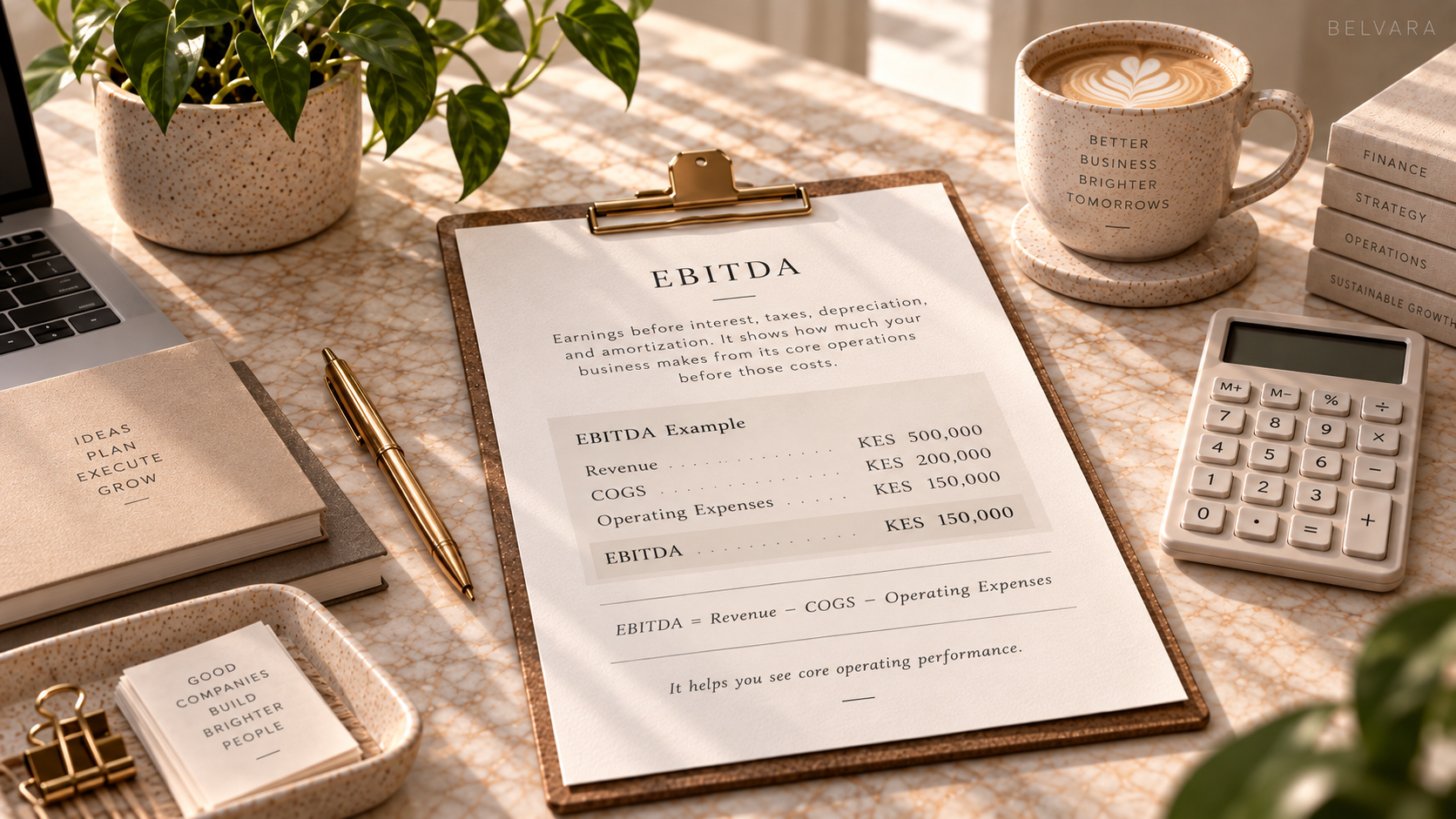
EBITDA stands for Earnings Before Interest, Taxes, Depreciation and Amortisation.
It is a measure of business earnings before four categories are deducted:
- interest
- tax
- depreciation
- amortisation
In simple terms, EBITDA tries to show how profitable the core operation is before:
- financing costs
- tax
- certain non-cash charges related to long-term assets
This makes it useful for comparing businesses with different:
- debt levels
- tax situations
- asset structures
But EBITDA is not the same as:
- net profit
- EBIT
- operating cash flow
- free cash flow
What does EBITDA stand for?
EBITDA stands for:
Earnings Before Interest, Taxes, Depreciation and Amortisation
Each part matters.
Earnings
This refers to profit generated by the business.
Before interest
Interest is excluded because it depends partly on how the business is financed.
Two similar businesses can carry very different debt levels.
Before taxes
Tax is excluded because tax treatment can differ across businesses, locations and periods.
Before depreciation
Depreciation is excluded because it is a non-cash accounting charge that spreads the cost of a tangible asset over its useful life.
Before amortisation
Amortisation is excluded because it is a non-cash accounting charge that spreads the cost of certain intangible assets over time.
EBITDA formula
There are several common ways to calculate EBITDA.
Formula 1
EBITDA = EBIT + Depreciation + Amortisation
Formula 2
EBITDA = Net Profit + Interest + Tax + Depreciation + Amortisation
Formula 3
In a simplified operating model:
EBITDA = Revenue − Operating Expenses Before Depreciation and Amortisation
The exact presentation can vary depending on the financial statements.
The most important rule is to understand what has been included and excluded.
A simple EBITDA example
Suppose a business has:
- Revenue: KES 6,000,000
- Cost of goods sold: KES 3,000,000
- Other operating expenses: KES 1,200,000
- Depreciation: KES 300,000
- Amortisation: KES 100,000
- Interest: KES 250,000
- Tax: KES 200,000
First calculate EBITDA:
KES 6,000,000 − KES 3,000,000 − KES 1,200,000 = KES 1,800,000
Then subtract depreciation and amortisation:
KES 1,800,000 − KES 300,000 − KES 100,000 = KES 1,400,000 EBIT
Then interest:
KES 1,400,000 − KES 250,000 = KES 1,150,000
Then tax:
KES 1,150,000 − KES 200,000 = KES 950,000 net profit
So the business reports:
- EBITDA: KES 1,800,000
- EBIT: KES 1,400,000
- Net profit: KES 950,000
The numbers describe different layers of profitability.
EBITDA vs EBIT
EBIT means:
Earnings Before Interest and Taxes
EBITDA means:
Earnings Before Interest, Taxes, Depreciation and Amortisation
The difference is depreciation and amortisation.
Suppose:
- EBIT: KES 1,400,000
- Depreciation: KES 300,000
- Amortisation: KES 100,000
Then:
EBITDA = KES 1,400,000 + KES 300,000 + KES 100,000 = KES 1,800,000
EBIT keeps depreciation and amortisation in the profit calculation.
EBITDA removes them.
Belvara view: EBIT asks what the operation earned after using its assets. EBITDA asks what the operation earned before charging for that use.
Why depreciation is added back
Depreciation is generally a non-cash accounting expense.
Suppose a business buys equipment for:
KES 5,000,000
The business may not expense the full KES 5 million immediately in the income statement.
Instead, the asset may be depreciated over its useful life.
If annual depreciation is:
KES 500,000
EBIT will be reduced by KES 500,000.
EBITDA adds that KES 500,000 back.
Why?
Because the KES 500,000 depreciation expense did not represent a new KES 500,000 cash payment that year.
But this does not mean the asset was free.
The business paid for it at some point.
And eventually it may need to be replaced.
Why amortisation is added back
Amortisation works similarly for certain intangible assets.
Examples can include:
- purchased software
- licences
- acquired customer relationships
- certain intellectual property
The exact accounting treatment depends on the applicable reporting framework.
Like depreciation, amortisation is often non-cash in the current period.
EBITDA adds it back.
EBITDA vs net profit
Net profit is what remains after many more costs.
EBITDA excludes:
- interest
- tax
- depreciation
- amortisation
Net profit includes them.
Suppose:
- EBITDA: KES 2,000,000
- Depreciation and amortisation: KES 500,000
- Interest: KES 700,000
- Tax: KES 200,000
Net profit:
KES 600,000
A KES 2 million EBITDA can end as only KES 600,000 of net profit.
That is why EBITDA should never be treated as the final amount the business earned for the owner.
EBITDA vs operating profit
Operating profit is often close to EBIT.
That means depreciation and amortisation are generally included.
EBITDA removes them.
So EBITDA will normally be higher than operating profit when depreciation or amortisation exists.
But definitions can vary across companies.
Always check the specific calculation.
EBITDA vs gross profit
Gross profit is earlier in the profit calculation.
A common formula is:
Gross Profit = Revenue − Cost of Goods Sold
EBITDA goes further.
It subtracts operating expenses such as:
- payroll
- rent
- marketing
- utilities
- software
- administration
- professional costs
but excludes depreciation and amortisation.
Suppose:
- Revenue: KES 10,000,000
- COGS: KES 6,000,000
- Gross profit: KES 4,000,000
- Operating expenses before D&A: KES 2,500,000
EBITDA:
KES 1,500,000
Gross profit tells you whether the sale has enough room after direct costs.
EBITDA tells you what remains after most of the operating structure is paid for.
EBITDA margin
EBITDA margin shows EBITDA as a percentage of revenue.
A common formula is:
EBITDA Margin = EBITDA ÷ Revenue × 100
Suppose:
- EBITDA: KES 1,500,000
- Revenue: KES 10,000,000
EBITDA margin:
KES 1,500,000 ÷ KES 10,000,000 × 100 = 15%
That means the business keeps KES 15 of EBITDA for every KES 100 of revenue.
Why EBITDA margin matters
The absolute EBITDA number can make larger companies look automatically better.
Suppose:
Business A
- Revenue: KES 10,000,000
- EBITDA: KES 2,000,000
- EBITDA margin: 20%
Business B
- Revenue: KES 50,000,000
- EBITDA: KES 5,000,000
- EBITDA margin: 10%
Business B produces more EBITDA.
Business A produces more EBITDA relative to each shilling of revenue.
Both facts matter.
A high EBITDA margin is not automatically better
A high margin can indicate:
- strong pricing
- efficient operations
- low operating costs
- strong product mix
But it can also look high because the business has large depreciation charges excluded from EBITDA.
This is especially important in asset-heavy businesses.
A high EBITDA margin can therefore overstate the economic comfort of the business if replacing assets requires a lot of cash.
EBITDA is not cash flow
This is the most important warning.
EBITDA is not cash.
It can differ sharply from operating cash flow.
Suppose a business reports:
KES 2,000,000 EBITDA
But during the same period:
- Accounts receivable increase by KES 1,000,000
- Inventory increases by KES 700,000
- Suppliers are paid KES 300,000 faster than usual
The business may generate very little operating cash despite strong EBITDA.
Belvara view: EBITDA can say the operation earned money while working capital quietly absorbs nearly all of it.
EBITDA can be strong while the bank account is weak
Suppose:
- EBITDA: KES 2,000,000
- Customers still owe: KES 1,300,000
- New inventory purchased: KES 500,000
- Loan principal repaid: KES 300,000
- Tax paid: KES 200,000
The EBITDA number looks healthy.
The cash position may feel completely different.
That is because EBITDA does not capture all cash movements.
EBITDA ignores working capital
EBITDA does not directly account for changes in:
- accounts receivable
- inventory
- accounts payable
These can have a major effect on cash.
Suppose sales grow quickly.
EBITDA rises.
But customers pay in 60 days.
Receivables explode.
The business can report stronger EBITDA while needing more cash to survive the growth.
EBITDA ignores capital expenditure
Capital expenditure, often shortened to CapEx, is money spent on long-term assets such as:
- machinery
- vehicles
- equipment
- technology infrastructure
- property improvements
EBITDA does not deduct the full current cash cost of those purchases.
That is one of its biggest limitations.
Suppose a logistics business reports:
KES 5,000,000 EBITDA
But it needs:
KES 4,000,000
of vehicle replacement and fleet investment.
The economic picture is very different from a software business with the same EBITDA but little capital expenditure.
Asset-heavy businesses can look better under EBITDA
This is where EBITDA needs caution.
Suppose two businesses each report:
KES 5,000,000 EBITDA
Business A
Needs only:
KES 500,000
of annual capital expenditure.
Business B
Needs:
KES 4,000,000
of annual capital expenditure.
Same EBITDA.
Very different cash demands.
Business B’s operating model consumes much more capital.
A business that constantly needs new assets cannot live forever on a profit measure that ignores the cost of replacing them.
EBITDA can flatter a capital-intensive business
Imagine a transport company.
Vehicles depreciate heavily.
They also require:
- maintenance
- replacement
- tyres
- financing
EBITDA adds back depreciation.
That can make operating performance look strong.
But the vehicles still wear out.
Eventually cash must replace them.
This is why EBIT or free cash flow may sometimes be more informative than EBITDA for asset-heavy businesses.
EBITDA and debt
Interest is excluded from EBITDA.
That makes EBITDA useful for comparing operating performance across companies with different debt levels.
But debt still matters.
Suppose:
Business A
- EBITDA: KES 3,000,000
- Interest: KES 200,000
Business B
- EBITDA: KES 3,000,000
- Interest: KES 1,500,000
Same EBITDA.
Very different financial pressure.
Business B has much less room after debt costs.
EBITDA and interest coverage
Lenders often care about whether a business generates enough earnings to support debt obligations.
One common idea is to compare earnings with interest expense.
For example:
EBITDA ÷ Interest Expense
Suppose:
- EBITDA: KES 2,000,000
- Interest: KES 500,000
Ratio:
4.0 times
This suggests EBITDA is four times the interest expense.
But debt analysis should not stop there.
Loan principal repayments also require cash.
EBITDA does not deduct principal.
EBITDA and loan repayments
Suppose:
- EBITDA: KES 2,000,000
- Interest: KES 300,000
- Loan principal repayments: KES 1,200,000
The business appears strong on EBITDA.
But debt service consumes:
KES 1,500,000
before tax and other cash needs.
That leaves much less room.
This is why EBITDA should not be confused with cash available for debt repayment.
EBITDA and tax
Tax is excluded from EBITDA.
That helps compare businesses before tax differences.
But tax still has to be paid.
A strong EBITDA can create a false sense of available cash if the owner forgets:
- income tax
- VAT-related obligations
- payroll taxes
- other statutory payments
Tax treatment depends on jurisdiction and circumstances.
Any current Kenya-specific tax rules should be verified against authoritative KRA or legal sources before action.
EBITDA and revenue growth
Revenue can rise while EBITDA falls.
Suppose:
Year 1
- Revenue: KES 10,000,000
- EBITDA: KES 2,000,000
- Margin: 20%
Year 2
- Revenue: KES 15,000,000
- EBITDA: KES 1,800,000
- Margin: 12%
Revenue grew by KES 5 million.
EBITDA fell.
The business became larger but less profitable at the operating level before D&A.
Possible reasons include:
- weaker gross margin
- higher payroll
- more rent
- aggressive marketing
- inefficient expansion
Growth is not automatically good growth. If EBITDA margin collapses, revenue can get bigger while the operation gets weaker.
Revenue can stay flat while EBITDA improves
Suppose:
Year 1
- Revenue: KES 10,000,000
- EBITDA: KES 1,000,000
Year 2
- Revenue: KES 10,000,000
- EBITDA: KES 2,000,000
Revenue did not grow.
Operating profitability doubled.
Possible reasons include:
- better pricing
- better supplier costs
- lower waste
- stronger product mix
- better productivity
That can represent major improvement.
EBITDA and gross margin
Gross margin strongly affects EBITDA.
Suppose gross margin improves by:
5 percentage points
on:
KES 10,000,000 revenue
That can create:
KES 500,000
of additional gross profit.
If operating expenses stay similar, much of that can flow into EBITDA.
This is why pricing and purchasing decisions can have a powerful effect on EBITDA.
EBITDA and payroll
Payroll is usually included in operating expenses before EBITDA.
If payroll grows faster than revenue or gross profit:
- EBITDA can fall
- EBITDA margin can compress
That does not mean hiring is bad.
It means the business needs enough economic output to support the larger team.
EBITDA and rent
Rent is also typically an operating expense before EBITDA, subject to the accounting treatment and lease structure.
New branches can increase:
- revenue
- payroll
- rent
- utilities
- overhead
The question is whether the additional gross profit supports the expanded operating base.
EBITDA and marketing
Marketing normally reduces EBITDA in the period because it is an operating expense.
But good marketing can drive:
- revenue
- repeat purchases
- customer growth
The right question is not:
Did marketing reduce this month’s EBITDA?
It is:
Did marketing generate enough future gross profit to justify the cost?
Negative EBITDA
Negative EBITDA means the business is losing money before:
- interest
- tax
- depreciation
- amortisation
Suppose:
- Revenue: KES 5,000,000
- Operating costs before D&A: KES 5,500,000
EBITDA:
KES -500,000
That means the core operation is not covering its operating costs before those excluded items.
This is a serious operating signal.
Negative EBITDA can be deliberate
A young or fast-growing company may intentionally run negative EBITDA while investing heavily in:
- customer acquisition
- product development
- expansion
- teams
- new markets
That can be rational.
But it still consumes cash.
The business needs enough funding to survive until operating economics improve.
EBITDA and startups
Startups often talk about EBITDA because it helps separate:
- core operating performance
- from financing
- from tax
- from non-cash asset charges
But early-stage companies can have unusual cost structures.
A startup with:
- negative EBITDA
- strong growth
- good unit economics
may still attract capital.
That does not make negative EBITDA irrelevant.
It means investors are betting on future operating profitability.
EBITDA in retail
For a retailer, EBITDA can be influenced by:
- sales
- gross margin
- payroll
- rent
- marketing
- utilities
- software
- admin costs
A retailer with strong gross profit can still have weak EBITDA if overhead is too high.
EBITDA in wholesale
Wholesale businesses often operate on:
- larger volumes
- thinner margins
- customer credit
- supplier credit
Small changes in gross margin can have a large effect on EBITDA because the revenue base is large.
EBITDA in service businesses
Service businesses often have relatively low depreciation compared with manufacturing or logistics.
That means EBITDA and EBIT may be closer together.
Key drivers can include:
- pricing
- utilisation
- payroll
- contractor costs
- overhead
EBITDA in SaaS
SaaS businesses can have:
- recurring revenue
- relatively low physical asset requirements
- high payroll
- high sales and marketing costs
EBITDA can be useful for mature SaaS businesses.
But fast-growing SaaS companies may deliberately spend heavily and run low or negative EBITDA.
EBITDA in manufacturing
Manufacturing businesses can carry:
- machinery
- factories
- equipment
Depreciation can be significant.
That means the gap between EBITDA and EBIT can be large.
This is exactly why EBITDA should be read carefully in manufacturing.
EBITDA in logistics
Logistics can be highly asset-intensive.
Vehicles, warehouses and equipment require capital.
EBITDA can look strong.
But maintenance and replacement still require cash.
Free cash flow and capital expenditure deserve close attention.
EBITDA in hospitality
Hotels and hospitality businesses can have:
- property
- furniture
- equipment
- refurbishments
Depreciation can be meaningful.
EBITDA is widely used in hospitality analysis, but asset maintenance remains economically real.
Adjusted EBITDA
Adjusted EBITDA starts with EBITDA and removes selected items that management considers:
- unusual
- non-recurring
- not part of normal operations
Examples might include:
- restructuring costs
- one-off legal expenses
- unusual transaction costs
Adjusted EBITDA can be useful.
It can also be abused.
Why adjusted EBITDA can become dangerous
Suppose management removes:
- one-time legal costs
- restructuring costs
- acquisition costs
- stock write-offs
- repeated “exceptional” expenses
Every adjustment makes the number look better.
At some point, the business may be adjusting away costs that are actually part of running the business.
Belvara view: If the same “one-off” cost keeps returning, it is not one-off. It is your business model.
EBITDA before and after adjustments
Suppose reported EBITDA is:
KES 1,500,000
Management adds back:
- restructuring: KES 300,000
- legal fees: KES 200,000
- unusual consulting: KES 100,000
Adjusted EBITDA:
KES 2,100,000
That is a meaningful difference.
Anyone using the number should ask:
- What was adjusted?
- Why?
- Will it really not happen again?
EBITDA and valuation
EBITDA is widely used in business valuation.
One common multiple is:
EV / EBITDA
Where:
EV = Enterprise Value
Suppose a business has:
- Enterprise value: KES 100,000,000
- EBITDA: KES 10,000,000
EV/EBITDA:
10×
That means the business is valued at ten times EBITDA in this simplified example.
Why buyers use EBITDA
Buyers may use EBITDA because it helps compare businesses before:
- financing structure
- tax
- depreciation
- amortisation
A buyer may plan to:
- refinance debt
- change ownership structure
- combine operations
- alter tax treatment
EBITDA can therefore provide a cleaner starting point for comparing operating earnings.
EBITDA does not equal business value
A strong EBITDA does not automatically mean a high valuation.
Valuation also depends on:
- growth
- risk
- customer concentration
- recurring revenue
- margins
- industry
- competitive position
- capital intensity
- management dependence
- cash flow quality
Two businesses with the same EBITDA can deserve very different valuations.
Quality of EBITDA matters
Suppose two companies each report:
KES 10,000,000 EBITDA
Business A
EBITDA comes from:
- repeat customers
- stable margins
- diversified revenue
- predictable costs
Business B
EBITDA comes from:
- one large customer
- unusual discounts
- temporary supplier support
- aggressive cost deferrals
Same EBITDA.
Different quality.
The stronger question is:
How repeatable is the EBITDA?
EBITDA and customer concentration
If one customer creates most of the EBITDA, the business may be fragile.
Suppose:
60% of EBITDA
depends on one customer.
If that customer leaves, reported operating profitability can collapse.
This matters in valuation and risk analysis.
EBITDA and supplier concentration
Supplier dependence can also affect EBITDA quality.
One supplier may provide:
- favourable pricing
- long credit terms
- unique products
If those terms disappear, gross margin and EBITDA can fall.
EBITDA and recurring revenue
Recurring revenue can make EBITDA more predictable.
Examples include:
- subscriptions
- retainers
- repeat wholesale contracts
- service agreements
Predictability can improve the quality of operating earnings.
But recurring revenue should still be evaluated alongside:
- churn
- collection
- gross margin
- cost to serve
EBITDA and pricing power
A business with pricing power may be able to increase prices without losing too much demand.
That can improve:
- gross profit
- EBITDA
- EBITDA margin
A business with no pricing power may struggle to protect EBITDA when costs rise.
EBITDA and cost control
Cost control can improve EBITDA.
But careless cost cutting can damage future performance.
Cutting:
- duplicated tools
- waste
- unnecessary overhead
can help.
Cutting:
- customer service
- essential staff
- product quality
- productive marketing
may improve EBITDA temporarily while weakening the business.
EBITDA and operating leverage
Businesses with high fixed operating costs can see EBITDA move sharply when revenue changes.
Suppose fixed costs are high.
A small increase in revenue may create a large increase in EBITDA once the business moves beyond break-even.
But a small decline in sales can also cause EBITDA to fall quickly.
EBITDA and break-even
In a simplified model, EBITDA break-even is reached when:
Revenue = Operating Costs Before Depreciation and Amortisation
At that point:
EBITDA ≈ 0
This does not mean:
- cash flow is zero
- EBIT is zero
- net profit is zero
because depreciation, amortisation, interest, tax and working-capital movements still exist.
EBITDA and cash conversion
A strong EBITDA is more valuable when it turns into cash efficiently.
Suppose:
Business A:
- EBITDA: KES 5,000,000
- Operating cash flow: KES 4,500,000
Business B:
- EBITDA: KES 5,000,000
- Operating cash flow: KES 1,000,000
Same EBITDA.
Very different cash conversion.
The difference may come from:
- receivables
- inventory
- payables
- other working-capital changes
EBITDA to cash conversion
There is no single universal formula used by every business.
A simple management view might compare:
Operating Cash Flow ÷ EBITDA
The closer operating cash flow tracks EBITDA over time, the better the operating earnings may be converting into cash.
But this should be interpreted carefully because:
- tax
- interest
- working capital
- accounting classification
can affect the comparison.
EBITDA and free cash flow
Free cash flow generally considers operating cash flow after necessary capital expenditure.
That makes it a much stricter cash measure.
Suppose:
- EBITDA: KES 5,000,000
- Operating cash flow: KES 3,500,000
- Capital expenditure: KES 3,000,000
Free cash flow may be only:
KES 500,000
The business has strong EBITDA.
Very little cash remains after operating and asset needs.
EBITDA can tell you the business is profitable before major claims. Free cash flow tells you what survived those claims.
Why owners should not run the business from EBITDA alone
EBITDA can answer:
Is the core operation producing earnings before financing, tax and D&A?
It cannot answer:
- Can we pay suppliers?
- Can we pay tax?
- Can we repay debt?
- Can we replace equipment?
- Are customers paying on time?
- Is inventory trapping cash?
- Is the bank balance improving?
Those require additional measures.
What is a good EBITDA margin?
There is no universal good EBITDA margin.
It varies by:
- industry
- scale
- competition
- asset intensity
- growth stage
- pricing power
A retailer and a software company should not be expected to have the same margin.
The best comparison is usually:
- the business’s own history
- similar companies
- the economics of the business model

Common EBITDA mistakes
1. Treating EBITDA as cash
It is not.
2. Treating EBITDA as net profit
Interest, tax, depreciation and amortisation still matter.
3. Ignoring capital expenditure
Assets still need to be bought and replaced.
4. Ignoring working capital
Receivables and inventory can absorb cash even when EBITDA is strong.
5. Ignoring debt
Interest and principal still need payment.
6. Assuming adjusted EBITDA is always more accurate
Adjustments can make the number artificially flattering.
7. Comparing businesses without checking definitions
Companies may calculate adjusted EBITDA differently.
8. Ignoring asset intensity
The same EBITDA can mean different things in software and transport.
9. Celebrating growth while EBITDA margin falls
Revenue growth can hide weakening operating economics.
10. Using EBITDA without cash-flow analysis
Profitability and liquidity are different.
How to improve EBITDA
Improve gross margin
This can come from:
- pricing
- supplier negotiation
- product mix
- lower direct costs
Control operating costs
Review:
- payroll
- rent
- software
- marketing
- utilities
- overhead
Improve productivity
Increase output without increasing cost at the same rate.
Remove low-value overhead
Every recurring cost should earn its place.
Improve product mix
Sell more of the products or services that create stronger contribution.
Price deliberately
Small pricing changes can have a large effect on EBITDA.
Stop unprofitable growth
More revenue is not useful if operating earnings keep weakening.
How Belvara helps you understand EBITDA
EBITDA becomes useful when the owner can see the business records underneath the number.
Belvara helps keep revenue, COGS and operating expense records closer together so the owner can understand what is strengthening or weakening operating earnings.
See what changed
If EBITDA falls, the owner should be able to investigate:
- revenue
- gross margin
- payroll
- rent
- marketing
- operating expenses
Read EBITDA beside EBIT
A large gap between EBITDA and EBIT can show that depreciation and amortisation are significant.
That matters especially in asset-heavy operations.
Read EBITDA beside cash
A strong EBITDA number should never hide weak cash conversion.
Keeping receivables, inventory, payables and cash closer to the operating picture helps the owner see whether earnings are actually turning into usable money.
Separate operations from financing
EBITDA can help show whether the core operation is strong before debt costs enter the picture.
That distinction helps the owner identify whether the main problem is:
- operations
- financing
- cash timing
Belvara view: EBITDA is most useful when it starts a better question, not when it ends the conversation.
The better EBITDA question
Many owners ask:
What is our EBITDA?
That is useful.
But the stronger questions are:
- Is EBITDA growing?
- Is EBITDA margin improving?
- How much of EBITDA becomes cash?
- How much CapEx does the business need?
- How much interest is being paid?
- How much debt principal needs repayment?
- Are working-capital needs increasing?
- Are adjustments making the number look better than reality?
That is where EBITDA becomes useful management information rather than a headline number.
The takeaway
EBITDA means:
Earnings Before Interest, Taxes, Depreciation and Amortisation
Common formulas include:
EBITDA = EBIT + Depreciation + Amortisation
and:
EBITDA = Net Profit + Interest + Tax + Depreciation + Amortisation
EBITDA helps isolate operating earnings before:
- financing costs
- tax
- depreciation
- amortisation
It is useful for:
- comparing businesses
- tracking operating profitability
- valuation
- debt analysis
- margin analysis
But EBITDA is not:
- cash
- free cash flow
- net profit
- EBIT
The wrong question is:
“How big is our EBITDA?”
The better question is:
“How much of that EBITDA survives debt, tax, working capital and the assets the business needs to keep operating?”
Because KES 2 million of EBITDA can look impressive.
What matters is how much economic value is actually left when the real business has finished taking its share.
Frequently Asked Questions About EBITDA
What does EBITDA mean?
EBITDA stands for Earnings Before Interest, Taxes, Depreciation and Amortisation.
What is EBITDA in simple terms?
EBITDA is a measure of business earnings before interest, tax, depreciation and amortisation are deducted.
What is the EBITDA formula?
A common formula is:
EBITDA = EBIT + Depreciation + Amortisation
You can also calculate it as:
EBITDA = Net Profit + Interest + Tax + Depreciation + Amortisation
Is EBITDA the same as EBIT?
No. EBIT includes depreciation and amortisation. EBITDA excludes them.
Is EBITDA the same as net profit?
No. Net profit includes interest, tax, depreciation and amortisation.
Is EBITDA cash flow?
No. EBITDA does not account for all cash movements, including working capital, tax, debt principal and capital expenditure.
Why is depreciation added back in EBITDA?
Depreciation is generally a non-cash accounting expense in the current period, so EBITDA adds it back.
Why is amortisation added back?
Amortisation is generally a non-cash accounting expense related to certain intangible assets.
What is EBITDA margin?
EBITDA margin is EBITDA divided by revenue and expressed as a percentage.
What is the EBITDA margin formula?
EBITDA Margin = EBITDA ÷ Revenue × 100
Can EBITDA be negative?
Yes. Negative EBITDA means the business is losing money before interest, tax, depreciation and amortisation.
Is high EBITDA good?
Generally, stronger EBITDA is positive, but it should be read alongside margin, cash flow, debt, CapEx and working-capital needs.
Can a business have high EBITDA and no cash?
Yes. Receivables, inventory, capital expenditure, tax and debt repayments can absorb cash even when EBITDA is strong.
Does EBITDA include interest?
No.
Does EBITDA include tax?
No.
Does EBITDA include depreciation?
No.
Does EBITDA include amortisation?
No.
What is adjusted EBITDA?
Adjusted EBITDA is EBITDA modified to remove selected unusual or non-recurring items.
Why can adjusted EBITDA be misleading?
Companies may remove costs that are actually recurring, which can make profitability look stronger than it really is.
How does Belvara help with EBITDA?
Belvara helps keep revenue, COGS, operating expenses and related business records closer together so the owner can understand what is driving EBITDA and how those operating earnings connect to cash and the wider business.
What should I learn after EBITDA?
Useful next concepts include EBIT, EBITDA margin, free cash flow, operating cash flow, CapEx, working capital, debt service and enterprise value.
