
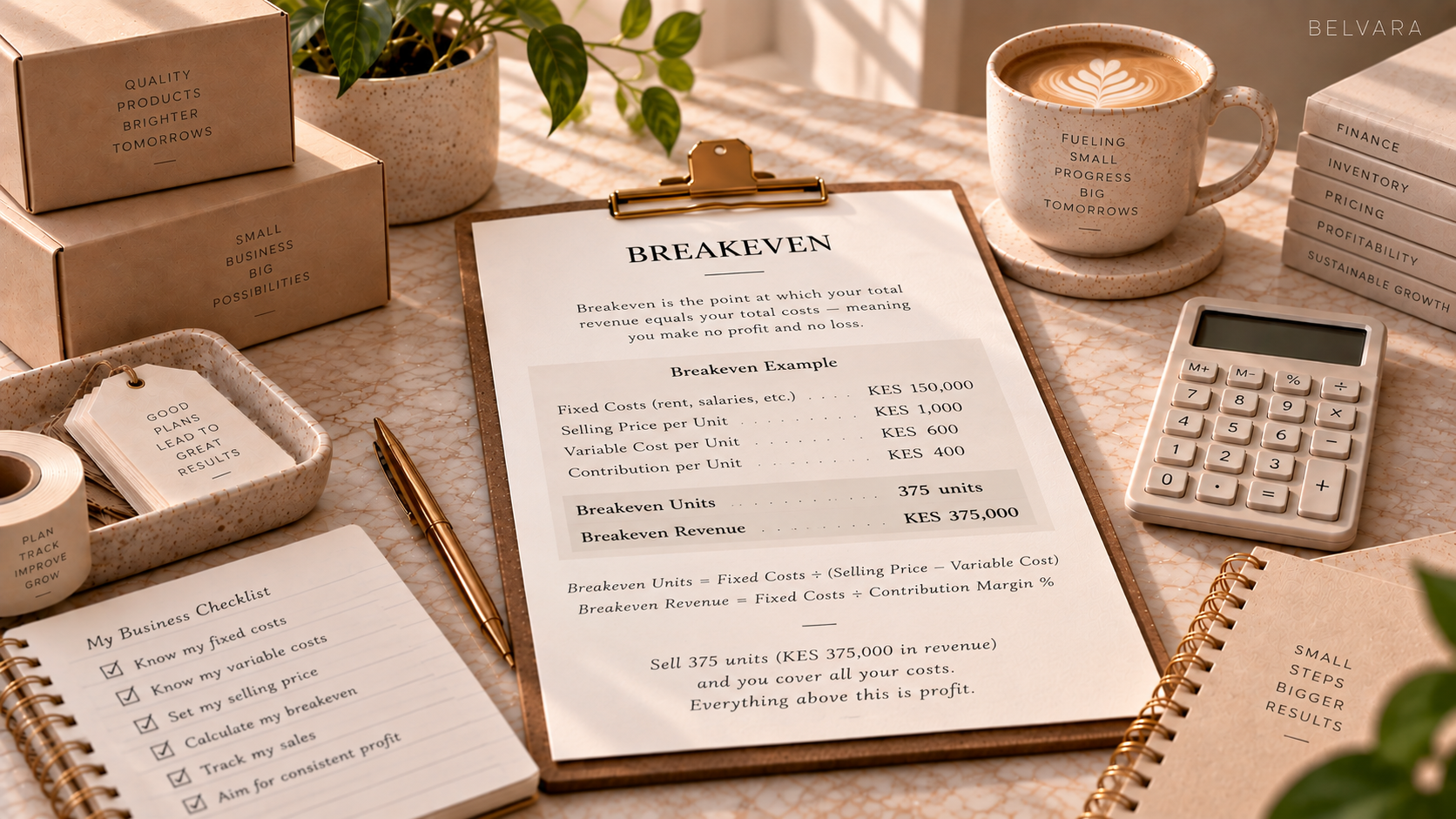
You can be selling every day and still not have made a single shilling of profit.
That is what break-even exposes.
A shop can be busy.
Orders can be coming in.
Revenue can be rising.
Customers can be paying.
And the business can still be below break-even.
Why?
Because before profit begins, the business first has to cover the cost of existing.
Rent.
Salaries.
Software.
Utilities.
Marketing.
Insurance.
And the variable costs attached to every sale.
Break-even is the point where the money coming in has covered the relevant costs.
No profit yet.
No loss either.
Just zero.
Belvara view: Revenue tells you how much you sold. Break-even tells you how much you had to sell before the business started making money.
What is the break-even point?
The break-even point is the level of sales where total revenue equals total costs.
At break-even:
Profit = KES 0
The business has covered its costs, but it has not yet made a profit.
Below break-even, the business is making a loss.
Above break-even, the business begins to make profit, assuming the cost and price assumptions still hold.
A simple way to think about it is:
Break-even is the line between covering costs and earning profit.
What is the break-even formula?
For a single product, the common formula is:
Break-even Units = Fixed Costs ÷ Contribution Margin per Unit
Where:
Contribution Margin per Unit = Selling Price per Unit − Variable Cost per Unit
Example
Suppose a business sells a product for:
KES 2,000
Variable cost per unit:
KES 1,200
Contribution margin per unit:
KES 800
Monthly fixed costs:
KES 240,000
Break-even units:
KES 240,000 ÷ KES 800 = 300 units
The business needs to sell:
300 units
before it covers the fixed costs for that period.
At 300 units, profit is zero.
The 301st unit begins contributing to profit, assuming the same price and cost structure.
Until the fixed costs are covered, contribution margin is not profit. It is paying back the cost of opening the doors.
What is contribution margin?
Contribution margin is the amount left from a sale after variable costs are deducted.
Formula:
Contribution Margin = Revenue − Variable Costs
For one unit:
Contribution Margin per Unit = Selling Price − Variable Cost per Unit
Example:
- Selling price: KES 1,500
- Variable cost: KES 900
Contribution margin:
KES 600
That KES 600 contributes toward:
- fixed costs
- then profit, after fixed costs are fully covered
This is why contribution margin is central to break-even analysis.
Fixed costs vs variable costs
You cannot calculate a useful break-even point if you do not understand the difference between fixed and variable costs.
Fixed costs
Fixed costs do not usually change directly with each extra unit sold within the relevant range.
Examples can include:
- rent
- fixed salaries
- software subscriptions
- insurance
- licences
- some administrative costs
Variable costs
Variable costs change with sales or activity.
Examples can include:
- product cost
- packaging
- sales commissions
- transaction fees
- delivery cost paid per order
- materials used per job
The exact classification depends on the business.
A break-even calculation built on badly classified costs can look precise and still be wrong.
Break-even units vs break-even revenue
Break-even can be expressed as:
- units
- revenue
Break-even units
Useful when the business sells a product with a clear unit price and unit variable cost.
Formula:
Break-even Units = Fixed Costs ÷ Contribution Margin per Unit
Break-even revenue
Useful when the business wants to know how much revenue it needs.
Formula:
Break-even Revenue = Fixed Costs ÷ Contribution Margin Ratio
Where:
Contribution Margin Ratio = Contribution Margin ÷ Revenue
How to calculate break-even revenue
Suppose:
- Monthly fixed costs: KES 300,000
- Contribution margin ratio: 40%
Break-even revenue:
KES 300,000 ÷ 0.40 = KES 750,000
The business needs:
KES 750,000 in revenue
to break even for the period.
Below KES 750,000, it is operating at a loss.
Above KES 750,000, it begins generating profit, assuming the same margin and fixed costs.
A sales target without a break-even number can be motivational and still be financially useless.
Break-even vs profit
Break-even is not profit.
At break-even:
Profit = KES 0
Suppose a business needs KES 750,000 revenue to break even.
If it earns exactly:
KES 750,000
it has covered the relevant costs.
It has not made profit yet.
If it earns:
KES 1,000,000
and the cost assumptions remain the same, the revenue above break-even begins to create profit.
Reaching break-even means the business has stopped losing money. It does not mean the business has won.
Break-even vs revenue target
A revenue target says:
“We want to sell KES 1 million.”
A break-even target says:
“We need at least KES 720,000 before this business covers its costs.”
Those are different conversations.
A business can hit a revenue target and still miss its profit target.
That is why good targets should connect:
- revenue
- margin
- break-even
- profit
Belvara helps you keep those numbers in the same business picture instead of treating sales targets as if they automatically mean profit.
Break-even vs cash flow
Break-even measures profitability using cost and revenue assumptions.
It does not tell you when cash arrives.
A business can be above break-even and still struggle for cash if:
- customers pay late
- too much cash is tied up in stock
- supplier payments fall due early
- loan repayments are heavy
- tax payments create timing pressure
Likewise, a business can have cash from a loan or owner injection while still operating below break-even.
Belvara view: Break-even tells you whether the model is covering its costs. Cash flow tells you whether the money arrived in time to keep the model alive.
Break-even vs gross profit
Gross profit is:
Revenue − COGS
Break-even goes further.
It asks whether the contribution from sales is enough to cover fixed costs.
Suppose:
- Revenue: KES 1,000,000
- COGS: KES 600,000
- Gross profit: KES 400,000
- Fixed and other operating costs: KES 500,000
The business has gross profit.
But it may still be below break-even at the wider operating level.
Gross profit can be positive while the business as a whole is still losing money.
Break-even for a retail business
Suppose a homeware retailer has monthly fixed costs of:
- Rent: KES 80,000
- Salaries: KES 120,000
- Software and admin: KES 20,000
- Marketing: KES 30,000
Total fixed costs:
KES 250,000
Average selling price per item:
KES 2,000
Average variable cost per item:
KES 1,250
Contribution margin per item:
KES 750
Break-even units:
KES 250,000 ÷ KES 750 = 333.3
The business cannot sell a third of a unit, so it needs about:
334 units
to cover the fixed costs.
If it sells 250 units, it is below break-even.
If it sells 500 units, the units above break-even help generate profit.
Break-even for a wholesale business
Suppose a wholesaler has:
- Fixed costs: KES 400,000
- Selling price per carton: KES 10,000
- Variable cost per carton: KES 8,000
Contribution margin:
KES 2,000 per carton
Break-even:
KES 400,000 ÷ KES 2,000 = 200 cartons
The wholesaler must sell:
200 cartons
before it covers fixed costs.
A lower contribution margin means the business needs more volume to break even.
Thin margins are not automatically bad, but they demand volume. Break-even tells you how much volume.
Break-even for a service business
Service businesses may not sell physical units, but break-even still applies.
Suppose a cleaning company has monthly fixed costs of:
KES 300,000
Average job price:
KES 20,000
Variable cost per job:
KES 8,000
Contribution margin per job:
KES 12,000
Break-even jobs:
KES 300,000 ÷ KES 12,000 = 25 jobs
The business needs:
25 jobs per month
to break even.
Job 26 begins contributing to profit.
Break-even for an agency
Suppose an agency has:
- Monthly fixed costs: KES 600,000
- Average project revenue: KES 150,000
- Variable project cost: KES 50,000
Contribution margin per project:
KES 100,000
Break-even:
KES 600,000 ÷ KES 100,000 = 6 projects
The agency needs six projects in the period to cover fixed costs.
But there is another question:
Can the team actually deliver six projects well?
Break-even should be compared with capacity.
A break-even target that requires more work than the team can deliver is not a target. It is a warning.
Break-even for restaurants
Suppose a restaurant has monthly fixed costs of:
KES 600,000
Average customer bill:
KES 1,500
Average variable cost per customer:
KES 600
Contribution margin per customer:
KES 900
Break-even customers:
KES 600,000 ÷ KES 900 = 666.7
The restaurant needs roughly:
667 customer visits
to break even for the month.
If it opens 30 days:
667 ÷ 30 ≈ 23 customers per day
Now the break-even number becomes operational.
The owner can ask:
Can this location reliably serve at least 23 paying customers a day at this average spend and cost?
Break-even for SaaS and subscription businesses
Suppose a software business has:
- Monthly fixed costs: KES 1,000,000
- Subscription price: KES 5,000 per customer
- Variable cost to serve each customer: KES 1,000
Contribution margin per customer:
KES 4,000
Break-even customers:
KES 1,000,000 ÷ KES 4,000 = 250 customers
The business needs about:
250 active paying customers
to cover the fixed cost base.
If customers cancel frequently, the business must keep replacing them just to stay near break-even.
That is why break-even should not be read without retention.
Break-even for a new branch
A new branch should not be judged only by expected revenue.
Suppose the branch adds:
- Rent: KES 100,000
- Staff: KES 180,000
- Utilities and admin: KES 40,000
- Other fixed costs: KES 30,000
New fixed cost:
KES 350,000
If the branch’s average contribution margin ratio is 35%:
Break-even revenue:
KES 350,000 ÷ 0.35 = KES 1,000,000
The branch needs about:
KES 1 million monthly revenue
to cover those costs.
That gives the opening decision a harder question:
Is there enough realistic demand in that location to support KES 1 million a month at the expected margin?
Belvara view: “The branch can sell” is not enough. The branch needs to sell enough to pay for itself.
Break-even for a sales channel
Different channels can have different break-even points.
A marketplace channel may add:
- commission
- promotions
- settlement fees
An online channel may add:
- advertising
- payment fees
- delivery subsidies
A physical shop may add:
- rent
- staff
- utilities
Suppose a new channel adds KES 150,000 in monthly fixed or committed costs.
If contribution margin from that channel is 30%:
Break-even channel revenue:
KES 150,000 ÷ 0.30 = KES 500,000
The channel must generate about KES 500,000 before it covers those extra costs.
How price changes move break-even
Price has a direct effect on contribution margin.
Suppose:
- Fixed costs: KES 300,000
- Variable cost per unit: KES 1,000
Selling price: KES 1,500
Contribution margin:
KES 500
Break-even:
600 units
Selling price: KES 1,800
Contribution margin:
KES 800
Break-even:
375 units
A higher price lowers the number of units needed to break even, if demand still holds.
That final condition matters.
A higher price is not useful if customers stop buying.
Discounts push break-even further away
Discounts reduce contribution margin if variable cost stays the same.
Suppose:
- Fixed costs: KES 300,000
- Normal selling price: KES 2,000
- Variable cost: KES 1,200
Normal contribution margin:
KES 800
Normal break-even:
375 units
Now give a 20% discount.
New price:
KES 1,600
New contribution margin:
KES 400
New break-even:
750 units
The discount doubled the number of units needed to break even.
A 20% discount can force you to sell twice as much just to reach zero.
That is why discount campaigns should be tested against break-even, not only against expected sales volume.
Supplier cost increases also move break-even
Suppose:
- Fixed costs: KES 300,000
- Selling price: KES 2,000
- Old variable cost: KES 1,200
Old contribution margin:
KES 800
Old break-even:
375 units
Supplier cost rises and variable cost becomes:
KES 1,500
New contribution margin:
KES 500
New break-even:
600 units
The selling price did not move.
But the business now needs 225 more sales to cover the same fixed costs.
Your supplier can move your break-even point without changing your rent, staff or selling price.
Higher fixed costs push break-even up
Suppose your current fixed costs are:
KES 250,000
Contribution margin per unit:
KES 1,000
Break-even:
250 units
Then you hire more staff and move to a larger shop.
Fixed costs rise to:
KES 400,000
New break-even:
400 units
The business now needs 150 extra unit sales before profit begins.
The new costs may be worth it.
But the business should know the sales burden they create.
Every new fixed cost quietly raises the amount of business you must do before you earn anything.
What is the contribution margin ratio?
The contribution margin ratio shows contribution margin as a percentage of revenue.
Formula:
Contribution Margin Ratio = Contribution Margin ÷ Revenue × 100
Suppose:
- Revenue: KES 1,000,000
- Variable costs: KES 600,000
Contribution margin:
KES 400,000
Contribution margin ratio:
40%
That means KES 40 from every KES 100 of revenue is available to cover fixed costs and then profit.
What is margin of safety?
Margin of safety shows how far actual or expected sales are above break-even.
Formula:
Margin of Safety = Actual Sales − Break-even Sales
It can also be shown as a percentage.
Suppose:
- Actual revenue: KES 1,000,000
- Break-even revenue: KES 750,000
Margin of safety:
KES 250,000
The business is KES 250,000 above break-even.
Percentage:
KES 250,000 ÷ KES 1,000,000 × 100 = 25%
A larger margin of safety gives the business more room before it falls into loss.
Break-even tells you where danger begins. Margin of safety tells you how close you are to it.
Why a low break-even point can be powerful
A lower break-even point can make a business more resilient.
It means the business needs less sales activity before covering fixed costs.
That can happen when the business has:
- lower fixed costs
- stronger contribution margin
- better pricing
- lower variable costs
- a better product mix
A lower break-even point can give the business more room during:
- slow months
- seasonal dips
- supplier shocks
- economic pressure
But lower fixed costs are not always automatically better.
Cutting the wrong costs can damage the business.
Why a high break-even point is risky
A high break-even point means the business needs a lot of activity before profit begins.
That can be dangerous when:
- demand is uncertain
- sales are seasonal
- margins are thin
- fixed costs are heavy
- the business is new
- cash reserves are small
A business with high fixed costs can look impressive when sales are strong.
It can become fragile when sales fall.
The higher your break-even point, the more revenue the business must earn just to stand still.
Break-even and product mix
Break-even gets more complicated when a business sells several products with different contribution margins.
Suppose:
- Product A has a 50% contribution margin ratio
- Product B has a 20% contribution margin ratio
If the business suddenly sells more Product B and less Product A, the average contribution margin can fall.
That pushes break-even revenue higher.
Revenue may look healthy.
The mix underneath it became weaker.
A shift toward low-margin products can move break-even further away without reducing total sales.
Break-even for a multi-product business
A multi-product business can use a weighted average contribution margin based on the expected sales mix.
Example:
Suppose expected sales are:
- 60% Product A
- 40% Product B
Product A contribution margin ratio:
50%
Product B contribution margin ratio:
25%
Weighted contribution margin ratio:
(60% × 50%) + (40% × 25%)
= 30% + 10%
= 40%
If fixed costs are:
KES 400,000
Break-even revenue:
KES 400,000 ÷ 0.40 = KES 1,000,000
If the sales mix changes, the break-even calculation should be reviewed.
Break-even and stock turnover
Break-even analysis often assumes sales can happen at the expected volume.
Inventory can make that assumption fail.
A product may have a strong contribution margin but:
- sell slowly
- stay out of stock
- become obsolete
- require too much cash to replenish
A break-even target of 500 units is not useful if the business normally sells only 150.
A break-even number is not a prediction. It is a test of what the business must achieve.
Break-even and capacity
Service businesses, restaurants, salons and agencies should compare break-even with capacity.
Suppose a salon needs:
600 appointments per month
to break even.
But it has enough chairs and staff for only:
450 appointments
The problem is not marketing.
The model cannot reach break-even at current capacity and economics.
The business may need to change:
- price
- cost
- staffing
- capacity
- service mix
Break-even can reveal a structural problem before the bank account does.
Break-even and seasonality
Many businesses do not sell evenly every month.
A business may be:
- highly profitable in December
- below break-even in February
That does not automatically mean February is a failure.
The owner should understand:
- monthly break-even
- annual break-even
- seasonal cash needs
Seasonality matters when planning:
- inventory
- staffing
- promotions
- cash reserves
Break-even and growth
Growth usually raises one or more of these:
- fixed costs
- variable costs
- capacity
- revenue potential
The question is whether the growth lowers or raises the risk of the model.
Suppose a business adds KES 300,000 in monthly fixed costs to open a new location.
If that location adds only KES 200,000 in monthly contribution margin, the expansion weakens profit.
Belvara view: Growth should not be judged by how much cost it adds or how much revenue it promises. It should be judged by whether the economics clear the new break-even point.
Break-even and target profit
Break-even tells you the sales needed for zero profit.
You can extend the same idea to a target profit.
Formula:
Units for Target Profit = (Fixed Costs + Target Profit) ÷ Contribution Margin per Unit
Suppose:
- Fixed costs: KES 300,000
- Target profit: KES 200,000
- Contribution margin per unit: KES 1,000
Required units:
(KES 300,000 + KES 200,000) ÷ KES 1,000
= 500 units
Break-even was 300 units.
But the business needs 500 units to earn the KES 200,000 target profit.
Break-even tells you how to stop losing. Target-profit planning tells you how to start winning on purpose.
What can make a break-even calculation wrong?
Break-even is useful, but it depends on assumptions.
The answer can become misleading when:
- selling price changes
- supplier cost changes
- discounts increase
- fixed costs change
- sales mix changes
- variable costs are incomplete
- the business ignores capacity
- returns rise
- stock losses increase
Break-even is not a set-it-once number.
Review it when the business changes.

Common break-even mistakes
1. Using revenue instead of contribution margin
Revenue does not pay fixed costs dollar for dollar or shilling for shilling.
Variable costs come out first.
2. Treating gross profit and contribution margin as identical
They may differ depending on which variable costs sit outside COGS.
3. Forgetting fixed costs
A strong product margin does not mean the business has broken even.
4. Using old supplier costs
Higher variable cost pushes break-even up.
5. Ignoring discounts
Discounting can increase the number of sales needed to break even.
6. Ignoring sales mix
Different products create different contribution margins.
7. Ignoring capacity
The required sales level must be physically possible.
8. Treating break-even as a profit target
Break-even means zero profit.
9. Ignoring cash flow
A profitable model can still have cash-timing problems.
10. Calculating break-even once and never updating it
The business changes. The break-even point can change with it.
Belvara view: A break-even point built from last year’s costs can give this year’s business false confidence.
How to lower your break-even point
There are several ways to lower break-even.
Improve contribution margin
This can come from:
- better pricing
- lower variable cost
- better product mix
- fewer unnecessary discounts
Reduce unnecessary fixed costs
Review costs that do not create enough value.
Do not cut blindly.
Improve supplier terms and sourcing
Lower product or input cost can improve contribution margin.
Reduce waste and losses
Stock loss, spoilage and avoidable fulfilment costs weaken contribution.
Improve sales mix
More sales from stronger-contribution products can lower the revenue needed to cover fixed costs.
The best lever depends on the business.
How Belvara helps you understand break-even
Break-even becomes hard to trust when the numbers behind it are scattered.
Your sales are in one place.
Product cost is somewhere else.
Expenses are in a spreadsheet.
Discounts are remembered later.
Supplier prices changed but nobody updated the old calculation.
Belvara helps bring the business records behind break-even closer together.
Keep revenue and cost in the same picture
Break-even depends on both.
Belvara helps you keep sales, product costs and business expenses connected so the calculation is based on the business you are actually running.
See when supplier cost changes the target
If product cost rises, contribution margin falls.
That means the business may need more sales to break even.
Keeping supplier and inventory cost visible makes it easier to spot that pressure.
See the effect of discounts
A discount can move break-even much further away.
Belvara keeps discounts with the sales record, giving you better context when reviewing the price customers actually paid.
Compare products, branches and channels
Different parts of the business can carry different costs and margins.
Belvara helps you compare the records behind them so you can ask:
- Which products create stronger contribution?
- Which branch carries a higher cost base?
- Which channel adds expensive fees?
- Where is the business working hardest just to reach zero?
Keep break-even beside cash flow
Reaching break-even does not guarantee that cash is healthy.
Belvara helps you keep sales, expenses, receivables, payables, inventory and cash movement close enough to see the wider picture.
Belvara view: Break-even should not be a number you calculate once and forget. It should move when the business moves.
Use break-even before making expensive decisions
Break-even is especially useful before you:
- hire
- move to a bigger shop
- open a branch
- launch a new product
- add a delivery offer
- start a promotion
- reduce prices
- add a sales channel
- take on a large fixed commitment
Before asking:
“Can we afford this?”
ask:
“What will this do to our break-even point?”
A decision can sound small in isolation.
But if it adds KES 100,000 to monthly fixed costs, the business now has to earn enough extra contribution every month to carry it.
Every permanent cost creates a permanent sales requirement.
The takeaway
The break-even point is where total revenue equals total costs.
At break-even:
Profit = KES 0
For a single product:
Break-even Units = Fixed Costs ÷ Contribution Margin per Unit
For break-even revenue:
Break-even Revenue = Fixed Costs ÷ Contribution Margin Ratio
But the real value of break-even is not the formula.
It is the question it forces the business to answer:
How much must we sell before we stop losing money?
That number changes when:
- price changes
- supplier cost changes
- discounts change
- fixed costs rise
- product mix changes
- the business expands
A business that does not know its break-even point can celebrate sales that are still paying back the cost of existing.
Revenue tells you how much you sold.
Margin tells you how much each sale contributes.
Break-even tells you when those contributions finally become profit.
And that is why it belongs in every serious pricing, growth and cost decision.
Frequently Asked Questions About Break-Even
What is break-even in simple terms?
Break-even is the point where a business’s revenue is enough to cover its costs, leaving zero profit and zero loss.
What is the break-even formula?
For a single product:
Break-even Units = Fixed Costs ÷ Contribution Margin per Unit
What is contribution margin?
Contribution margin is revenue minus variable costs. It is the amount available to cover fixed costs and then profit.
What is contribution margin per unit?
Contribution Margin per Unit = Selling Price per Unit − Variable Cost per Unit
What is break-even revenue?
Break-even revenue is the amount of sales revenue needed to cover total fixed costs at a given contribution margin ratio.
What is the formula for break-even revenue?
Break-even Revenue = Fixed Costs ÷ Contribution Margin Ratio
Does break-even mean the business is profitable?
No. At break-even, profit is zero.
What happens after break-even?
Once fixed costs are covered, further contribution margin begins to create profit, assuming costs and prices stay as expected.
Is break-even the same as cash flow?
No. Break-even measures profitability. Cash flow measures when money actually moves into and out of the business.
Is break-even the same as gross profit?
No. A business can have gross profit and still be below break-even after fixed costs are considered.
How do discounts affect break-even?
Discounts can reduce contribution margin, which means the business may need more sales to break even.
How do supplier price increases affect break-even?
Higher variable cost reduces contribution margin and can push break-even higher.
How do fixed costs affect break-even?
Higher fixed costs increase the amount of contribution or sales needed to break even.
Can a business lower its break-even point?
Yes. It may lower break-even through stronger pricing, lower variable costs, lower unnecessary fixed costs or a stronger product mix.
What is margin of safety?
Margin of safety shows how far actual or expected sales are above break-even sales.
Can a service business calculate break-even?
Yes. A service business can use jobs, appointments, billable hours or revenue as the sales measure.
Can a multi-product business calculate break-even?
Yes. It can use a weighted average contribution margin based on the expected sales mix.
How often should I review break-even?
Review it whenever important prices, costs, fixed expenses, discounts or product mix change.
Why is break-even useful before opening a branch?
It shows how much extra sales or contribution the branch needs to cover the new fixed-cost base.
How does Belvara help with break-even?
Belvara helps you keep the records behind break-even closer together, including sales, product costs, discounts, inventory and business expenses. This gives you better context when costs or prices change and helps you understand when the sales level needed to cover the business has moved.
What should I learn after break-even?
The next useful concepts are contribution margin, margin of safety, fixed costs, variable costs, unit economics and cash-flow forecasting.
