
BELVARA BUSINESS EDUCATION
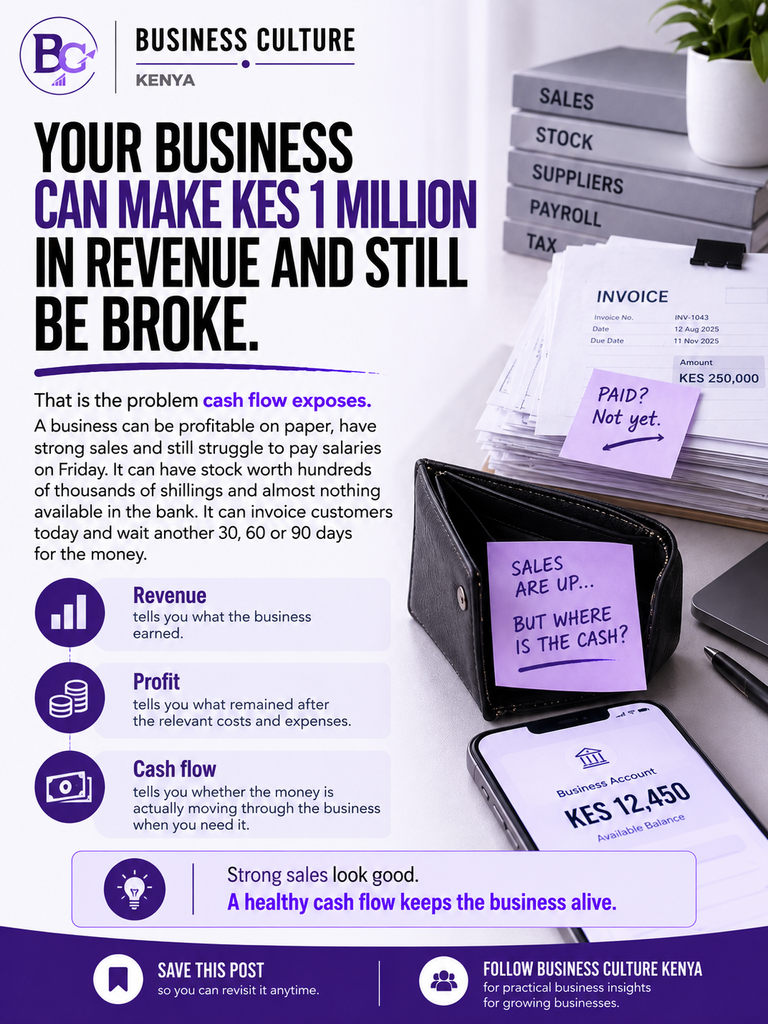
Your business can make KES 1 million in revenue and still be broke.
That is the problem cash flow exposes.
A business can be profitable on paper, have strong sales and still struggle to pay salaries on Friday. It can have stock worth hundreds of thousands of shillings and almost nothing available in the bank. It can invoice customers today and wait another 30, 60 or 90 days for the money.
Revenue tells you what the business earned.
Profit tells you what remained after the relevant costs and expenses.
Cash flow tells you whether the money is actually moving through the business when you need it.
That difference can decide whether a business grows, stalls or runs out of money.
What is cash flow?
Cash flow is the movement of cash and cash equivalents into and out of a business during a specific period.
Money coming into the business is a cash inflow.
Money leaving the business is a cash outflow.
Examples of cash inflows include:
- customer payments
- cash sales
- M-Pesa collections
- bank receipts
- loan proceeds
- owner or investor capital
- proceeds from selling a business asset
Examples of cash outflows include:
- supplier payments
- stock purchases
- salaries and wages
- rent
- utilities
- taxes
- loan repayments
- equipment purchases
- refunds
- operating expenses
The important part is that cash flow tracks actual cash movement.
A sale that has not been paid does not create the same cash movement as a sale that has already been collected.
Belvara view: A sale you have not collected cannot pay your supplier. Revenue without collection is not cash.
Belvara is built to connect the records behind that reality: what was sold, what has been paid, what customers still owe, what the business has spent and what money is due to leave next.
What is the cash flow formula?
The simplest cash flow formula is:
Net Cash Flow = Total Cash Inflows − Total Cash Outflows
Suppose a business receives KES 600,000 during the month and pays out KES 480,000.
Net Cash Flow = KES 600,000 − KES 480,000 = KES 120,000
The business had positive net cash flow of KES 120,000 during that period.
If it received KES 600,000 but paid out KES 680,000:
Net Cash Flow = KES 600,000 − KES 680,000 = −KES 80,000
The business had negative net cash flow of KES 80,000.
Another useful formula is:
Closing Cash Balance = Opening Cash Balance + Net Cash Flow
If the business started the month with KES 100,000 and generated KES 120,000 of positive net cash flow:
Closing Cash Balance = KES 220,000
This is a simplified view. Formal cash flow statements classify cash movements into operating, investing and financing activities.
The three main types of cash flow
Under IAS 7, cash flows are classified into three broad categories:
- Operating cash flow
- Investing cash flow
- Financing cash flow
These categories help explain why cash changed, not just how much changed.
1. Operating cash flow
Operating cash flow is cash generated and used by the normal revenue-producing activities of the business.
Typical operating inflows include:
- cash received from customers
- payments received for services
- commissions collected
- recurring subscription collections
- other operating receipts
Typical operating outflows can include:
- payments to suppliers
- wages and salaries
- rent
- utilities
- operating expenses
- applicable tax payments
For most small and growing businesses, operating cash flow is the category that deserves the most attention.
Why?
Because it tells you whether the core business is producing enough cash to keep operating.
If normal operations cannot produce cash, something else has to keep feeding the business. Eventually that “something else” runs out.
A company can temporarily survive on owner injections, loans or investors.
A sustainable business eventually needs its operations to support themselves.
2. Investing cash flow
Investing cash flow generally relates to buying and selling long-term assets and investments that are not treated as cash equivalents.
Examples may include:
- buying machinery
- purchasing equipment
- buying vehicles
- purchasing certain long-term investments
- selling equipment
- selling long-term assets
Suppose a business buys equipment for KES 300,000.
That creates a KES 300,000 investing cash outflow.
Negative investing cash flow is not automatically bad.
A growing company may deliberately spend cash on equipment, technology, warehouses or other productive assets.
Negative cash flow is not always a warning. Sometimes it is the price of building capacity. The question is what the cash bought you.
3. Financing cash flow
Financing cash flow relates to changes in the business’s borrowings and contributed capital.
Examples may include:
- receiving a business loan
- repaying loan principal
- receiving capital from owners or investors
- certain distributions to owners or shareholders
If a business receives a KES 1,000,000 loan, cash increases.
But the business did not make KES 1,000,000 in profit.
It took on financing.
A loan can make your cash balance look strong overnight. It does not make the business profitable.
This is one reason bank balances need context.
Cash flow vs revenue
Revenue and cash flow answer different questions.
Revenue asks: What did the business earn?
Cash flow asks: What cash actually moved?
Suppose a wholesaler sells KES 500,000 worth of goods on 30-day credit.
The sale may count toward revenue when it is earned under the applicable accounting rules.
But if the customer has not paid yet, the business has not received the KES 500,000 cash.
Now imagine suppliers require KES 300,000 this week.
The business can have strong revenue and still face a cash shortage.
An invoice can make your revenue report look better while doing absolutely nothing for today’s bank balance.
That distinction matters for:
- wholesale businesses
- agencies
- consultants
- contractors
- businesses offering credit
- instalment arrangements
- subscriptions
- preorders
- long projects
- businesses with delayed settlements
Cash flow vs profit
Profit and cash flow are not the same thing.
Profit measures whether the business earned more than its relevant costs and expenses. Cash flow measures when cash actually enters and leaves.
A profitable business can have negative cash flow.
An unprofitable business can temporarily have positive cash flow.
Example: profitable but cash-poor
A business records:
- Revenue: KES 800,000
- Relevant costs and expenses: KES 600,000
- Profit: KES 200,000
But KES 350,000 of customer invoices remain unpaid.
The business may have KES 200,000 accounting profit and still struggle to pay this month’s obligations.
Example: unprofitable but cash-rich
A business makes a KES 100,000 operating loss.
Then it receives a KES 1,000,000 loan.
Its cash position improves dramatically.
Its underlying operating performance did not.
Belvara view: Profit can look healthy while cash is dying. Cash can look healthy while the business is losing money. You need both truths at the same time.
Cash flow vs cash balance
Cash flow is movement over a period.
Cash balance is the amount of cash available at a point in time.
If you start Monday with KES 200,000, receive KES 100,000 and pay KES 150,000:
Net cash flow = −KES 50,000
Closing cash balance = KES 150,000
The cash balance tells you what is there.
Cash flow tells you what happened to get there.
A business owner who only checks the balance can miss the pattern.
The balance may be falling every week even though it still looks comfortable today.
Cash flow vs money moving between your own accounts
This is a major source of bad reporting.
Suppose you transfer KES 200,000 from your business M-Pesa till to your business bank account.
The bank shows KES 200,000 coming in.
But the business has not earned another KES 200,000.
The money simply moved from one business cash account to another.
Moving KES 200,000 from M-Pesa to your bank did not create KES 200,000 of new cash. Count it twice and your reports are fiction.
For a cash flow statement, movements between items that are both part of the business’s cash and cash equivalents are generally cash-management movements rather than new operating, investing or financing cash flows.
Belvara’s financial records need to distinguish real inflows and outflows from internal transfers so owners do not inflate activity by moving their own money around.
Positive cash flow vs negative cash flow
What is positive cash flow?
Positive cash flow means cash inflows exceeded cash outflows during the period.
Example:
- Cash received: KES 700,000
- Cash paid: KES 550,000
Net cash flow = +KES 150,000
Positive cash flow can strengthen liquidity.
But it is not automatically proof of a healthy business.
The positive cash may have come from a loan or owner injection rather than customers.
What is negative cash flow?
Negative cash flow means cash outflows exceeded cash inflows during the period.
Example:
- Cash received: KES 500,000
- Cash paid: KES 650,000
Net cash flow = −KES 150,000
Negative cash flow can be a warning if normal operations repeatedly consume more cash than they generate.
But context matters.
A business may have negative net cash flow because it bought equipment, opened a branch or deliberately invested in growth.
“Positive” and “negative” describe direction. They do not tell you whether the decision was good.
What is a cash flow statement?
A cash flow statement is a financial statement that explains how cash and cash equivalents changed during a period.
It typically groups cash movements into:
- operating activities
- investing activities
- financing activities
A simplified cash flow statement might look like this:
| Cash flow activity | Amount |
| Cash received from customers | KES 800,000 |
| Cash paid to suppliers | (KES 350,000) |
| Salaries and operating payments | (KES 250,000) |
| Net operating cash flow | KES 200,000 |
| Equipment purchase | (KES 150,000) |
| Net investing cash flow | (KES 150,000) |
| Loan received | KES 100,000 |
| Loan principal repaid | (KES 50,000) |
| Net financing cash flow | KES 50,000 |
| Net increase in cash | KES 100,000 |
If opening cash was KES 200,000:
Closing cash = KES 300,000
A formal statement may contain additional classifications and disclosures depending on the accounting framework and business.
Direct method vs indirect method
Operating cash flow can be presented using a direct method or indirect method under IAS 7.
Direct method
The direct method shows major categories of actual cash receipts and cash payments.
For example:
- cash collected from customers
- cash paid to suppliers
- cash paid to employees
- cash paid for operating expenses
For a business owner, this can feel intuitive because it follows actual cash movement.
Indirect method
The indirect method begins with profit or loss and adjusts for items such as:
- non-cash transactions
- changes in receivables
- changes in payables
- changes in inventory
- other relevant adjustments
The purpose is to reconcile accounting profit with operating cash flow.
If your profit says KES 300,000 but cash barely moved, the reconciliation is not an accounting nuisance. It is the explanation you need.
What is a cash flow forecast?
A cash flow forecast estimates how much cash a business expects to receive and pay during a future period.
Unlike a historical cash flow statement, which explains what already happened, a forecast helps the business prepare for what may happen next.
A useful forecast can include:
Expected inflows
- cash sales
- expected customer payments
- recurring subscriptions
- scheduled instalments
- deposits
- other known receipts
Expected outflows
- supplier payments
- inventory orders
- payroll
- rent
- loan repayments
- taxes
- software
- utilities
- planned equipment
- other commitments
The purpose is not to predict the future perfectly.
It is to see pressure before the business reaches it.
Belvara view: Finding out you cannot make payroll on payroll day is not a cash-flow problem. It is a visibility failure that started weeks earlier.
A simple cash flow forecast example
Suppose a business starts October with KES 120,000.
Expected cash inflows:
- Cash and M-Pesa sales: KES 400,000
- Customer balances expected: KES 180,000
Total expected inflows = KES 580,000
Expected outflows:
- Supplier payments: KES 250,000
- Payroll: KES 160,000
- Rent: KES 50,000
- Marketing: KES 40,000
- Utilities and software: KES 25,000
- Tax payment: KES 45,000
- Other expenses: KES 30,000
Total expected outflows = KES 600,000
Expected net cash flow:
KES 580,000 − KES 600,000 = −KES 20,000
Expected closing cash:
KES 120,000 − KES 20,000 = KES 100,000
The business is not out of cash.
But the forecast exposes a month in which cash is expected to shrink.
The owner can now investigate before the money disappears.
Cash flow for a product-based business
Product businesses have a specific cash-flow problem:
Cash often leaves before the product is sold.
Suppose a retailer imports KES 500,000 of stock.
The KES 500,000 may leave the bank today.
But the products might sell over three months.
This creates a timing gap between:
- buying inventory
- receiving stock
- selling stock
- collecting customer payments
The business can be profitable overall while cash is trapped in unsold inventory.
Stock on a shelf cannot pay rent. Until it sells and the money is collected, your cash is wearing a product costume.
Belvara connects inventory activity with sales and financial records because inventory decisions are cash-flow decisions too.
A business owner should be able to see:
- what stock was purchased
- what has sold
- what remains unsold
- what stock is moving slowly
- what suppliers are owed
- what cash has actually been collected
Cash flow for service-based businesses
Service businesses may not carry large amounts of stock, but cash timing still matters.
Common pressure points include:
- staff paid before clients pay
- deposits that do not cover delivery costs
- 30-day or 60-day client terms
- project expenses paid upfront
- retainers collected at different times
- delayed milestone payments
Consider an agency that completes KES 600,000 of work this month.
Clients have only paid KES 250,000 so far.
Meanwhile, the agency must pay:
- salaries: KES 220,000
- freelancers: KES 100,000
- software: KES 40,000
- rent and operating expenses: KES 80,000
Cash outflows:
KES 440,000
Cash collected:
KES 250,000
Even if the work is profitable, the timing creates a cash deficit.
A profitable client who pays too late can still become a cash-flow problem.
Cash flow for subscription businesses
Subscription businesses benefit from recurring collections, but they are not immune to cash-flow problems.
Cash flow can be affected by:
- monthly vs annual billing
- churn
- failed payments
- refunds
- customer acquisition spending
- infrastructure costs
- payroll
- annual contracts paid upfront
- expansion spending
Annual prepayments can create strong cash inflows before all of the related revenue is recognised.
That is another example of why cash and revenue are different.
Cash flow for marketplaces and commission businesses
Marketplaces need to distinguish:
- money belonging to the platform
- money collected on behalf of merchants or service providers
- commissions
- refunds
- settlements
- payment processing costs
A platform may process KES 10 million while earning only KES 500,000 in commission revenue.
If customer money temporarily passes through the platform, that does not automatically mean the full amount is the platform’s own operating cash.
Money passing through your hands is not automatically money your business owns.
This distinction becomes especially important for settlement, reconciliation and financial reporting.
Cash flow for rental businesses
Rental businesses may have regular inflows but irregular large outflows.
Examples include:
- repairs
- maintenance
- insurance
- loan repayments
- renovations
- vacancies
- asset purchases
A property may look highly cash-generative during quiet months and suddenly require a large repair.
That is why owners should not treat the current month’s collection as fully available for spending.
Cash flow for restaurants, salons and hospitality businesses
These businesses often receive customer cash quickly.
That can create the illusion that cash flow is easy.
But daily collections may need to fund:
- stock replenishment
- payroll
- utilities
- rent
- supplier balances
- wastage
- delivery commissions
- taxes
- equipment replacement
High-frequency cash receipts do not solve poor cash management.
Daily sales can hide a cash-flow problem because money keeps arriving just fast enough to stop you noticing how fast it is leaving.
How partial payments affect cash flow
Partial-payment arrangements change when cash arrives.
Suppose a customer buys an item worth KES 30,000 and pays:
- KES 10,000 today
- KES 10,000 next week
- KES 10,000 the following week
The business may have a KES 30,000 customer order, but it has only collected KES 10,000 today.
That matters if stock has already been reserved or other costs have already been incurred.
For Belvara’s Lipa PolePole workflow, the point is not to pretend the full order value is already cash. The owner needs visibility into:
- total amount agreed
- amount paid
- outstanding balance
- expected payment schedule
- payment completion status
Where dispatch is configured to happen only after full payment, the operational status and cash-collection status need to remain connected.
Belvara view: “Customer committed” and “cash collected” are two different events. Your reports should know the difference.
How supplier credit affects cash flow
Supplier credit can improve short-term cash flow because the business receives stock or services before paying for them.
Example:
A supplier delivers KES 300,000 of stock today but allows 30 days to pay.
The business has not yet used KES 300,000 of cash.
That can create breathing room.
But the liability still exists.
If the business spends the collected cash before the supplier becomes due, the problem has only been delayed.
Supplier credit does not remove a cash outflow. It moves it into the future. Forget that date and the future arrives with an invoice.
How customer credit affects cash flow
Offering customers credit can help sales, but it can also stretch cash.
Suppose a wholesaler sells KES 800,000 this month but only collects KES 450,000.
The remaining KES 350,000 is still outstanding.
The revenue may look strong.
The cash available to operate is much lower.
Useful questions include:
- How much is outstanding?
- Who owes it?
- When is it due?
- How old is the balance?
- How much is overdue?
- How much is realistically collectible?
Belvara’s job is to keep payment status connected to the underlying sale so “sold” does not quietly become “paid” in the owner’s head.
Why inventory can destroy cash flow
Inventory consumes cash before it generates cash.
That becomes dangerous when a business:
- over-orders
- buys slow-moving products
- purchases too early
- keeps too many variants
- carries dead stock
- ignores damaged stock
- buys based on excitement instead of demand
Suppose KES 700,000 is sitting in inventory and the business has only KES 80,000 available for operations.
The business may own valuable stock and still be cash-constrained.
Belvara view: Dead stock is not just an inventory problem. It is cash that stopped moving.
This is why stock turnover, purchasing and cash flow belong in the same management conversation.
Why growth can create a cash-flow crisis
Growth consumes cash.
A growing business may need to pay for:
- more inventory
- additional staff
- larger premises
- marketing
- packaging
- delivery capacity
- software
- equipment
before the additional customer cash arrives.
This creates a working-capital gap.
Example:
A retailer doubles monthly sales from KES 500,000 to KES 1,000,000.
To support the growth, it must purchase KES 550,000 of additional inventory before the selling period begins.
If customers take time to pay or stock sells more slowly than expected, the growing business can become more cash-stressed than the smaller one.
Growth does not always cure cash-flow problems. Sometimes growth is the thing that exposes them.
What is working capital?
Working capital is closely related to cash flow.
A common formula is:
Working Capital = Current Assets − Current Liabilities
Current assets can include items such as:
- cash
- receivables
- inventory
Current liabilities can include:
- supplier balances
- short-term obligations
- taxes due
- other current amounts payable
Working capital helps show whether a business has enough short-term resources to meet short-term obligations.
But not all current assets are equally liquid.
KES 500,000 of slow-moving inventory is not the same as KES 500,000 in the bank.
A business can look liquid on paper because it owns stock and receivables that cannot pay today’s bills.
What is free cash flow?
Free cash flow is a measure of cash remaining after the business generates operating cash and pays for capital expenditure needed for its assets and operations.
A simplified formula is:
Free Cash Flow = Operating Cash Flow − Capital Expenditure
Suppose:
- Operating cash flow = KES 500,000
- Equipment and other capital expenditure = KES 180,000
Free cash flow = KES 320,000
Free cash flow can help show how much cash the business produces after funding certain long-term asset needs.
The exact calculation used by analysts can vary, so businesses should define the measure consistently.
What causes cash-flow problems?
Cash-flow problems usually come from timing, weak economics or poor control.
Common causes include:
1. Customers paying late
Revenue exists, but cash does not arrive on time.
2. Too much money tied up in stock
Cash leaves before inventory converts back into cash.
3. Paying suppliers faster than customers pay you
The timing gap has to be financed somehow.
4. Low profit margins
There may simply not be enough cash generated by each sale.
5. Rapid growth
The business spends ahead of collections.
6. Large irregular expenses
Taxes, equipment, annual subscriptions, repairs and renewals can create sudden pressure.
7. Owner withdrawals
Cash leaves the business even when it is needed for operations.
8. Weak collection discipline
Outstanding balances remain unresolved.
9. Poor expense control
Small recurring outflows compound.
10. No forecast
The owner discovers shortages only after commitments are already due.
Most cash-flow crises do not begin on the day the account hits zero. That is simply the day the business finally notices.
Common cash-flow mistakes business owners make
1. Treating every sale as collected cash
A completed sale, invoice or order does not automatically mean payment has been received.
2. Treating loans as income
Loans increase cash but create financing obligations.
3. Treating owner capital as revenue
Money introduced by the owner is not customer revenue.
4. Double-counting internal transfers
Moving money between the business’s own cash accounts does not create new cash.
5. Ignoring future supplier payments
Receiving stock on credit delays payment. It does not erase it.
6. Ignoring stock as a use of cash
Inventory can absorb large amounts of cash even before it appears in cost of goods sold.
7. Spending tax money
Some money collected by the business may represent tax obligations rather than money available for normal spending.
8. Looking only at today’s bank balance
A strong balance today can sit next to large obligations due tomorrow.
9. Ignoring seasonality
A good month can fund a weak month, but only if the business plans for it.
10. Waiting until cash is low to react
By then, many useful options may already be gone.
How to improve cash flow
Improving cash flow does not always mean “make more sales.”
Sometimes the better lever is timing.
1. Collect customer money faster
Depending on the business model, this might include:
- deposits
- shorter payment terms
- payment reminders
- clearer due dates
- easier payment methods
- better receivables follow-up
2. Manage inventory more tightly
Buy based on evidence, not optimism.
Reduce slow-moving and dead stock.
3. Negotiate supplier terms
Where appropriate, aligning supplier payment timing more closely with customer collections can reduce pressure.
4. Forecast large payments
Payroll, tax, rent, annual subscriptions and loan payments should not arrive as surprises.
5. Protect margins
Poor margins weaken operating cash generation.
6. Control owner withdrawals
Personal withdrawals should not undermine required operating cash.
7. Build a cash buffer
A reserve can help absorb timing shocks and unexpected expenses.
8. Review cash flow frequently
For some businesses, monthly is too slow.
Fast-moving businesses may need weekly or even daily operational cash visibility.
Belvara view: You cannot control cash flow from a month-end report alone. By then, the decisions that created the problem have already happened.
What should a business owner watch every week?
Not every small business needs a complicated treasury dashboard.
A useful weekly cash view can answer:
- How much cash is available now?
- How much came in this week?
- Where did it come from?
- How much went out?
- Where did it go?
- Which customer balances are still outstanding?
- What payments are expected next?
- Which supplier bills are due?
- Is payroll approaching?
- Are taxes or statutory obligations approaching?
- Are large stock purchases planned?
- Are refunds or reversals expected?
- What will the expected balance be after known commitments?
That turns cash flow from an accounting history lesson into an operating tool.
How Belvara fits into cash-flow visibility
For a business owner, cash flow is created by events happening across the business:
- a sale is recorded
- a customer pays
- another customer still owes
- stock is purchased
- inventory sells
- a supplier becomes due
- payroll is processed
- an expense is recorded
- a refund is issued
- a partial payment is collected
- a branch spends money
- a tax obligation approaches
If those events live in disconnected notebooks, spreadsheets, M-Pesa messages and staff WhatsApps, the owner is forced to reconstruct the cash position manually.
Belvara is built to connect those operational records so you can understand not only what happened, but what it means financially.
Belvara view: Cash-flow problems thrive in the gap between “I think we’re okay” and “I know what is due.”
The goal is being able to answer:
What cash do we have?
What are we waiting to collect?
What is about to leave?
What decision is putting pressure on cash next?
The takeaway
Cash flow is the movement of cash and cash equivalents into and out of a business.
The basic formula is:
Net Cash Flow = Cash Inflows − Cash Outflows
But the number only becomes useful when you understand where the cash came from and where it went.
Operating cash flow shows cash generated or used by normal operations.
Investing cash flow shows cash used for or received from longer-term assets and investments.
Financing cash flow shows cash movements related to borrowings and contributed capital.
And none of them should be confused with revenue, profit or the current bank balance.
The business owner needs all of those numbers, because they tell different parts of the story.
Profit tells you whether the business works. Cash flow decides whether it can keep working long enough to prove it.
Belvara’s role is to help make that movement visible by connecting the operating records that create it: sales, payments, balances, stock, expenses and obligations.
Because “we made money this month” is not enough.
The harder question is:
Where is the cash now?
Frequently Asked Questions About Cash Flow
What is cash flow in simple terms?
Cash flow is the movement of cash and cash equivalents into and out of a business during a period. Cash received creates inflows, while cash paid creates outflows.
What is the basic cash flow formula?
The basic formula is:
Net Cash Flow = Total Cash Inflows − Total Cash Outflows
What are the three types of cash flow?
The three main categories are operating cash flow, investing cash flow and financing cash flow.
What is operating cash flow?
Operating cash flow is cash generated and used by the business’s normal revenue-producing activities, such as customer collections, supplier payments and other operating payments.
What is investing cash flow?
Investing cash flow generally relates to buying and selling long-term assets and investments that are not cash equivalents.
What is financing cash flow?
Financing cash flow relates to changes in contributed capital and borrowings, such as receiving a loan, repaying loan principal or receiving owner or investor capital.
Is cash flow the same as revenue?
No. Revenue measures what the business earns. Cash flow measures actual movement of cash. A business can earn revenue before the customer pays.
Is cash flow the same as profit?
No. Profit measures financial performance after relevant costs and expenses. Cash flow measures cash movement. A profitable business can still experience negative cash flow.
Can a profitable business run out of cash?
Yes. Cash may be tied up in unpaid customer balances, inventory or other working-capital items while immediate obligations still need to be paid.
Can a business have positive cash flow and still make a loss?
Yes. Cash can enter from loans, owner capital, investors or asset sales even when normal operations are making a loss.
Is a loan cash flow?
Receiving a loan creates a cash inflow, generally classified as financing cash flow. It is not business revenue or profit.
Is owner capital revenue?
No. Owner or investor capital can increase cash but is not customer revenue.
Does moving money from M-Pesa to the bank count as cash flow?
If both accounts belong to the same business and both are treated as cash or cash equivalents, moving money between them does not create new cash for the business. It is an internal cash-management movement.
Is buying inventory a cash outflow?
If the business pays cash for inventory, cash leaves the business when payment is made. The timing of when the inventory cost affects profit can be different from the timing of the cash payment.
How do credit sales affect cash flow?
Credit sales can generate revenue before cash is collected. Until the customer pays, the business may have a receivable rather than cash.
How do customer deposits affect cash flow?
A customer deposit creates a cash inflow when received, but receiving cash does not automatically mean all of it has already been earned as revenue.
What is positive cash flow?
Positive cash flow means cash inflows exceeded cash outflows during the period.
What is negative cash flow?
Negative cash flow means cash outflows exceeded cash inflows during the period. It may signal pressure, although negative investing cash flow can also reflect deliberate investment in growth or assets.
What is a cash flow statement?
A cash flow statement explains how cash and cash equivalents changed during a period by classifying cash flows into operating, investing and financing activities.
What is a cash flow forecast?
A cash flow forecast estimates future cash receipts, payments and balances so a business can identify potential shortages or excess cash before they occur.
What is free cash flow?
Free cash flow is commonly used to describe cash remaining after operating cash flow is reduced by capital expenditure. Exact definitions can vary depending on how the measure is being used.
What is working capital?
Working capital is commonly calculated as current assets minus current liabilities. It helps assess the short-term financial resources available to meet short-term obligations.
Why do businesses have cash-flow problems?
Common causes include late customer payments, too much inventory, weak margins, rapid growth, high expenses, supplier timing, owner withdrawals and lack of cash-flow forecasting.
How can a business improve cash flow?
A business can improve cash flow by collecting faster, managing inventory, protecting margins, planning large payments, negotiating appropriate supplier terms, controlling unnecessary spending and forecasting future cash needs.
What should I learn after cash flow?
The next useful concepts are working capital, accounts receivable, accounts payable, cash-flow forecasting, inventory turnover and the cash conversion cycle. Together, they explain how quickly business activity turns back into usable cash.
