

Revenue can make you look successful. Net profit is where the business runs out of places to hide.
A business can have:
- strong sales
- healthy gross profit
- a growing customer base
- busy staff
- full shelves
and still finish the month with almost nothing left.
That is what net profit exposes.
Revenue tells you how much business was generated.
Gross profit tells you what remained after direct cost.
Operating profit begins to show whether the core operation works after operating expenses.
Net profit shows what remains after the recognised income and expenses of the period have had their turn.
It is the closest widely used profit measure to the question most business owners actually care about:
After everything, did this business make money?
What is net profit?
Net profit is the amount of profit remaining after the relevant costs, operating expenses, financing costs, taxes and other recognised income or expenses for the period are taken into account.
In everyday business language, net profit is often called:
- net income
- net earnings
- the bottom line
- profit after tax
In IFRS financial statements, the final line may simply be presented as profit or profit for the period rather than using the label “net profit”.
A simplified formula is:
Net Profit = Total Income − Total Expenses
For a typical trading business, a more detailed management view might look like:
Revenue
− COGS
= Gross Profit
− Operating Expenses
= Operating Profit
± Other Income and Expenses
− Financing Costs
− Income Tax
= Net Profit
The exact presentation depends on the business and accounting framework.
Belvara view: Net profit is the number left after every department, supplier, lender, tax obligation and operating decision has taken its share.
What is the net profit formula?
The simplest formula is:
Net Profit = Total Income − Total Expenses
Suppose a business records:
- Revenue: KES 1,000,000
- COGS: KES 550,000
- Operating expenses: KES 300,000
- Financing and other applicable expenses: KES 40,000
- Income tax expense: KES 30,000
Net profit:
KES 1,000,000 − KES 550,000 − KES 300,000 − KES 40,000 − KES 30,000
Net Profit = KES 80,000
The business generated KES 1 million in revenue.
But after the recognised costs and expenses, only KES 80,000 remained as net profit.
KES 1 million in sales can sound like a big business. KES 80,000 in net profit tells you how much of that size actually survived.
Why net profit matters
Net profit helps show whether the whole business model produced an accounting profit after the period’s recognised costs and expenses.
It can help answer:
- Is the business actually profitable?
- Is growth creating more bottom-line value?
- Are operating costs consuming too much gross profit?
- Are financing costs too high?
- Are taxes or unusual expenses materially affecting results?
- Is one branch or channel dragging down the business?
- Is profit improving over time?
- Is the business becoming more efficient or less efficient?
Net profit is not the only number that matters.
But it is one of the hardest numbers to fake with top-line excitement.
Net profit vs revenue
Revenue measures the value generated by the business before most expenses.
Net profit is what remains after the recognised expenses are deducted.
Suppose two businesses each generate:
KES 2,000,000 revenue
Business A
Net profit:
KES 300,000
Business B
Net profit:
KES 50,000
Same revenue.
Very different result.
Net profit margins:
- Business A: 15%
- Business B: 2.5%
Two businesses can brag about the same revenue while one is six times better at turning that revenue into profit.
That is why revenue should never be used alone to judge business quality.
Net profit vs gross profit
Gross profit is calculated before most operating expenses.
Net profit comes later.
Suppose:
- Revenue: KES 1,000,000
- COGS: KES 600,000
Gross profit:
KES 400,000
Then the business has:
- Salaries: KES 160,000
- Rent: KES 60,000
- Marketing: KES 70,000
- Software and administration: KES 30,000
- Other recognised costs: KES 40,000
Net profit in this simplified example:
KES 40,000
The business created KES 400,000 of gross profit.
Only KES 40,000 survived to the bottom line.
Gross profit tells you whether the sale has room. Net profit tells you how much of that room the business managed not to consume.
Net profit vs operating profit
Operating profit focuses on profit generated from the operating activities of the business before certain financing, tax and other categories are considered.
Net profit reflects the broader final result.
Under IFRS 18, which is effective for annual reporting periods beginning on or after 1 January 2027, financial statements using IFRS will present defined subtotals including operating profit or loss and profit or loss before financing and income taxes, before arriving at total profit or loss.
For a simple business explanation:
Operating profit asks: Does the core operation make money?
Net profit asks: What remained after the broader recognised income and expenses?
A company can have strong operating profit but much weaker net profit because of:
- interest
- financing costs
- tax
- losses from other activities
- impairment
- other recognised expenses
Net profit vs EBITDA
EBITDA stands for:
Earnings Before Interest, Taxes, Depreciation and Amortisation
It is a performance measure often used to look at earnings before those items.
Net profit includes their effects where applicable.
Suppose a business reports:
- EBITDA: KES 500,000
- Depreciation and amortisation: KES 100,000
- Interest: KES 80,000
- Tax: KES 70,000
Simplified net profit:
KES 250,000
EBITDA can be useful for certain comparisons.
But it is not the same as money the business finally kept.
EBITDA can make a business look cleaner by temporarily ignoring bills that still exist. Net profit brings more of the mess back into the room.
That does not make EBITDA useless.
It means the two measures answer different questions.
Net profit vs cash flow
Net profit is not cash.
This distinction is critical.
A business can report net profit while experiencing negative cash flow.
It can also receive cash while making a net loss.
Profitable but cash-poor
Suppose a wholesaler reports:
KES 200,000 net profit
But customers still owe:
KES 500,000
Meanwhile suppliers are due:
KES 350,000
The profit exists in the accounting result.
The cash may still be unavailable.
Cash-rich but loss-making
Suppose a business reports:
KES 100,000 net loss
Then receives:
KES 1,000,000 loan
Cash increases dramatically.
The business did not suddenly become profitable.
Belvara view: Net profit tells you whether the business earned money. Cash flow tells you whether the money showed up when the business needed it. Never force one number to do both jobs.
Net profit vs cash in the bank
A bank balance is not net profit.
Cash in the bank may include:
- customer collections
- loans
- owner capital
- investor funding
- deposits
- tax amounts collected
- money reserved for suppliers
- transfers from other business accounts
Similarly, some net profit may be tied up in:
- receivables
- inventory
- prepayments
- other working-capital items
A big bank balance can belong to your supplier, lender, tax authority and future payroll before a single shilling belongs to the owner.
Net profit vs owner drawings
Owner drawings are not automatically the same as expenses.
Suppose a sole owner-managed business generates:
KES 300,000 net profit
The owner withdraws:
KES 200,000
The business did not necessarily make only KES 100,000 profit.
The withdrawal is a separate owner-equity or capital movement depending on the legal and accounting structure.
Likewise, an owner can withdraw money even when the business is making a loss.
That can weaken cash without changing the underlying profitability calculation in the way a normal operating expense would.
Net profit vs retained earnings
Net profit and retained earnings are connected but different.
Net profit measures profit for a period.
Retained earnings generally accumulate profits kept in the business over time, adjusted for distributions and other relevant equity movements.
A company might make:
KES 1,000,000 net profit
Then distribute:
KES 600,000
The remaining amount may contribute to retained earnings, subject to the company’s broader equity movements and accounting treatment.
Net profit is a period result.
Retained earnings are part of accumulated equity.
Net profit vs taxable profit
Net profit in the financial accounts is not always the same as taxable profit.
Tax rules can require adjustments to accounting profit.
For example, certain items may:
- be deductible for accounting but not tax
- receive different tax treatment
- qualify for tax allowances
- be recognised in different periods
The exact rules depend on:
- jurisdiction
- legal entity
- transaction
- tax regime
For Kenyan businesses, the tax treatment should follow current KRA requirements and applicable tax law.
Belvara view: “Profit in the accounts” and “profit the tax calculation starts from” are related. They are not always identical.
Net profit before tax vs net profit after tax
Businesses often distinguish between:
Profit before tax
The profit remaining before income tax expense.
Profit after tax
The profit remaining after income tax expense.
Example:
- Profit before tax: KES 300,000
- Income tax expense: KES 90,000
Profit after tax:
KES 210,000
In everyday business conversations, “net profit” often refers to profit after tax.
But reports should label the measure clearly.
What is net profit margin?
Net profit margin expresses net profit as a percentage of revenue.
Formula:
Net Profit Margin = Net Profit ÷ Revenue × 100
Suppose:
- Revenue: KES 1,000,000
- Net profit: KES 100,000
Net profit margin:
KES 100,000 ÷ KES 1,000,000 × 100 = 10%
That means:
For every KES 100 of revenue, the business kept KES 10 as net profit.
Net profit tells you what survived. Net profit margin tells you how much had to pass through the business to create it.
Net profit vs net profit margin
Suppose:
Business A
- Revenue: KES 5,000,000
- Net profit: KES 250,000
- Net margin: 5%
Business B
- Revenue: KES 2,000,000
- Net profit: KES 240,000
- Net margin: 12%
Business A earns slightly more net profit.
Business B converts revenue into net profit much more efficiently.
Neither metric automatically makes one business “better”.
But they tell different parts of the story.
Net profit for a product-based business
Consider a homeware retailer.
Revenue
KES 1,500,000
COGS
KES 850,000
Gross profit:
KES 650,000
Operating expenses
- Salaries: KES 180,000
- Rent: KES 80,000
- Marketing: KES 100,000
- Delivery support: KES 40,000
- Software and admin: KES 30,000
- Other operating expenses: KES 50,000
Total operating expenses:
KES 480,000
Operating profit:
KES 170,000
Then:
- Financing and other applicable expenses: KES 30,000
- Tax expense: KES 35,000
Net profit:
KES 105,000
Net profit margin:
7%
The business generated KES 1.5 million in revenue.
Only KES 105,000 survived as net profit.
Belvara view: The shelf can look busy, the sales dashboard can look exciting, and the bottom line can still be whispering for help.
Net profit for a service business
Suppose a cleaning company earns:
KES 1,000,000 revenue
Direct service costs:
KES 400,000
Gross profit:
KES 600,000
Operating expenses:
- Admin salaries: KES 180,000
- Office and utilities: KES 80,000
- Marketing: KES 70,000
- Software and administration: KES 30,000
Operating expenses:
KES 360,000
Operating profit:
KES 240,000
After financing, tax and other applicable items:
Net profit:
KES 170,000
The service business may not hold inventory.
But labour, subcontracting, overhead and non-billable time can still consume profit.
Net profit for agencies and consultancies
Agency revenue can look impressive because contracts are large.
That does not mean the contracts are profitable.
Suppose an agency bills:
KES 1,200,000
Direct project costs:
KES 400,000
Gross profit:
KES 800,000
Then:
- permanent staff: KES 350,000
- software: KES 70,000
- office and admin: KES 80,000
- marketing and sales: KES 100,000
- other expenses: KES 80,000
Operating expenses:
KES 680,000
Operating profit:
KES 120,000
After other applicable items:
Net profit may be much smaller.
A KES 1.2 million client can still be a bad client if the business has to burn KES 1.15 million to keep them happy.
Net profit for restaurants and hospitality
A restaurant can generate strong gross margins and still weak net margins because operating costs are heavy.
Common expenses include:
- staff
- rent
- utilities
- delivery commissions
- spoilage
- licences
- cleaning
- repairs
- equipment
- marketing
- administration
Suppose:
- Revenue: KES 2,000,000
- Gross profit: KES 1,200,000
- Operating and other recognised expenses: KES 1,100,000
Net profit:
KES 100,000
Net margin:
5%
The gross profit looked large.
The final room was thin.
Net profit for SaaS businesses
A SaaS business can have a high gross margin and still lose money.
Suppose:
- Revenue: KES 5,000,000
- Cost of revenue: KES 1,000,000
Gross profit:
KES 4,000,000
Gross margin:
80%
Then the company spends:
- product and engineering: KES 1,800,000
- sales and marketing: KES 1,400,000
- administration: KES 600,000
- other recognised expenses: KES 500,000
The business can still report a loss despite an 80% gross margin.
High gross margin gives a SaaS business room. It does not stop the company from spending all of it.
That distinction matters for Belvara itself as it grows.
Net profit for marketplaces
A marketplace should calculate profit from its own recognised revenue, not simply from GMV.
Suppose:
- GMV: KES 20,000,000
- Marketplace revenue: KES 1,600,000
- Direct cost of revenue: KES 400,000
- Operating and other expenses: KES 1,000,000
Net profit before additional applicable items:
KES 200,000
The platform processed KES 20 million.
That does not mean it made KES 20 million.
Transaction volume can make a platform look enormous. Net profit reminds you which part of that activity actually belonged to the business.
Net profit for manufacturers
Manufacturers face profitability pressure from:
- raw material costs
- direct labour
- factory overhead
- production efficiency
- maintenance
- administration
- financing
- tax
Suppose:
- Revenue: KES 10,000,000
- COGS: KES 7,000,000
- Gross profit: KES 3,000,000
- Operating expenses: KES 2,200,000
- Financing and other expenses: KES 300,000
- Tax: KES 150,000
Net profit:
KES 350,000
Net margin:
3.5%
A large manufacturing business can move huge amounts of money while keeping relatively little at the bottom line.
Can net profit be negative?
Yes.
Negative net profit is a net loss.
Example:
- Total income: KES 800,000
- Total recognised expenses: KES 950,000
Net loss:
KES 150,000
A business can report a net loss because:
- COGS is too high
- pricing is weak
- operating expenses are excessive
- financing costs are heavy
- sales fell
- one-off losses occurred
- tax expense increased
- the company is investing heavily
- costs were misclassified or corrected
A net loss does not automatically mean the company should close.
But repeated losses require an explanation and a credible plan.
Can net profit increase while net margin falls?
Yes.
Year 1
- Revenue: KES 5,000,000
- Net profit: KES 500,000
- Net margin: 10%
Year 2
- Revenue: KES 10,000,000
- Net profit: KES 700,000
- Net margin: 7%
Net profit increased by:
KES 200,000
But the business now keeps less profit from every shilling of revenue.
More net profit can still come with weaker economics if the business had to double in size to earn it.
This is why the absolute profit and margin should be analysed together.
Can net margin improve while net profit falls?
Yes.
Year 1
- Revenue: KES 10,000,000
- Net profit: KES 600,000
- Margin: 6%
Year 2
- Revenue: KES 6,000,000
- Net profit: KES 480,000
- Margin: 8%
Efficiency improved.
Total net profit fell.
Again, both numbers matter.
Why net profit can fall even when revenue rises
Revenue growth does not guarantee profit growth.
Net profit can fall because:
- COGS increased
- discounts increased
- payroll grew
- rent increased
- advertising rose faster than sales
- financing became more expensive
- tax expense changed
- stock write-offs increased
- refunds rose
- product mix deteriorated
- new branches added cost before enough revenue arrived
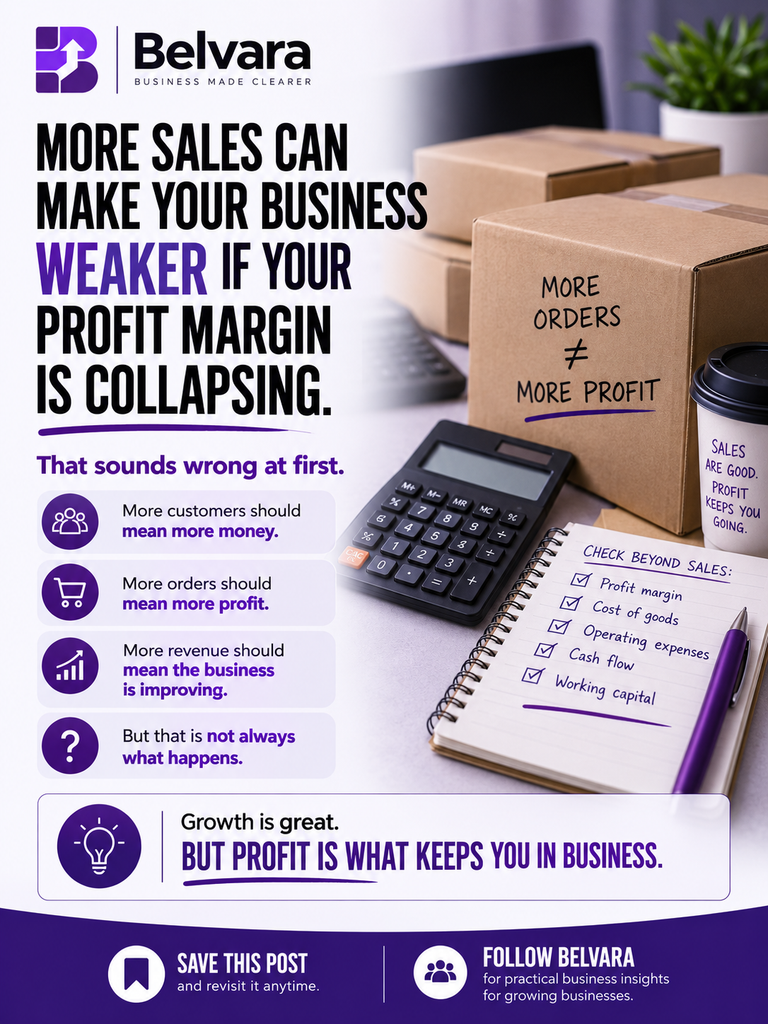
Belvara view: “Sales grew” is not a defence for shrinking net profit. Growth is supposed to create a stronger business, not just a busier one.
Why one-off income can make net profit look stronger
Net profit can sometimes be boosted by income that is not part of normal recurring operations.
Examples may include:
- disposal of an asset
- unusual gains
- reversals
- settlements
- other non-recurring income
Suppose a retailer normally makes:
KES 100,000 net profit
Then sells an old vehicle and records a gain that increases profit by:
KES 300,000
Reported profit for the period may look unusually strong.
But the store did not suddenly become four times more profitable in its core operations.
One lucky gain can improve the bottom line without improving the business underneath it.
This is why profit quality matters.
What is quality of earnings?
Quality of earnings is a management and analytical concept used to assess how much reported profit reflects sustainable, repeatable business performance.
Higher-quality earnings are generally more closely linked to recurring, well-supported operating activity.
Questions include:
- Did profit come from normal customers?
- Is it repeatable?
- Did receivables explode?
- Did inventory build up?
- Were costs deferred?
- Was there unusual income?
- Did the company cut essential spending temporarily?
- Did cash flow support the profit?
A net profit number without context can hide weak underlying economics.
Net profit and depreciation
Depreciation is a non-cash accounting expense that allocates the cost of certain long-term assets over their useful lives.
It reduces accounting profit even though the cash used to buy the asset may have left in an earlier period.
That is one reason net profit and cash flow differ.
Suppose:
- Operating result before depreciation: KES 300,000
- Depreciation expense: KES 80,000
Profit after depreciation is lower.
But there may be no KES 80,000 cash payment in that period.
Net profit includes some costs whose cash moved in another period. Cash flow keeps the timing honest.
Net profit and interest
Interest expense can reduce net profit.
Two otherwise similar businesses can therefore have different net profit because one uses more debt.
Business A
Operating profit:
KES 500,000
Interest:
KES 50,000
Business B
Operating profit:
KES 500,000
Interest:
KES 250,000
The businesses may have identical operating performance.
Their financing structures produce different bottom-line results.
This is why operating profit and net profit should both be understood.
Net profit and taxes
Income tax expense can reduce the final profit for the period.
Tax depends on:
- jurisdiction
- legal structure
- taxable income
- applicable deductions
- tax rules
- timing differences
- other factors
Businesses should not assume:
Accounting profit × headline tax rate = exact tax payable
Tax calculations can be more complex.
For Belvara, tax-related records and eTIMS support should connect to the financial picture without pretending the software replaces the business’s accountant or tax adviser.
Net profit and discounts
Discounting can damage net profit faster than expected.
Suppose a product:
- sells for KES 2,000
- costs KES 1,200
- generates KES 800 gross profit
Give a 20% discount.
New selling price:
KES 1,600
Gross profit:
KES 400
Before operating expenses, half the gross profit is already gone.
The rent did not fall.
Payroll did not fall.
Software did not fall.
The customer received a 20% discount. The bottom line may have lost far more than 20%.
Net profit and operating expenses
A business can have excellent gross profit but weak net profit because operating expenses consume the room.
Common operating expenses include:
- salaries
- rent
- marketing
- utilities
- software
- professional fees
- transport
- administration
- insurance
- repairs
The goal is not simply to minimise expenses.
Some expenses create growth.
The question is whether the spending creates enough value.
Cutting every expense can improve this month’s net profit and destroy next year’s business. Efficiency is not starvation.
Net profit by product
Accounting net profit is usually reported for the entity as a whole.
But management can estimate profitability by:
- product
- category
- customer
- service
- project
- branch
- channel
This requires sensible allocation of direct and shared costs.
The result should be treated carefully because overhead allocation involves judgement.
Still, product-level analysis can reveal:
- products that sell well but contribute little
- products that create strong gross profit but require heavy support
- categories absorbing disproportionate marketing or fulfilment cost
Belvara view: The product with the highest revenue can still be the product doing the least useful work for the bottom line.
Net profit by branch
Suppose:
Branch A
- Revenue: KES 1,000,000
- Gross profit: KES 400,000
- Allocated operating costs: KES 250,000
- Branch contribution before shared corporate costs: KES 150,000
Branch B
- Revenue: KES 1,400,000
- Gross profit: KES 350,000
- Allocated operating costs: KES 300,000
- Branch contribution: KES 50,000
Branch B has higher revenue.
Branch A is economically stronger on this management view.
The goal is not to fake precise branch “net profit” when shared costs make that impossible.
The goal is to understand what each location contributes.
Net profit by sales channel
A channel can look profitable before its hidden costs are considered.
An online channel may have:
- marketplace fees
- payment fees
- ads
- delivery subsidies
- returns
- packaging
A physical branch may have:
- rent
- staff
- utilities
- local stock
- security
Channel profitability should therefore go beyond revenue.
A sales channel is not successful because customers bought there. It is successful when the economics justify keeping the channel alive.
Net profit and growth
Growth should eventually strengthen net profit.
But during expansion, profit can temporarily fall because the business invests ahead of revenue.
Examples include:
- hiring
- branch launches
- software
- equipment
- marketing
- product development
- stock expansion
That can be deliberate.
The danger is when management keeps calling every loss “investment” without measuring whether the investment produces returns.
Belvara view: “We are investing in growth” is a strategy only when somebody can explain what return the spending is supposed to create. Otherwise it is an excuse with a budget.
What is a good net profit?
There is no universal good net profit amount.
KES 100,000 may be strong for a small side business.
It may be dangerously low for a company carrying:
- large debt
- expensive staff
- significant inventory
- multiple branches
- high fixed costs
The amount must be evaluated alongside:
- revenue
- net margin
- cash flow
- working capital
- capital invested
- risk
- growth stage
- industry
What is a good net profit margin?
There is no universal good net profit margin.
Margins vary significantly by:
- industry
- pricing
- capital intensity
- competition
- business model
- stage of growth
- financing structure
- tax environment
A lower-margin wholesaler can be healthy.
A higher-margin consultancy can be healthy.
The useful questions are:
- Is margin improving?
- Is it sustainable?
- Is it enough for the risk?
- How does it compare with relevant peers?
- Does cash flow support it?
Common net profit mistakes business owners make
1. Calling revenue profit
Sales are not profit.
2. Calling gross profit net profit
The rest of the business still needs to be paid.
3. Treating bank balance as profit
Cash has other sources and obligations.
4. Ignoring unpaid expenses
An expense can belong to the period even before cash leaves.
5. Ignoring tax
Profit before tax and after tax are different.
6. Ignoring financing costs
Debt can materially change the bottom line.
7. Treating owner drawings as ordinary operating expenses
The correct treatment depends on structure.
8. Ignoring depreciation and other non-cash expenses
Accounting profit is not cash profit.
9. Celebrating one-off gains as normal business performance
Repeatability matters.
10. Looking at net profit without margin
A larger business can make more profit but become less efficient.
11. Looking at margin without total profit
Efficiency can improve while total profit shrinks.
12. Allocating shared costs badly
Fake precision can make product or branch profitability misleading.
Belvara view: Net profit is only the final answer if you do not care how the business got there. Good management always asks the next question: why?
What should a business track alongside net profit?
Useful measures include:
- revenue
- COGS
- gross profit
- gross margin
- operating expenses
- operating profit
- financing costs
- tax expense
- net profit
- net profit margin
- cash flow
- working capital
- receivables
- payables
- inventory
- contribution margin
- branch performance
- product performance
- channel performance
- budget vs actual
- period-over-period change
The goal is not to drown the owner in financial ratios.
The goal is to make the bottom line explainable.
How Belvara Will Help You Understand net profit
Net profit is not created inside the finance report.
It is created by decisions happening across the business.
A customer buys.
A discount is applied.
Stock leaves inventory.
COGS is recognised.
A supplier changes price.
A staff member is hired.
Payroll increases.
A branch spends money.
A refund is issued.
Advertising runs.
Software renews.
A loan creates interest.
Tax becomes due.
Every one of those decisions can affect the final result.
Belvara connects:
Sales
- revenue
- discounts
- returns
- channels
- customers
Inventory and purchasing
- COGS
- landed cost
- stock losses
- supplier cost changes
- product mix
People
- payroll
- staffing
- commissions
- labour cost
Operations
- branches
- fulfilment
- service delivery
- recurring costs
Finance
- operating expenses
- financing costs
- taxes
- receivables
- payables
- cash flow
The useful output is not:
“Net profit: KES 105,000.”
The useful output is:
“Net profit fell KES 60,000 because gross margin declined, payroll increased and Branch B ran a heavier discount mix.”
Belvara view: A bottom line that cannot explain itself is accounting history.
From reporting to operating intelligence
A traditional accounting report tells you what happened.
Belvara will help answer:
- What changed?
- Why did it change?
- Which product caused it?
- Which branch caused it?
- Which supplier change mattered?
- Which expense category jumped?
- Is the issue temporary or recurring?
- Did cash flow move with profit?
- What is likely to happen if the pattern continues?
That requires connected data.
Not another isolated dashboard.
Net profit is one of the best places to prove that idea.
The takeaway
Net profit is the profit remaining after the recognised income and expenses of the period are taken into account.
In everyday business language, that usually means the final profit after:
- direct costs
- operating expenses
- financing costs
- tax
- other recognised items
The simplest formula is:
Net Profit = Total Income − Total Expenses
But net profit is not:
- revenue
- gross profit
- operating profit
- EBITDA
- cash flow
- cash in the bank
- owner drawings
- retained earnings
Each measure answers a different question.
Net profit answers one of the biggest:
Did the entire business produce a profit after everything recognised for the period?
Revenue proves the business can sell. Gross profit proves the sale has room. Net profit proves whether the whole machine left anything behind.
For Belvara, the long-term opportunity is not merely to calculate that answer.
It is to explain it.
Because the real management question is never only:
“What was our net profit?”
It is:
“Why was it that number, what changed it, and what should we do next?”
Frequently Asked Questions About Net Profit
What is net profit in simple terms?
Net profit is the amount remaining after the relevant costs, operating expenses, financing costs, taxes and other recognised income or expenses for a period are taken into account.
What is the net profit formula?
The simplest formula is:
Net Profit = Total Income − Total Expenses
Is net profit the same as revenue?
No. Revenue is the value generated before most expenses. Net profit is what remains after recognised expenses are deducted.
Is net profit the same as gross profit?
No. Gross profit subtracts direct cost from revenue. Net profit reflects the wider costs and expenses of the business.
Is net profit the same as operating profit?
No. Operating profit focuses on operating performance before certain financing, tax and other categories. Net profit reflects the broader final result.
Is net profit the same as net income?
The terms are often used interchangeably in everyday business and financial analysis.
Is net profit the same as profit after tax?
Often, yes, in ordinary business usage. Reports should still state clearly whether the figure is before or after tax.
Is net profit the same as cash flow?
No. Net profit is an accounting performance measure. Cash flow measures actual movement of cash.
Is net profit the same as cash in the bank?
No. Cash can come from loans, owner capital, customer deposits and other sources. Net profit may also be tied up in receivables or inventory rather than cash.
Is net profit the same as EBITDA?
No. EBITDA excludes interest, taxes, depreciation and amortisation. Net profit includes the effects of those items where applicable.
What is net profit margin?
Net profit margin is net profit expressed as a percentage of revenue.
Net Profit Margin = Net Profit ÷ Revenue × 100
What does a 10% net profit margin mean?
It means the business generates approximately KES 10 of net profit for every KES 100 of revenue.
Can net profit be negative?
Yes. Negative net profit is a net loss.
Can a profitable business have negative cash flow?
Yes. Profit may be tied up in receivables or inventory, while cash leaves for suppliers, payroll, tax or investment.
Can net profit increase while net margin falls?
Yes. Revenue can grow enough to increase total net profit even while the percentage of revenue kept as profit declines.
Can net margin rise while net profit falls?
Yes. A business can become more efficient but generate less total profit because revenue declined.
Does depreciation reduce net profit?
Yes. Depreciation is an accounting expense and can reduce reported profit even though it is not a current-period cash payment.
Does interest reduce net profit?
Interest expense can reduce net profit where it is recognised in the period.
Does tax reduce net profit?
Income tax expense generally reduces profit after tax.
Are owner drawings included in net profit?
Owner drawings are generally treated separately from ordinary operating expenses, although the exact accounting treatment depends on the business structure.
Is net profit the same as taxable profit?
Not necessarily. Tax rules can require adjustments to accounting profit when calculating taxable income.
What is a good net profit margin?
There is no universal good net profit margin. Appropriate margins vary by industry, business model, risk, capital requirements, financing and growth stage.
Why can revenue rise while net profit falls?
Costs may be growing faster than revenue. Possible causes include supplier increases, discounting, payroll growth, higher marketing spend, financing costs, tax, stock losses and inefficient expansion.
Why is net profit important?
Net profit helps show whether the business generated an overall accounting profit after the relevant recognised income and expenses for the period.
How should Belvara help with net profit?
As Belvara evolves into a Business OS, it should connect net profit to the operational records that created it: revenue, COGS, inventory, supplier costs, payroll, branches, discounts, returns, expenses, financing, taxes, receivables and cash flow. The goal should be to explain why net profit changed, not merely display the number.
What should I learn after net profit?
The next useful concepts are net profit margin, operating profit, EBITDA, contribution margin, break-even point, retained earnings, return on investment and unit economics.
