

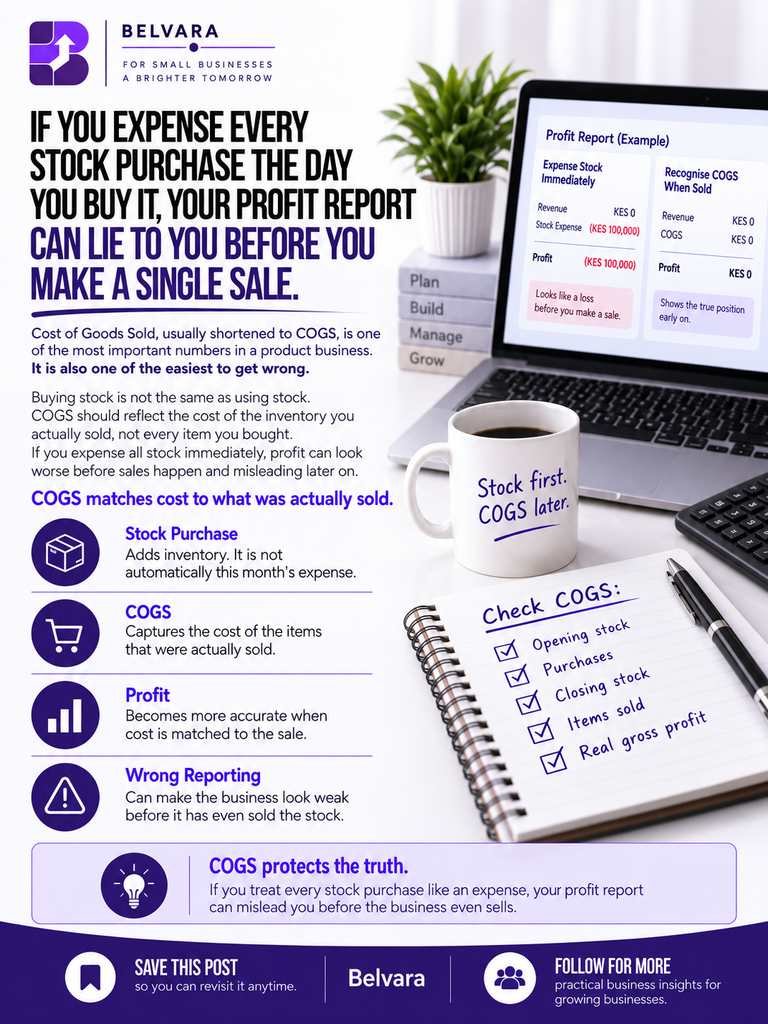
If you expense every stock purchase the day you buy it, your profit report can lie to you before you make a single sale.
Cost of Goods Sold, usually shortened to COGS, is one of the most important numbers in a product business.
It is also one of the easiest to get wrong.
A retailer can spend KES 500,000 buying stock this month without having KES 500,000 of COGS this month.
Why?
Because buying stock and selling stock are not the same event.
The stock you have not sold is still inventory. The cost becomes part of COGS as the related goods are sold, subject to the accounting method and costing policy the business uses.
That distinction matters because COGS directly affects gross profit, gross margin, pricing and the apparent profitability of the business.
What is Cost of Goods Sold (COGS)?
Cost of Goods Sold is the direct cost attributable to the goods a business sold during a specific period.
For a retailer or wholesaler, COGS usually includes the cost of purchasing the inventory that was actually sold.
For a manufacturer, it can include:
- raw materials
- direct labour
- production costs
- an appropriate allocation of production overhead
For other business models, the equivalent may be called cost of sales, cost of revenue or direct costs rather than COGS.
In simple terms:
COGS tells you what the products you sold actually cost the business.
Belvara view: Sales tell you what left the shelf. COGS tells you what value left with it. Ignore the second number and your profit is guesswork.
What is the COGS formula?
For a periodic inventory system, a common formula is:
COGS = Beginning Inventory + Net Inventory Purchases − Ending Inventory
Depending on the business, inventory cost can also include other costs properly attributable to bringing inventory to its present location and condition.
Example
Suppose a retailer has:
- Beginning inventory: KES 300,000
- Inventory purchases during the month: KES 500,000
- Ending inventory: KES 350,000
Then:
COGS = KES 300,000 + KES 500,000 − KES 350,000
COGS = KES 450,000
The business bought KES 500,000 of inventory during the month.
But only KES 450,000 of inventory cost was recognised as COGS in this simplified example.
The rest remains in ending inventory.
Buying KES 500,000 of stock does not mean KES 500,000 disappeared into expense. Some of that money may now be sitting on your shelves.
Why COGS matters
COGS sits directly between revenue and gross profit.
The basic relationship is:
Gross Profit = Revenue − COGS
Suppose a shop records:
- Revenue: KES 800,000
- COGS: KES 480,000
Gross profit:
KES 800,000 − KES 480,000 = KES 320,000
Gross margin:
KES 320,000 ÷ KES 800,000 × 100 = 40%
If COGS is wrong, gross profit is wrong.
If gross profit is wrong, gross margin is wrong.
And if those numbers are wrong, pricing and performance decisions can be wrong too.
COGS is not bookkeeping trivia. Get it wrong and every margin conversation after it starts from bad data.
COGS vs inventory purchases
This is the distinction many small businesses miss.
Inventory purchases measure what stock the business bought.
COGS measures the cost of the stock that was sold.
They can be very different numbers.
Example
During September, a business buys:
KES 600,000 of new stock
But by the end of the month, only KES 250,000 of that stock, together with some older inventory, has been sold.
The entire KES 600,000 purchase should not automatically be treated as September COGS.
Unsold stock remains inventory until it is sold, written down or otherwise appropriately recognised.
This is why a business can have:
- high stock purchases
- large cash outflows
- relatively low COGS
all at the same time.
COGS vs cash flow
Buying inventory affects cash when the supplier is paid.
COGS affects profit as the relevant inventory is sold.
Those timings may not match.
Suppose a retailer pays KES 400,000 for inventory today.
Cash decreases by KES 400,000.
But if none of that inventory has sold yet, the purchase has not automatically created KES 400,000 of COGS.
The business has exchanged cash for inventory.
Belvara view: Stock can drain cash today and hit COGS weeks later. If your system cannot separate those events, cash flow and profit start telling you two stories you cannot reconcile.
This is why inventory, purchasing, payments and financial reporting need to connect.
COGS vs operating expenses
COGS and operating expenses are both costs, but they represent different things.
COGS is directly connected to what was sold.
Operating expenses support the wider running of the business.
A simplified comparison:
| COGS / direct cost | Operating expense |
| Product purchase cost | Office rent |
| Raw materials | Administrative salaries |
| Direct production labour | General marketing |
| Production overhead where applicable | Accounting fees |
| Freight-in where attributable to inventory | Office internet |
| Direct packaging required to prepare goods for sale where applicable | General software subscriptions |
Classification depends on the nature of the business and applicable accounting policy.
The key question is not:
“Did we spend money?”
It is:
“Was this cost directly part of acquiring or producing the goods sold, or was it part of running the wider business?”
COGS vs cost of sales
Cost of sales is often used interchangeably with COGS, particularly in product businesses.
But cost of sales can sometimes be a broader label.
A retailer may use COGS to describe the cost of inventory sold.
A service company may use cost of sales for direct labour or subcontracting costs related to delivering services.
The exact label matters less than using it consistently and understanding what is included.
COGS vs cost of revenue
Cost of revenue is another broader term commonly used by businesses whose direct costs are not primarily physical inventory.
Examples include:
- SaaS businesses
- platforms
- hosting businesses
- service companies
- digital businesses
A SaaS company may have no physical goods to sell, so “Cost of Goods Sold” can sound strange.
It may instead report cost of revenue, which could include direct costs of delivering the service such as certain infrastructure or support costs depending on the accounting policy.
Do not force COGS onto a business model where “cost of revenue” or “direct costs” tells the truth more accurately.
What costs can be included in inventory cost?
Under IAS 2, inventory cost includes costs of purchase, costs of conversion and other costs incurred in bringing inventory to its present location and condition.
For a trading business, relevant inventory cost can include:
- purchase price
- import duties that are not recoverable
- certain non-recoverable taxes
- transport
- handling
- other directly attributable acquisition costs
Trade discounts, rebates and similar reductions affect the purchase cost.
For manufacturing, inventory cost can also include:
- direct materials
- direct labour
- variable production overhead
- an appropriate allocation of fixed production overhead
Not every cost belongs in inventory.
Selling costs, unnecessary storage costs, abnormal waste and general administration costs that do not contribute to bringing inventory to its present location and condition are generally treated differently.
Supplier cost vs landed cost
Supplier price is not always the true cost of inventory.
Suppose a Kenyan retailer imports 100 units.
Supplier purchase price
KES 100,000
That looks like:
KES 1,000 per unit
But the shipment also has:
- Freight: KES 20,000
- Import duties and non-recoverable charges: KES 15,000
- Clearing: KES 10,000
- Local transport to the warehouse: KES 5,000
Total relevant acquisition cost:
KES 150,000
Effective cost per unit:
KES 1,500
If the owner prices the product using KES 1,000 as the cost, the markup and margin can look much healthier than they really are.
The supplier invoice can be the cheapest part of a product that becomes expensive by the time it reaches your shelf.
This is why accurate landed-cost treatment matters.
What does not normally belong in COGS?
Not every business cost belongs in COGS.
Costs commonly treated outside COGS can include:
- general advertising
- office rent
- administrative salaries
- general software
- accounting fees
- unrelated travel
- owner personal expenses
- general selling expenses
- financing costs
However, classification can vary by business and accounting framework.
For example, some production-related overhead may form part of inventory cost, while general administrative overhead may not.
The principle is more useful than memorising a list:
COGS should reflect the cost of what was sold, not become a dumping ground for every expense the business paid.
COGS for a retail business
Consider a homeware retailer.
During the month:
- Beginning inventory: KES 400,000
- New inventory purchases: KES 600,000
- Ending inventory: KES 350,000
COGS:
KES 400,000 + KES 600,000 − KES 350,000 = KES 650,000
Suppose revenue was:
KES 1,100,000
Gross profit:
KES 1,100,000 − KES 650,000 = KES 450,000
Gross margin:
KES 450,000 ÷ KES 1,100,000 × 100 = 40.9%
The KES 600,000 purchases alone do not tell you the month’s gross profit.
Inventory movement does.
COGS for a wholesale business
Wholesalers often operate on thinner margins and higher volume, making COGS accuracy even more important.
Suppose a wholesaler sells 500 units for KES 2,000 each.
Revenue:
KES 1,000,000
The cost assigned to those units sold is KES 1,500 each.
COGS:
500 × KES 1,500 = KES 750,000
Gross profit:
KES 250,000
Gross margin:
25%
A KES 50 error in unit cost across 500 units would change reported gross profit by:
KES 25,000
Small costing errors scale quickly.
Thin-margin businesses do not need dramatic accounting mistakes to lose control. Tiny cost errors repeated at volume are enough.
COGS for a manufacturing business
Manufacturers have a more complex cost structure.
Inventory can move through:
- raw materials
- work in progress
- finished goods
- cost of goods sold
Suppose a furniture manufacturer produces tables.
Relevant production costs may include:
- timber
- hardware
- direct factory labour
- production electricity
- allocated factory overhead
When the tables are completed, those costs become part of finished-goods inventory.
When the tables are sold, the carrying cost of those units becomes COGS.
A manufacturer does not create profit when raw materials enter the factory. Profit only becomes visible when production cost meets an actual sale.
COGS for a restaurant
Restaurants are product-and-service hybrids, but food cost is a major direct cost.
Suppose a restaurant earns:
KES 900,000 in food sales
The ingredients used in the food sold cost:
KES 300,000
Simplified food COGS:
KES 300,000
Gross profit before other direct and operating costs:
KES 600,000
Gross margin:
66.7%
But restaurant inventory introduces extra problems:
- spoilage
- waste
- theft
- portion inconsistency
- complimentary meals
- staff meals
- price changes
- stock count errors
If food disappears from the kitchen without becoming a sale, COGS still has to explain where the value went.
COGS for a salon or beauty business
A salon may have both product sales and service delivery.
For retail products, the cost of products sold can form COGS.
For services, direct product usage and direct service costs may be tracked as cost of sales or direct costs depending on the accounting system.
Example:
A salon sells KES 100,000 of retail products.
The products sold cost KES 55,000.
Gross profit on retail products:
KES 45,000
The salon also earns KES 300,000 from treatments.
The cost of products used in those treatments should not simply disappear inside general expenses if the business wants to understand service profitability.
COGS for an e-commerce business
E-commerce businesses can have several costs around the transaction.
The inventory cost of goods sold may include the cost of the product and appropriate acquisition costs.
Other costs may include:
- outbound delivery
- payment processing
- platform fees
- advertising
- fulfilment
- packaging
- returns
Not all of those costs necessarily belong in accounting COGS.
But they still matter commercially.
COGS can tell you whether the product has room. It cannot tell you whether Meta ads, payment fees and delivery consumed the rest of that room.
That is why product-level profitability often needs a wider contribution view after gross profit.
COGS for a service business
A pure service business may not use the term COGS at all.
Instead, it may track:
- cost of services
- direct costs
- cost of sales
- cost of revenue
Suppose an agency earns KES 500,000 from a client project.
Direct project costs:
- Freelancers: KES 120,000
- Production: KES 80,000
- Project-specific travel: KES 20,000
Direct cost of service:
KES 220,000
Gross profit on the project before overhead:
KES 280,000
The business still has rent, permanent staff, software, administration and other operating expenses.
Service businesses have COGS problems too. They just hide them under unpaid owner time, staff hours and subcontractor invoices.
COGS for subscription businesses
A SaaS business typically uses cost of revenue rather than traditional COGS.
Depending on the business and accounting policy, direct service-delivery costs may include items such as:
- hosting and infrastructure
- third-party services required to deliver the product
- certain customer support costs
- transaction costs directly tied to delivery
The principle is similar:
How much does it directly cost to deliver the revenue being generated?
But the terminology and cost classification should fit the business model.
COGS for marketplaces
A marketplace needs to first understand whether it acts as a principal or agent in the underlying transaction.
If the marketplace merely facilitates a transaction and earns a commission, the full merchant product cost is not automatically the marketplace’s COGS.
Its direct costs may instead relate to delivering the marketplace service.
Do not copy a retailer’s COGS model into a marketplace. Different economics need different accounting logic.
Beginning inventory explained
Beginning inventory is the value of inventory the business has at the start of the accounting period.
It is usually the same as the previous period’s ending inventory.
Example:
If December ends with:
KES 420,000 inventory
January begins with:
KES 420,000 beginning inventory
That inventory is available to be sold in January along with new purchases.
Ending inventory explained
Ending inventory is the value of stock still held at the end of the period.
It has not yet become COGS simply because the business bought it.
Ending inventory can include:
- goods held for resale
- raw materials
- work in progress
- finished goods
depending on the business.
Accurate ending inventory is essential because it directly affects COGS under a periodic calculation.
Why stock counts matter for COGS
If the physical stock count is wrong, COGS can be wrong.
Suppose the system says ending inventory is:
KES 400,000
But the business physically has only:
KES 350,000
There is a KES 50,000 discrepancy.
Possible causes include:
- theft
- damage
- unrecorded sales
- write-offs
- receiving errors
- counting errors
- staff usage
- misplaced stock
If nobody reconciles the difference, the financial reports may continue assuming inventory exists when it does not.
Belvara view: Inventory that exists in software but not on the shelf is not an asset. It is an unanswered question.
How inventory write-offs affect COGS and profit
Inventory can lose value because it is:
- damaged
- expired
- obsolete
- stolen
- unsellable
- missing
Under IAS 2, inventory is measured at the lower of cost and net realisable value, and write-downs or losses are recognised as expenses when appropriate.
The exact presentation can depend on the business and reporting policy.
Operationally, the lesson is simple:
Stock loss reduces business value even if no customer sale happened.
This is why write-offs need:
- a reason
- a quantity
- a value
- an approver where appropriate
- an audit trail
A write-off is not “just stock adjustment.” It is profit leaving the business without revenue coming back.
Inventory costing methods
A business needs a consistent method for assigning cost to inventory sold.
Under IAS 2, common cost formulas include:
- Specific identification
- FIFO
- Weighted average
For interchangeable inventory, IAS 2 permits FIFO or weighted average. Specific identification is used for appropriate non-interchangeable items or items tied to specific projects.
Specific identification
Each item carries its own identifiable cost.
This can work for:
- vehicles
- high-value equipment
- unique luxury goods
- individually identifiable items
FIFO
FIFO means First In, First Out.
The earliest inventory costs are treated as the costs of the first units sold.
Weighted average
Weighted average combines the cost of similar inventory to calculate an average unit cost.
Your costing method is not a cosmetic setting. When purchase prices move, it can change when cost appears in COGS and how much inventory remains on the balance sheet.
Businesses should use the costing method appropriate to their accounting framework and apply it consistently.
FIFO example
Suppose a business purchases:
- 10 units at KES 1,000
- 10 units at KES 1,200
It then sells 12 units.
Under FIFO, the first 10 units sold carry the KES 1,000 cost.
The next 2 units carry the KES 1,200 cost.
COGS:
(10 × KES 1,000) + (2 × KES 1,200)
COGS = KES 12,400
Ending inventory:
8 × KES 1,200 = KES 9,600
Weighted average example
Using the same purchases:
- 10 units at KES 1,000 = KES 10,000
- 10 units at KES 1,200 = KES 12,000
Total inventory cost:
KES 22,000
Total units:
20
Weighted average cost per unit:
KES 22,000 ÷ 20 = KES 1,100
If 12 units are sold:
COGS = 12 × KES 1,100 = KES 13,200
Ending inventory:
8 × KES 1,100 = KES 8,800
Same purchases.
Same sales volume.
Different cost timing.
COGS and gross margin
COGS directly drives gross margin.
Formula:
Gross Margin % = (Revenue − COGS) ÷ Revenue × 100
Suppose:
- Revenue = KES 1,000,000
- COGS = KES 650,000
Gross profit:
KES 350,000
Gross margin:
35%
Now imagine true COGS was actually KES 720,000 because freight and inventory losses had been omitted.
Correct gross profit:
KES 280,000
Correct gross margin:
28%
A seven-point margin difference is not small.
If COGS is understated, your margin is not strong. It is fictional.
COGS and markup
Markup uses cost as the base.
Formula:
Markup % = Gross Profit ÷ Cost × 100
If a product costs KES 1,000 and sells for KES 1,500:
- Gross profit = KES 500
- Markup = 50%
- Gross margin = 33.3%
If the true landed cost is KES 1,200 instead:
- Gross profit = KES 300
- Markup = 25%
- Gross margin = 20%
Cost accuracy changes the entire pricing picture.
COGS and discounts
Discounting lowers selling price but does not automatically lower the product’s cost.
Suppose:
- Cost = KES 1,000
- Selling price = KES 1,500
- Gross profit = KES 500
Now the business discounts the product to:
KES 1,200
COGS is still:
KES 1,000
Gross profit becomes:
KES 200
Gross profit fell by 60%.
The discount came off the customer’s price. The cost stayed exactly where it was. Guess who absorbed the difference?
COGS and returns
Returns can affect:
- revenue
- inventory
- COGS
- gross profit
If a customer returns a saleable product and the business restores it to inventory, the accounting entries may reverse both the revenue and the related COGS.
If the returned item is damaged and cannot be resold at full value, additional adjustments may be needed.
Returns should therefore never be tracked only as a payment refund.
They affect stock and profitability too.
COGS and stock theft
Stock theft creates an inventory loss without generating revenue.
If inventory disappears:
- cash was already spent acquiring it
- the asset is gone
- there was no customer sale
- the business loses value
This is why stock controls are financial controls.
A missing unit is not just an inventory discrepancy. It is money that left the business and never got the chance to become revenue.
COGS and dead stock
Dead or slow-moving stock creates two different problems.
First, it ties up cash.
Second, it may eventually need to be discounted or written down.
That can reduce future gross profit.
A product can therefore hurt the business even before it is officially written off.
This is why inventory turnover belongs next to COGS and margin analysis.
COGS and VAT
For VAT-registered businesses, recoverable VAT is generally not part of inventory cost in the same way as a non-recoverable tax.
IAS 2 states that inventory purchase cost includes import duties and other taxes other than those subsequently recoverable from taxing authorities.
That means businesses should avoid casually including recoverable VAT in product cost and then treating the VAT collected from customers as revenue.
Tax treatment depends on the business and transaction, so current KRA requirements and professional advice should be followed where necessary.
Tax collected for government should not make your revenue look bigger, and recoverable tax should not quietly inflate your product cost.
COGS and shipping
Shipping needs context.
Freight-in, meaning transport required to acquire inventory and bring it to the appropriate location and condition, may form part of inventory cost where applicable.
Outbound delivery, meaning delivery from the business to the customer, is generally a selling or fulfilment cost rather than part of inventory acquisition cost.
The commercial effect still matters either way.
A product with KES 500 gross profit can become a weak transaction if the business pays KES 400 to deliver it.
Periodic vs perpetual inventory systems
Periodic inventory
A periodic system calculates inventory and COGS at intervals.
Physical stock counts are especially important.
A common formula is:
Beginning Inventory + Purchases − Ending Inventory = COGS
Perpetual inventory
A perpetual system updates inventory records continuously as transactions happen.
When a sale is recorded, the system can also record the cost of the inventory sold based on the configured costing method.
That gives the business more timely visibility.
But automation does not eliminate the need for controls.
If receiving, costs, stock movements or write-offs are wrong, the automated COGS can still be wrong.
Real-time bad data is still bad data. It just becomes wrong faster.
Why COGS can suddenly rise
COGS can increase because:
- supplier prices rose
- exchange rates changed
- freight increased
- import costs increased
- the sales mix shifted toward higher-cost products
- stock losses increased
- production became less efficient
- discounts and rebates changed
- costing errors were corrected
If revenue stays flat while COGS rises, gross profit falls.
That is why changes in COGS should be explainable.
Why COGS percentage matters
A useful ratio is:
COGS % = COGS ÷ Revenue × 100
Suppose:
- Revenue = KES 1,000,000
- COGS = KES 600,000
COGS percentage:
60%
Gross margin:
40%
If COGS rises to 70% of revenue, gross margin falls to 30%.
Tracking the ratio over time can reveal:
- supplier inflation
- poor pricing
- excessive discounting
- stock loss
- product-mix changes
- purchasing problems
Common COGS mistakes business owners make
1. Expensing all stock purchases immediately
Purchases and COGS are not the same thing.
2. Using supplier price as full cost
Freight, duties, handling and other attributable acquisition costs may materially change cost.
3. Ignoring beginning and ending inventory
Without inventory values, periodic COGS can be badly distorted.
4. Treating every expense as COGS
Rent, general marketing and administration do not automatically belong in COGS.
5. Leaving direct costs out
Understated COGS creates overstated gross profit.
6. Ignoring stock losses and write-offs
Missing or damaged inventory still affects economic performance.
7. Using inconsistent costing methods
Changing methods casually can make periods difficult to compare.
8. Failing to update unit costs
Supplier prices change. Old costs create false margins.
9. Ignoring product bundles
Bundles need their component costs allocated correctly.
10. Trusting system stock without physical reconciliation
A database can say 20 units exist while the shelf says 14.
Belvara view: COGS errors rarely announce themselves. They hide inside “good margins” until somebody finally checks the stock.
How COGS affects pricing
A business cannot price intelligently without knowing cost.
Suppose a product is sold for KES 2,000.
If assumed cost is KES 1,000
Gross profit:
KES 1,000
Gross margin:
50%
If true cost is KES 1,400
Gross profit:
KES 600
Gross margin:
30%
Nothing changed for the customer.
The product still sells for KES 2,000.
But the business economics are completely different.
Bad cost data turns pricing into confidence theatre. The number looks deliberate. The economics are not.
How COGS affects profit
Gross profit must first pay for operating expenses.
Example:
- Revenue: KES 1,000,000
- COGS: KES 650,000
- Gross profit: KES 350,000
- Operating expenses: KES 300,000
Simplified operating profit:
KES 50,000
If true COGS is KES 700,000:
Gross profit becomes:
KES 300,000
The simplified operating profit falls to:
KES 0
A KES 50,000 COGS error just erased all apparent operating profit.
What should a business track alongside COGS?
Useful measures include:
- revenue
- gross profit
- gross margin
- markup
- landed cost
- inventory purchases
- beginning inventory
- ending inventory
- stock turnover
- stock write-offs
- supplier price changes
- product-level gross profit
- category-level gross margin
- returns
- discounts
- operating expenses
- cash flow
The goal is not to produce more numbers.
The goal is to understand what each sale actually contributed.
How Belvara should helps a business understand COGS
COGS is not a number that should be typed into a report at month-end and forgotten.
It is created by operational events:
- stock is ordered
- inventory is received
- purchase costs are recorded
- attributable acquisition costs are added
- units move between locations
- products are sold
- returns come back
- stock is damaged
- inventory is written off
- supplier prices change
Belvara’s role is to connect those records so cost moves with the underlying inventory activity.
The system should help the business distinguish:
- inventory purchased
- inventory currently held
- inventory sold
- inventory lost or written off
- cost attached to each sale
- gross profit generated
The exact costing and valuation method should follow the business’s configured accounting policy and applicable accounting requirements.
That distinction matters.
Because when sales, inventory and costs live separately, the owner is forced to estimate.
When they connect, gross profit becomes explainable.
The takeaway
Cost of Goods Sold is the direct cost associated with the goods a business sold during a specific period.
For a simple periodic inventory business:
COGS = Beginning Inventory + Net Inventory Purchases − Ending Inventory
But the formula only works when the underlying inventory records are credible.
COGS is not automatically:
- everything you bought
- every expense you paid
- every cash outflow
- the supplier invoice alone
It is the cost associated with what was actually sold, based on the business’s accounting and inventory-costing method.
COGS sits directly underneath revenue.
That means every COGS error moves gross profit in the opposite direction.
Understate COGS and profit looks better than reality.
Overstate COGS and profit looks worse.
Revenue can be counted from sales. Gross profit cannot be trusted until the cost behind those sales is trusted too.
Belvara’s role is to connect inventory, purchasing, stock movements, sales and financial records so the owner can answer the question that matters:
What did the things we sold actually cost us?
Frequently Asked Questions About Cost of Goods Sold (COGS)
What is COGS in simple terms?
COGS is the direct cost of the goods a business sold during a specific period.
What does COGS stand for?
COGS stands for Cost of Goods Sold.
What is the formula for COGS?
A common periodic formula is:
COGS = Beginning Inventory + Net Inventory Purchases − Ending Inventory
Is COGS the same as purchases?
No. Purchases are stock acquired during the period. COGS is the cost assigned to inventory that was actually sold during the period.
Is COGS an expense?
Yes. When inventory is sold, its carrying cost is recognised as an expense associated with the related revenue.
Is inventory an expense?
Unsold inventory is generally recorded as an asset rather than immediately becoming COGS. Its cost is recognised as an expense as the inventory is sold or otherwise appropriately written down or written off.
Is COGS the same as operating expenses?
No. COGS is directly associated with goods sold. Operating expenses generally relate to running the wider business.
Is COGS the same as cost of sales?
The terms are often used interchangeably in product businesses, although cost of sales can be used more broadly in some businesses.
Is COGS the same as cost of revenue?
Not always. Cost of revenue is a broader term often used by service, SaaS and digital businesses for direct costs associated with generating revenue.
Does freight count as COGS?
Freight and transport required to acquire inventory and bring it to its present location and condition may form part of inventory cost where applicable. Outbound delivery to customers is generally treated differently.
Does import duty count as inventory cost?
Non-recoverable import duties can form part of inventory purchase cost under IAS 2.
Does VAT count as COGS?
Recoverable VAT is generally excluded from inventory purchase cost under IAS 2. Tax treatment depends on the business and transaction.
Are salaries included in COGS?
Direct production labour can form part of inventory cost for manufacturing businesses. General administrative salaries usually do not.
Is packaging included in COGS?
Packaging directly required to bring goods to their saleable condition may form part of product cost in some circumstances. General promotional or outbound packaging may be classified differently depending on the business and accounting policy.
How does COGS affect gross profit?
Gross Profit = Revenue − COGS
Higher COGS reduces gross profit if revenue stays the same.
How does COGS affect gross margin?
Gross margin is calculated using gross profit relative to revenue. If COGS rises while selling prices remain unchanged, gross margin falls.
How does COGS affect markup?
Markup depends on product cost. If the true cost increases while the selling price stays the same, markup falls.
Can COGS be negative?
Normal COGS is not expected to be negative. A negative amount can indicate adjustments, reversals, returns, system configuration issues or reporting errors that need investigation.
What is beginning inventory?
Beginning inventory is the inventory value held at the start of the accounting period.
What is ending inventory?
Ending inventory is the value of inventory still held at the end of the accounting period.
What inventory costing methods can be used under IAS 2?
IAS 2 permits specific identification for appropriate items and FIFO or weighted average for interchangeable inventory. Businesses should use an appropriate method consistently.
Is LIFO allowed under IFRS?
IAS 2 specifies FIFO or weighted average for ordinarily interchangeable inventory and does not permit LIFO as a cost formula.
How do stock write-offs affect COGS?
Damaged, obsolete, missing or unsellable inventory can require write-downs or loss recognition. The exact presentation depends on the circumstances and accounting policy.
Should service businesses calculate COGS?
Some service businesses use terms such as cost of services, direct costs, cost of sales or cost of revenue instead of COGS. The goal is still to identify the direct cost of delivering revenue.
What should I learn after COGS?
The next important concepts are gross profit, gross margin, landed cost, inventory valuation, stock turnover, contribution margin and operating expenses.
