

BELVARA BUSINESS EDUCATION
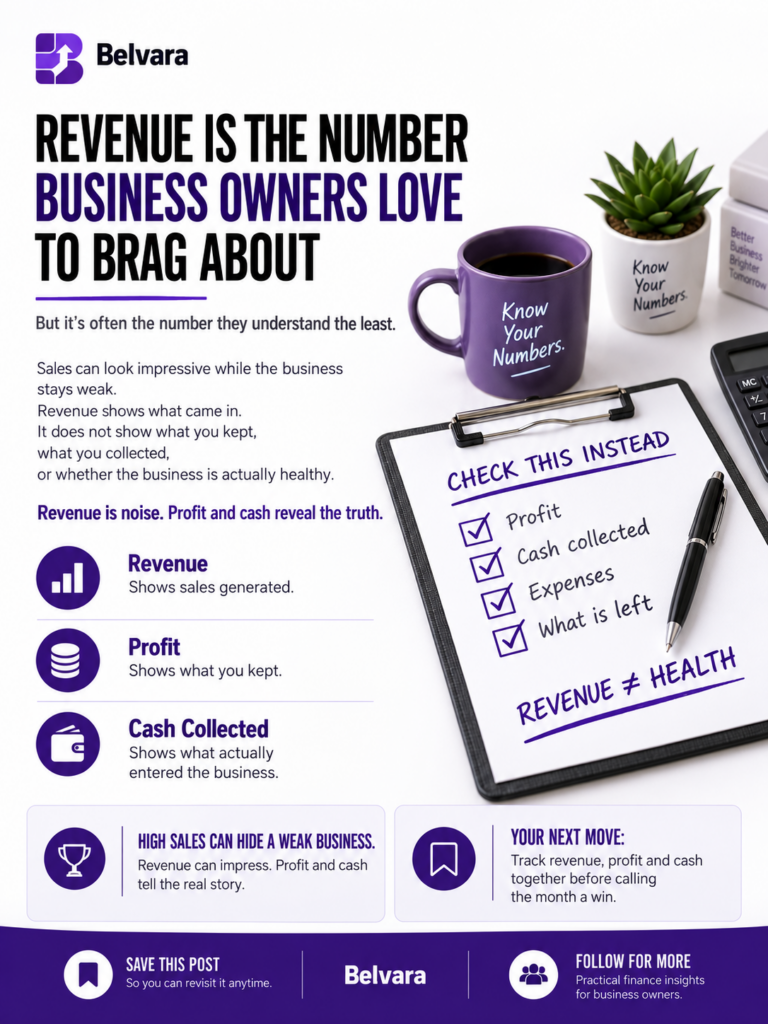
Revenue is the number business owners love to brag about and often understand the least.
A business can post impressive sales, have customers buying every day and still be financially weaker than it looks. That is because revenue tells you how much business you generated. It does not tell you how much you kept, how much cash you actually collected or whether the business is healthy.
What is revenue?
Revenue is the value a business earns from its normal activities, such as selling products, providing services, charging subscriptions, collecting commissions or renting assets, during a specific period. It is measured before most business costs and expenses are deducted.
For a retailer, revenue may come from selling products.
For a consultant, it may come from client work.
For a software company, it may come from subscriptions.
For a marketplace, it may come from commissions or transaction fees rather than the full value of everything sold through the platform.
Revenue is often called the top line because it usually appears near the top of an income statement.
Belvara view: If you only know your total revenue, you do not know your business. You know one number.
At Belvara, we treat revenue as a starting point, not a victory lap. KES 800,000 in monthly revenue becomes much more useful when you can also see where it came from, how much has been collected, what is still outstanding, what it cost to generate and what eventually became profit.
What is the formula for revenue?
For a simple product business:
Revenue = Units sold × Selling price per unit
If a business sells 100 products at KES 1,500 each:
100 × KES 1,500 = KES 150,000 revenue
But not every business earns money by selling units. The correct formula depends on the business model.
| Business model | Simple revenue formula |
| Product business | Units sold × Selling price |
| Service business | Jobs completed × Price per job |
| Hourly service | Billable hours × Hourly rate |
| Subscription business | Paying customers × Subscription price |
| Commission business | Transaction value × Commission rate |
| Rental business | Units rented × Rental rate × Rental period |
| Usage-based business | Customer usage × Usage rate |
| Advertising business | Ad units, impressions or placements × Rate |
| Licensing business | Licence fees + applicable royalties |
| Multi-revenue business | Sum of all recognised revenue streams |
The formula may be simple. The hard part is knowing what should actually be counted as revenue.
Types of revenue
Businesses can earn revenue in very different ways. Understanding the revenue model matters because it affects pricing, forecasting, cash flow, reporting and how growth should be measured.
1. Product revenue
Product revenue comes from selling physical or digital products.
Examples include:
- clothing
- homeware
- electronics
- food
- beauty products
- furniture
- books
- digital templates
- downloadable products
Product revenue example
A homeware business sells:
- 80 mugs at KES 1,500 = KES 120,000
- 50 storage containers at KES 2,000 = KES 100,000
- 30 serving trays at KES 3,000 = KES 90,000
Total product revenue = KES 310,000
If the business also earns money from delivery, wholesale orders or another service, those can be tracked as separate revenue streams.
2. Service revenue
Service revenue comes from providing labour, expertise, professional work or an outcome for a customer.
Examples include:
- consulting
- accounting
- legal services
- photography
- graphic design
- cleaning
- repairs
- beauty services
- marketing
- construction
- training
A photographer who completes eight shoots at KES 20,000 each generates:
8 × KES 20,000 = KES 160,000 revenue
A consultant charging KES 5,000 per hour for 60 billable hours generates:
60 × KES 5,000 = KES 300,000 revenue
Service businesses may charge per hour, appointment, project, milestone, retainer or outcome.
3. Subscription and recurring revenue
Subscription revenue comes from customers paying repeatedly for continued access to a product or service.
Examples include:
- SaaS platforms
- gyms
- membership communities
- subscription boxes
- maintenance plans
- recurring professional services
If 300 customers each pay KES 2,000 per month:
Monthly subscription revenue = 300 × KES 2,000 = KES 600,000
Recurring revenue can make future income more predictable, but only if customers continue paying and remain active.
A subscription is not predictable revenue just because the payment is recurring. Customers can still cancel.
That is why subscription businesses also watch retention, churn and renewal rates rather than celebrating recurring revenue in isolation.
4. Commission and marketplace revenue
Some businesses earn money by facilitating a transaction between other parties.
Examples include:
- online marketplaces
- property agencies
- booking platforms
- recruitment agencies
- sales agents
- affiliate businesses
Suppose a marketplace facilitates KES 5,000,000 in customer purchases and charges sellers an 8% commission.
Commission revenue = KES 5,000,000 × 8% = KES 400,000
The KES 5 million passing through the platform is not automatically the platform’s own revenue.
Moving KES 5 million through your platform does not mean you made KES 5 million. Confusing transaction value with revenue can make a business look far bigger than it really is.
This distinction is especially important for marketplaces, payment platforms and businesses that act as intermediaries.
5. Rental revenue
Rental revenue comes from allowing customers to use an asset for a fee.
Examples include:
- residential property
- commercial property
- vehicles
- machinery
- equipment
- event furniture
- storage space
- coworking spaces
If 12 storage units are rented at KES 8,000 each per month:
Monthly rental revenue = 12 × KES 8,000 = KES 96,000
6. Licensing and royalty revenue
A person or business may earn money by allowing another party to use intellectual property or other protected rights.
Examples include:
- software licences
- music royalties
- book royalties
- trademarks
- patents
- photography licences
- franchise intellectual property
The amount earned may be a fixed licence fee, a percentage of sales or a combination of both.
7. Advertising and sponsorship revenue
Publishers, creators, media businesses, platforms and event companies may earn revenue by giving advertisers access to an audience.
This may include:
- display advertising
- sponsored content
- event sponsorship
- brand partnerships
- promoted listings
- paid placements
A media business may combine advertising revenue with subscriptions, events, products or memberships.
8. Interest and fee revenue
For some financial businesses, revenue may come from interest and service fees.
Examples can include:
- banks
- lenders
- asset-financing businesses
- some financial technology companies
The accounting and regulatory treatment can become more complex in financial services.
For example, when a borrower repays a loan, repayment of the original principal is not the same thing as interest revenue.
9. Franchise revenue
A franchisor may earn revenue through:
- initial franchise fees
- recurring royalties
- training fees
- licence fees
- approved product sales
- other contracted services
A franchise business may therefore have several different revenue streams from the same franchisee relationship.
10. Usage-based revenue
Some businesses charge according to how much a customer uses.
Examples include:
- cloud infrastructure
- telecommunications
- utilities
- APIs
- logistics services
- pay-per-use equipment
If a service charges KES 10 per unit of usage and customers consume 50,000 units:
Revenue = 50,000 × KES 10 = KES 500,000
11. Project and milestone revenue
Some businesses earn revenue through longer projects where work is delivered in stages.
Examples include:
- construction companies
- agencies
- software development firms
- architects
- contractors
- consultants
A KES 1,200,000 contract does not always mean KES 1,200,000 of revenue should be treated as earned on the day the contract is signed or the day a deposit arrives.
Revenue recognition depends on what has been delivered and the accounting rules that apply to the arrangement.
12. Nonprofit and mission-driven organisation revenue
Not every organisation earns revenue through ordinary commercial sales.
Depending on its structure and accounting framework, a nonprofit or mission-driven organisation may receive:
- grants
- donations or contributions
- membership fees
- programme service fees
- fundraising income
- sponsorships
These sources may be classified and recognised differently from commercial sales, so organisations should follow the accounting requirements that apply to them.
Revenue examples by type of business
The same word can describe very different economic activity.
| Business | Typical revenue sources |
| Retail shop | Product sales |
| E-commerce store | Online product sales, delivery charges, wholesale sales |
| Wholesaler | Bulk product sales |
| Manufacturer | Finished goods sold to distributors, retailers or customers |
| Restaurant | Food, beverages, catering, delivery |
| Salon | Treatments, appointments, product sales |
| Consultant | Project fees, hourly fees, retainers |
| Accounting firm | Professional service fees, retainers |
| Marketing agency | Project fees, retainers, campaign services |
| SaaS company | Monthly or annual subscriptions, usage fees, add-ons |
| Marketplace | Commissions, transaction fees, listing fees |
| Property business | Rent, management fees where applicable |
| Car rental company | Vehicle rental charges, additional service fees |
| Logistics company | Delivery, transport, storage and handling charges |
| Hotel | Rooms, food, events, conferencing and other guest services |
| School or training company | Tuition, course and programme fees |
| Creator or publisher | Advertising, sponsorships, subscriptions, royalties |
| Franchise company | Franchise fees, royalties and licences |
| Construction company | Project and milestone revenue |
| Financial business | Interest and applicable service fees |
Most growing businesses eventually become multi-revenue businesses.
A retailer may add wholesale.
A salon may sell products.
A software company may add paid implementation.
A logistics company may add storage.
A consultant may introduce training or subscriptions.
That creates opportunity, but it can also hide what is really happening.
Belvara view: A business with five revenue streams and one total is flying half-blind.
Belvara is designed around keeping the underlying business activity visible. Instead of only seeing that the company made KES 1 million, the owner should be able to understand which products, services, branches, channels or other revenue streams actually produced it.
Revenue vs sales, profit, cash flow and income
Revenue is often confused with other financial terms. They are related, but they answer different questions.
| Term | What it tells you |
| Revenue | How much the business earned from its activities |
| Sales | Usually the value generated from selling products or services |
| Gross profit | What remains after direct costs of producing or acquiring what was sold |
| Net profit | What remains after relevant business costs and expenses |
| Cash received | How much money has actually been collected |
| Cash flow | How money moves into and out of the business |
| Income | A broader accounting term that can include revenue and other income |
| GMV | Total value transacted through a marketplace or platform |
| Turnover | Often used to mean gross sales or revenue, depending on context |
Revenue vs sales
Sales and revenue are often used interchangeably, especially in simple businesses.
But revenue can be broader.
Suppose a retailer earns:
- KES 600,000 from product sales
- KES 80,000 from delivery services
- KES 120,000 from wholesale support or another operating revenue stream
Product sales are KES 600,000.
Total revenue may be KES 800,000.
Revenue vs profit
Revenue measures what the business earns.
Profit measures what remains after costs and expenses.
Example:
| Item | Amount |
| Revenue | KES 500,000 |
| Cost of goods sold | KES 250,000 |
| Operating expenses | KES 180,000 |
| Profit | KES 70,000 |
The business generated KES 500,000 in revenue but retained only KES 70,000 as profit in this simplified example.
A bigger top line can hide a weaker business. Revenue growth means very little if costs are growing faster.
This is why revenue should never be used as the sole measure of business health.
Revenue vs cash received
Revenue and cash collection do not always happen at the same time.
Example: revenue earned before cash arrives
You complete KES 60,000 worth of work this month and invoice the customer for payment next month.
The work may already represent revenue even though the cash has not been collected.
Example: cash arrives before revenue is fully earned
A customer pays KES 120,000 upfront for a 12-month service.
The cash has arrived, but depending on the agreement and applicable accounting rules, the business may recognise the revenue over the period in which the service is delivered rather than treating the whole payment as earned immediately.
Belvara view: Your bank balance is not your revenue report. Treating it like one is how businesses lose control.
Belvara separates the idea of a sale, an amount due, a payment and the financial result because those events are not always the same event.
Revenue vs cash flow
Revenue measures what was earned.
Cash flow measures actual money moving into and out of the business.
Imagine a wholesaler sells KES 1,000,000 worth of stock this month, but most customers have 30 days to pay.
The business may report strong revenue while still struggling to pay suppliers, salaries, rent or transport today.
That is not a contradiction.
The business has revenue.
It has a collection problem or working-capital problem.
Revenue vs income
Revenue normally refers to earnings generated through the ordinary activities of a business.
Other income may come from activities outside those normal operations.
For example, a furniture retailer earns revenue by selling furniture.
If it sells an old company vehicle, that transaction should not simply be mixed into normal furniture sales as though it came from customers buying the company’s products.
Separating operating revenue from unusual or non-operating income makes performance easier to understand.
Revenue vs turnover
In many business contexts, turnover is used to describe gross sales or revenue generated during a period.
Someone may say:
“The company has annual turnover of KES 20 million.”
They are generally talking about the scale of sales or revenue, not profit.
However, the precise meaning can depend on the accounting, tax or legal context. Businesses should use the definition required for the specific report, filing or decision they are making.
Revenue vs GMV
GMV, or gross merchandise value, generally describes the total value of goods or services sold through a platform.
It is not automatically the platform’s revenue.
Suppose a marketplace processes KES 10,000,000 of customer purchases and earns a 5% commission.
GMV = KES 10,000,000
Commission revenue = KES 500,000
Whether an entity recognises a gross transaction amount or only its fee can depend on the substance of the arrangement, including whether it is acting as the principal providing the good or service or as an agent arranging for another party to provide it.
Gross revenue vs net revenue
Gross revenue or gross sales generally refers to revenue before certain deductions such as returns, refunds and applicable discounts.
Net revenue reflects those deductions.
A simplified formula is:
Net revenue = Gross revenue − Returns − Refunds − Applicable discounts
Example:
- Gross sales: KES 500,000
- Returns: KES 20,000
- Refunds: KES 5,000
Net sales = KES 475,000
The exact accounting treatment depends on the transaction and accounting policy, but the operational lesson is simple:
If refunds and returns are disappearing inside your total sales number, your revenue report is flattering you.
A business should be able to see how much it sold and how much of those sales did not stick.
Does VAT count as revenue?
For a VAT-registered business, VAT charged to customers is generally collected as tax rather than earned as business revenue.
In Kenya, KRA describes VAT using an input and output tax system. Output VAT is tax charged on taxable sales, while input VAT is tax paid on qualifying business purchases. The VAT payable is generally determined from the relationship between the two.
For management reporting, this is another reason not to assume that every shilling entering an M-Pesa till, paybill, bank account or cash drawer belongs to the business as revenue.
Tax treatment depends on the business and transaction, so businesses should follow current KRA requirements and obtain professional advice where necessary.
When should revenue be recorded?
Revenue is not always recorded at the moment money moves.
Under revenue-recognition principles such as IFRS 15, revenue from customer contracts is recognised to reflect the transfer of promised goods or services to the customer, in the amount the business expects to be entitled to for providing them.
In practical terms, ask:
What have we actually delivered or earned?
1. Customer pays immediately
A customer buys a product for KES 5,000 and takes it home.
The sale and payment happen at roughly the same time.
2. Customer pays later
You complete KES 30,000 of work and give the customer 30 days to pay.
Revenue may have been earned even though the money is still outstanding.
3. Customer pays in advance
A customer pays today for services that will be delivered over several months.
Cash has been received, but the revenue may need to be recognised as the promised service is provided.
4. Customer pays a deposit
A deposit is not automatically the same thing as revenue.
The treatment depends on what the deposit represents, whether the business has fulfilled its obligations and the applicable accounting policy.
Cash can arrive before revenue. Revenue can exist before cash. Confuse the two and your reports start lying to you.
This distinction becomes especially important for:
- subscriptions
- retainers
- preorders
- deposits
- instalment arrangements
- long projects
- milestone contracts
- credit sales
How to calculate revenue for a business with several revenue streams
Consider a business that operates both a physical shop and online.
During one month it earns:
- Retail product sales: KES 420,000
- Online product sales: KES 310,000
- Wholesale sales: KES 180,000
- Delivery revenue: KES 35,000
Total revenue = KES 945,000
But stopping at KES 945,000 throws away useful information.
The owner should also ask:
- Which revenue stream grew?
- Which one has the highest margin?
- Which channel has the most returns?
- Which sales have not been paid yet?
- Which products generate most of the revenue?
- Which branch or channel is declining?
- Which customers account for a large share of revenue?
- Is revenue concentrated in one product or customer?
- What does each revenue stream cost to operate?
This is where Belvara’s approach goes beyond recording a total. Sales, payments, inventory, customers, channels and financial reporting should connect so the owner can understand the story behind the number.
Belvara view: Revenue without context is a vanity metric wearing an accounting label.
Common revenue mistakes business owners make
1. Calling every deposit revenue
Money entering the business account may include:
- customer payments
- owner capital
- loans
- refunds from suppliers
- transfers between your own accounts
- taxes collected
- deposits for future work
Not all of it is revenue.
2. Confusing revenue with profit
KES 1 million in sales does not mean the business made KES 1 million.
Products had to be bought or produced. Staff may need to be paid. Rent, delivery, software, marketing and other expenses still exist.
Revenue is the beginning of the calculation.
3. Ignoring unpaid revenue
A business can generate sales without collecting the money immediately.
If customers owe you KES 300,000, that matters.
A revenue report that does not help you distinguish earned amounts from collected amounts can create a false sense of liquidity.
4. Mixing business activity with other money
Owner injections, loans and transfers should not quietly inflate sales figures.
If you transferred KES 100,000 of your own money into the business, the business did not suddenly gain KES 100,000 in customer revenue.
5. Tracking only total revenue
A total tells you scale.
A breakdown tells you what is working.
If one product generates 70% of revenue, you have concentration risk.
If wholesale revenue is growing but margins are collapsing, growth may be expensive.
If one branch looks busy but generates weak revenue, foot traffic may be misleading.
6. Celebrating revenue growth without checking what it cost
Revenue can increase because you:
- spent heavily on advertising
- discounted aggressively
- extended more customer credit
- added expensive delivery subsidies
- hired additional staff
- accepted low-margin orders
The top line goes up.
The business may still become less profitable.
Revenue growth is not automatically business growth. Sometimes you are just working harder for worse money.
What should a business owner track alongside revenue?
Revenue becomes far more useful when viewed with other business numbers.
At minimum, consider tracking:
- gross profit
- gross margin
- net profit
- cash collected
- outstanding customer balances
- refunds and returns
- cost of goods sold
- operating expenses
- revenue by product or service
- revenue by channel
- revenue by branch
- recurring revenue where applicable
- average order or transaction value
- customer concentration where relevant
You do not need fifty dashboards.
You need enough context to explain why the number moved.
What does revenue actually tell you?
Revenue tells you how much economic activity the business generated from its revenue-producing activities during a period.
It can help answer:
- Are customers buying more or less?
- Which products or services generate the most revenue?
- Which revenue streams are growing?
- Which branch or channel performs best?
- Is the business becoming more dependent on one customer or product?
- Is recurring revenue increasing?
- Is growth seasonal?
- Is revenue growth translating into profit and cash?
What revenue cannot tell you on its own is whether the business is healthy.
A business can look successful from the top line and be falling apart underneath it.
That is why Belvara treats revenue as one part of a connected operating picture rather than the final score.
The takeaway
Revenue is the value a business earns from its normal business activities before most costs and expenses are deducted.
How it is calculated depends on the business model.
- A retailer earns product revenue.
- A consultant earns service revenue.
- A SaaS business may earn subscriptions.
- A marketplace may earn commissions.
- A property business may earn rental revenue.
- A modern business may earn several of these at once.
But the most important lesson is not the definition.
It is this:
Revenue tells you how much business you generated. It does not tell you whether that business was worth having.
To understand that, you need the next layers: direct costs, gross profit, margins, operating expenses, cash flow and ultimately profit.
Belvara is built around connecting those layers so a business owner can move from “How much did we sell?” to the far more useful question:
“What did those sales actually do for the business?”
Frequently Asked Questions About Revenue
What is revenue in simple terms?
Revenue is the value a business earns from selling products, providing services or carrying out its normal revenue-generating activities before most business costs and expenses are deducted.
What is the basic revenue formula?
For a simple product business:
Revenue = Units sold × Selling price per unit
The formula changes for businesses that charge by the hour, subscription, commission, rental period, usage or another pricing model.
Is revenue the same as profit?
No. Revenue is what a business earns before costs and expenses are deducted. Profit is what remains after the relevant costs and expenses have been accounted for.
Is revenue the same as sales?
Sometimes, but not always. Sales generally refer to money earned from selling goods or services. Revenue can include several operating revenue streams, so it may be broader than sales.
Is revenue the same as turnover?
Turnover is often used to mean sales or revenue, but its precise meaning can depend on the accounting, tax or legal context in which the term is being used.
Is money in my M-Pesa or bank account the same as revenue?
No. Money received by the business can include revenue, customer deposits, loans, owner capital, transfers, taxes collected or other amounts. A bank or M-Pesa balance should not be treated as a revenue report.
Does VAT count as revenue?
VAT charged by a VAT-registered business is generally tax collected rather than revenue belonging to the business. Businesses should follow the current tax rules that apply to them.
Can revenue be recorded before a customer pays?
Yes. Depending on the transaction and accounting method, a business may earn revenue before the customer pays. The unpaid amount may remain receivable until it is collected.
Is a customer deposit revenue?
Not automatically. Receiving cash does not by itself determine whether revenue has been earned. The treatment depends on what the payment represents, what the business has delivered and the applicable accounting rules.
What is monthly revenue?
Monthly revenue is the revenue a business earns during a month. Comparing it over time can help identify growth, decline, seasonality and changes in the business’s revenue mix.
What is annual revenue?
Annual revenue is the revenue a business earns during a 12-month period. It is commonly used as one measure of the size or activity level of a business.
What is recurring revenue?
Recurring revenue is revenue expected from ongoing customer arrangements such as subscriptions, memberships or retainers. It is more predictable than one-off revenue but still depends on customer retention and renewal.
Can a business have more than one revenue stream?
Yes. Many businesses combine several revenue streams. A retailer may earn from product sales, wholesale orders and delivery. A salon may earn from services and products. A software company may earn subscriptions, usage fees and implementation fees.
Why is revenue important?
Revenue helps measure the level and direction of business activity. It becomes much more useful when analysed alongside profit, margins, cash collection, expenses and other operating data.
What should I look at after revenue?
The next useful numbers are usually cost of goods sold or direct costs, gross profit, gross margin, operating expenses, cash flow and net profit. Together, they show what happened to the revenue after it was generated.
