

BELVARA BUSINESS EDUCATION
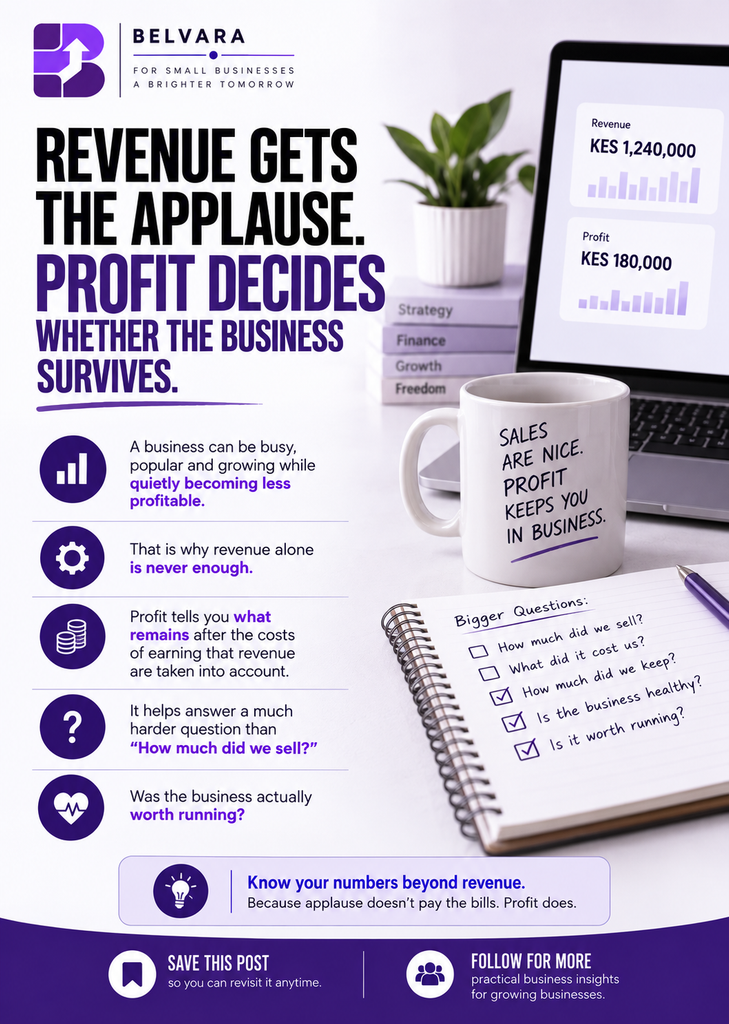
Revenue gets the applause. Profit decides whether the business survives.
A business can be busy, popular and growing while quietly becoming less profitable.
That is why revenue alone is never enough.
Profit tells you what remains after the costs of earning that revenue are taken into account. It helps answer a much harder question than “How much did we sell?”
Was the business actually worth running?
What is profit?
Profit is the amount left after the relevant costs and expenses of running a business are deducted from its revenue or income for a specific period.
In simple terms:
Profit = Revenue − Costs and expenses
If a business earns KES 500,000 in revenue and incurs KES 420,000 in costs and expenses:
Profit = KES 500,000 − KES 420,000 = KES 80,000
That KES 80,000 is not necessarily the amount sitting in the bank account. Profit is an accounting measure of performance, while cash depends on when money is actually received and paid.
Belvara view: A business that only tracks sales knows how busy it is. A business that tracks profit knows whether the work is paying off.
At Belvara, we treat profit as a result that needs context. The useful question is not only whether the business made a profit, but where that profit came from, what damaged it, which products or services created it and whether the cash actually followed.
What is the formula for profit?
The simplest formula is:
Profit = Revenue − Total costs
But “profit” can mean different things depending on which costs have already been deducted.
The three most common levels are:
1. Gross profit
2. Operating profit
3. Net profit
Each one tells you something different about the business.
| Profit measure | Simplified formula | What it tells you |
| Gross profit | Revenue − Direct costs / COGS | Whether the product or service is economically worthwhile before overhead |
| Operating profit | Gross profit − Operating expenses | Whether normal business operations are profitable |
| Net profit | Total income − All applicable expenses | What remains after the broader costs of the period |
The three main types of profit
1. Gross profit
Gross profit is the amount left after subtracting the direct cost of producing, buying or delivering the goods or services sold from revenue.
For a product business, this direct cost is commonly called cost of goods sold (COGS).
Gross profit formula
Gross Profit = Revenue − Cost of Goods Sold
Suppose a retailer sells products worth KES 600,000.
The products sold originally cost the business KES 360,000.
Gross Profit = KES 600,000 − KES 360,000 = KES 240,000
The KES 240,000 must still cover salaries, rent, software, advertising, utilities, professional fees and other operating costs.
So gross profit is not the final amount the owner made.
A product can sell fast and still be a terrible product for the business if the gross profit is too small.
This is why “best-selling” and “most profitable” are not the same thing.
2. Operating profit
Operating profit is what remains after the direct costs and normal operating expenses of running the business are deducted.
A simplified formula is:
Operating Profit = Gross Profit − Operating Expenses
Suppose the business has:
- Revenue: KES 600,000
- COGS: KES 360,000
- Gross profit: KES 240,000
- Operating expenses: KES 150,000
Then:
Operating Profit = KES 240,000 − KES 150,000 = KES 90,000
Operating profit helps show whether the core business operation works before certain financing, tax or non-operating items are considered.
A company can have a healthy gross profit but weak operating profit if overhead is too high.
If your gross profit looks good but your operating profit keeps disappearing, the problem may not be your sales. It may be the machine you built around them.
3. Net profit
Net profit is the amount left after the relevant costs and expenses for the period have been deducted from total income.
It is often called the bottom line because it appears near the bottom of an income statement.
A simplified formula is:
Net Profit = Total Income − Total Expenses
Depending on the business and financial statements, those expenses may include:
- cost of goods sold
- salaries
- rent
- utilities
- advertising
- software
- professional fees
- depreciation
- financing costs
- taxes
- other applicable expenses
Example:
| Item | Amount |
| Revenue | KES 800,000 |
| Cost of goods sold | KES 420,000 |
| Gross profit | KES 380,000 |
| Operating expenses | KES 250,000 |
| Other applicable costs | KES 30,000 |
| Net profit | KES 100,000 |
The business generated KES 800,000 in revenue but ultimately made KES 100,000 in net profit in this simplified example.
Belvara view: Revenue tells you how much money moved through the business. Net profit tells you how much value the business managed to protect.
Gross profit vs net profit
A business can have strong gross profit and weak net profit.
Imagine a retailer earns:
- Revenue: KES 1,000,000
- COGS: KES 550,000
- Gross profit: KES 450,000
But the business also spends:
- Salaries: KES 180,000
- Rent: KES 80,000
- Advertising: KES 90,000
- Delivery subsidies: KES 40,000
- Software and administration: KES 30,000
Total operating expenses:
KES 420,000
Only KES 30,000 remains before any other applicable costs.
In simple terms
Gross profit asks: Is what we sell profitable before overhead?
Net profit asks: After everything, did the business actually make money?
Profit vs revenue
Revenue is the value generated by the business before most costs and expenses are deducted.
Profit is what remains after the relevant costs and expenses are deducted.
Suppose a salon earns KES 500,000 during the month and has KES 400,000 in relevant costs and expenses.
Profit:
KES 500,000 − KES 400,000 = KES 100,000
KES 500,000 in revenue sounds impressive until you discover it took KES 490,000 to make it.
This is why judging a business by revenue alone can be dangerous.
Profit vs cash flow
Profit measures financial performance. Cash flow measures actual money moving into and out of the business.
A profitable business can have poor cash flow.
A business with cash in the bank can also be unprofitable.
Example: profitable but short on cash
A wholesaler sells KES 1,000,000 worth of goods this month.
Its costs and expenses are KES 800,000.
On paper, it may have KES 200,000 profit.
But customers still owe KES 400,000 and suppliers need to be paid this week.
The business may be profitable but still struggle to meet its immediate cash obligations.
Example: cash-rich but not profitable
A business receives:
- KES 500,000 from customers
- KES 300,000 owner capital
- KES 500,000 bank loan
Its bank account may look healthy.
But the owner capital and loan are not profit.
Cash in the bank can make a weak business feel healthy for months. Profit eventually exposes the truth.
Belvara separates sales, payments, expenses, receivables and financial reporting because those numbers need to be connected without being confused.
What is a profit margin?
Profit margin shows profit as a percentage of revenue.
It answers:
For every KES 100 of revenue, how much profit did the business keep?
Gross profit margin
Gross Profit Margin = (Gross Profit ÷ Revenue) × 100
If revenue is KES 500,000 and gross profit is KES 200,000:
Gross Profit Margin = 40%
The business keeps KES 40 of gross profit for every KES 100 of revenue before operating expenses.
Operating profit margin
Operating Profit Margin = (Operating Profit ÷ Revenue) × 100
If operating profit is KES 75,000 on KES 500,000 revenue:
Operating Profit Margin = 15%
Net profit margin
Net Profit Margin = (Net Profit ÷ Revenue) × 100
If net profit is KES 50,000 on KES 500,000 revenue:
Net Profit Margin = 10%
Profit tells you the amount you kept. Profit margin tells you how hard each shilling of revenue worked for you.
Profit vs profit margin
Suppose:
Business A
- Revenue: KES 1,000,000
- Net profit: KES 100,000
- Net profit margin: 10%
Business B
- Revenue: KES 500,000
- Net profit: KES 100,000
- Net profit margin: 20%
Both businesses made KES 100,000.
But Business B made the same profit from half the revenue.
That does not automatically make Business B better because business models differ, but the economics are clearly different.
Two businesses can make the same profit and have completely different quality of earnings.
Profit vs markup
Profit margin and markup are commonly confused.
Suppose a product costs KES 600 and sells for KES 1,000.
Gross profit:
KES 400
Markup
Markup = Profit ÷ Cost × 100
KES 400 ÷ KES 600 × 100 = 66.7%
Gross margin
Gross Margin = Profit ÷ Selling Price × 100
KES 400 ÷ KES 1,000 × 100 = 40%
The same product has:
- 66.7% markup
- 40% gross margin
Confusing markup with margin is one of the easiest ways to believe a product is more profitable than it really is.
How to calculate profit for a product-based business
Consider a homeware business.
Monthly sales:
- 100 mugs at KES 1,500 = KES 150,000
- 80 storage containers at KES 2,000 = KES 160,000
- 50 serving trays at KES 3,000 = KES 150,000
Total revenue = KES 460,000
Cost of the stock sold:
- Mugs: KES 75,000
- Storage containers: KES 88,000
- Serving trays: KES 80,000
Total COGS = KES 243,000
Gross profit
KES 460,000 − KES 243,000 = KES 217,000
Operating expenses:
- Rent: KES 40,000
- Salaries: KES 70,000
- Marketing: KES 30,000
- Software and admin: KES 12,000
- Other operating costs: KES 20,000
Operating expenses = KES 172,000
Simplified operating profit
KES 217,000 − KES 172,000 = KES 45,000
The business made KES 460,000 in sales but only KES 45,000 remained after these direct and operating costs.
Belvara view: A best seller that barely contributes profit can keep your team busy while quietly starving the business.
This is why Belvara should help an owner see not just what sold most, but what those sales contributed financially.
How to calculate profit for a service-based business
Consider a cleaning company.
Monthly revenue:
KES 600,000
Direct service costs:
- Cleaning staff wages tied to jobs: KES 180,000
- Cleaning materials: KES 70,000
- Job transport: KES 50,000
Direct service costs = KES 300,000
Gross profit
KES 600,000 − KES 300,000 = KES 300,000
Operating expenses:
- Office rent: KES 40,000
- Admin salary: KES 80,000
- Marketing: KES 40,000
- Software: KES 10,000
- Other overhead: KES 30,000
Operating expenses = KES 200,000
Simplified operating profit
KES 300,000 − KES 200,000 = KES 100,000
Service businesses still need to understand the cost of delivering each service. If labour, travel or materials are ignored, a service can look far more profitable than it really is.
Profit for subscription and SaaS businesses
Recurring revenue is not automatically recurring profit.
Suppose a SaaS company earns:
KES 1,000,000 monthly subscription revenue
It also incurs:
- Infrastructure and direct service costs: KES 180,000
- Customer support: KES 140,000
- Salaries: KES 300,000
- Marketing: KES 220,000
- Software and administration: KES 80,000
Profitability also depends on factors such as customer acquisition cost, churn, support cost, infrastructure cost, pricing and retention.
Recurring revenue can hide recurring waste just as easily as it can create recurring profit.
Profit for commission and marketplace businesses
A marketplace should calculate profit from its own recognised revenue, not simply from the total value of transactions moving through the platform.
Suppose:
- GMV: KES 10,000,000
- Commission rate: 8%
- Revenue: KES 800,000
- Total relevant costs: KES 700,000
Simplified profit:
KES 800,000 − KES 700,000 = KES 100,000
The marketplace processed KES 10 million in transactions but made KES 100,000 profit in this simplified example.
Those are completely different numbers.
Profit for rental businesses
Suppose a company earns:
KES 400,000 rental revenue
It incurs KES 220,000 in maintenance, staff, insurance, administration and other applicable costs.
Simplified profit:
KES 400,000 − KES 220,000 = KES 180,000
Rental profitability can also be affected by vacancy, repairs, financing, depreciation, bad debts and asset replacement costs.
Profit for agencies and project businesses
Agencies and project businesses often look at contract value instead of the cost of delivering the work.
Suppose an agency charges KES 300,000 for a campaign.
Direct project costs:
- Freelancers: KES 80,000
- Production: KES 50,000
- Travel: KES 20,000
Gross project profit:
KES 150,000
But the agency still has salaries, rent, software and overhead.
The client who pays you the most is not automatically the client who makes you the most money.
Profit for restaurants, salons and hospitality businesses
These businesses often combine products, labour and service delivery.
A restaurant may earn from dine-in sales, takeaway, delivery, catering and events, while profit is affected by food cost, wastage, labour, rent, commissions, discounts and utilities.
A salon may earn from treatments, appointments, product sales, home services and memberships.
Each revenue stream can have a different margin.
One blended total can hide which part of the business is actually worth expanding.
What is accounting profit?
Accounting profit is the profit calculated using the revenue and expenses recognised under the accounting rules and policies used by the business.
It can differ from:
- cash generated
- taxable profit
- economic profit
- owner drawings
Accounting profit vs taxable profit
Accounting profit and taxable profit are not always the same.
Tax rules may require adjustments when determining taxable income. Some expenses may be treated differently for tax purposes, while certain deductions or allowances may apply.
Do not assume the profit in your management accounts is automatically the exact amount on which tax will be calculated.
Businesses should follow the tax rules that apply to them and obtain professional advice where necessary.
Profit vs owner drawings
Owners often confuse money withdrawn from the business with profit.
They are not the same thing.
Suppose a business makes KES 200,000 profit and the owner withdraws KES 120,000 for personal use.
The withdrawal does not mean the business only made KES 80,000 profit.
Likewise, an owner can withdraw cash even when the business made little or no profit, weakening its cash position.
Taking money out of the business does not prove the business made money. Sometimes you are withdrawing tomorrow’s problem.
Can a profitable business fail?
Yes.
A profitable business can still fail because of:
- poor cash flow
- too much debt
- slow customer payments
- excessive stock
- weak working capital
- fraud
- uncontrolled growth
- customer concentration
- tax or compliance problems
- poor operational controls
Belvara view: Profit is a result. If you cannot explain what created it, you cannot reliably repeat it.
A business owner should be able to connect profit to the operational events that created it.
Can an unprofitable business survive?
Temporarily, yes.
A business can continue operating while making losses if it has access to owner capital, loans, investor funding or cash reserves.
A company may also accept short-term losses while investing in growth or infrastructure.
But losses cannot continue indefinitely without another source of funding.
A business still needs a credible path toward sustainable economics.
What is a loss?
A loss occurs when relevant costs and expenses exceed revenue or income for the period.
Formula
Loss = Total Costs and Expenses − Revenue
If:
- Revenue = KES 400,000
- Costs and expenses = KES 470,000
The business made a:
KES 70,000 loss
Why revenue growth can reduce profit
A business can increase revenue while profit falls because the growth requires deeper discounts, more advertising, more staff, delivery subsidies, more returns, more expensive financing or lower-margin sales.
Month 1
- Revenue: KES 500,000
- Profit: KES 100,000
- Profit margin: 20%
Month 2
- Revenue: KES 800,000
- Profit: KES 80,000
- Profit margin: 10%
Revenue grew by KES 300,000.
Profit fell by KES 20,000.
More sales can make you poorer if every extra sale comes with bad economics.
This is why Belvara should connect revenue, costs, stock, payments and profitability rather than treating growth as one number.
Why discounting can destroy profit faster than you think
Suppose a product sells for KES 1,000 and costs KES 600.
Normal gross profit:
KES 400
Now the business gives a 20% discount.
New selling price:
KES 800
Cost remains:
KES 600
New gross profit:
KES 200
The selling price fell by 20%.
But gross profit fell by 50%.
A 20% discount did not cut your profit by 20%. It cut it in half.
That does not mean discounts are always bad. It means the business should understand the margin effect before using them as a growth strategy.
Why stock can make profit confusing
For inventory businesses, buying stock does not necessarily mean the entire purchase becomes an expense immediately for profit calculation.
The cost of inventory generally becomes part of cost of goods sold as the relevant stock is sold, based on the accounting method being used.
That means:
- stock purchases affect cash
- stock sold affects COGS
- unsold stock remains an asset until appropriately recognised or written down
- damaged, lost or obsolete stock can reduce profitability
Your shelves can be full while your cash account is empty. Inventory is value, but it is not cash and it is not profit.
Belvara’s inventory and financial records should connect because a product sale without its cost gives an incomplete picture of profitability.
Common profit mistakes business owners make
1. Treating revenue as profit
Sales are not profit. The costs of generating those sales still matter.
2. Ignoring cost of goods sold
If a product sells for KES 2,000 and cost KES 1,200, the business did not make KES 2,000. Before overhead, it generated KES 800 gross profit.
3. Forgetting small operating expenses
Software, bank charges, delivery top-ups, packaging, fuel, airtime and commissions can quietly consume profit.
4. Mixing personal and business spending
Poor separation makes it harder to see true business performance.
5. Ignoring owner labour
A business can appear profitable because the owner is doing large amounts of work for free.
If the business only makes money because your own time is treated as free, you may have built yourself a job, not a profitable system.
6. Ignoring returns, refunds and write-offs
Returned products, refunds, damaged inventory and bad debts can reduce the profit that initially appeared to exist.
7. Looking only at total company profit
One branch, product, service or channel can lose money while the profitable parts hide it.
8. Confusing markup with margin
A 50% markup does not equal a 50% margin.
9. Assuming profit equals available cash
Profit may still be tied up in receivables, inventory or other working-capital items.
10. Celebrating profit without asking whether it is repeatable
One profitable month is a result. A repeatable profit engine is a business.
How can a business increase profit?
There are only a few fundamental ways.
1. Increase revenue without costs rising as fast
This may include selling more, increasing prices, improving average order value, increasing repeat purchases or improving retention.
2. Improve gross margin
A business can negotiate better supplier prices, reduce waste, improve pricing, sell a better product mix or reduce unnecessary discounting.
3. Reduce unnecessary operating expenses
The goal is to remove waste, not capability.
Cutting an expense that generates more value than it costs is not efficiency.
4. Improve product or service mix
A business may grow profit by selling more of the products, services or bundles with stronger economics.
5. Reduce leakage
Profit can disappear through stock loss, unrecorded expenses, fraud, discounts, incorrect pricing, unpaid balances, refunds and poor purchasing.
Belvara view: Most businesses do not lose profit in one dramatic event. They leak it in a hundred small decisions nobody is tracking.
What should a business track alongside profit?
Useful measures can include:
- revenue
- gross profit
- gross margin
- operating profit
- net profit
- net profit margin
- cash flow
- cash balance
- accounts receivable
- accounts payable
- cost of goods sold
- inventory value
- stock losses and write-offs
- refunds and returns
- average order value
- revenue and profit by product
- revenue and profit by branch
- revenue and profit by channel
- customer concentration
You do not need every metric on one screen.
You need enough visibility to explain why profit moved.
How Belvara should help a business understand profit
A useful business system should not make an owner reconstruct profitability from five disconnected tools.
Sales affect revenue.
Inventory affects cost of goods sold.
Expenses affect operating profit.
Customer balances affect cash collection.
Refunds change what the sale was worth.
Branches and channels affect where profit is being created or lost.
Belvara is designed around connecting those records so a business owner can move beyond:
“Did we make sales?”
to:
“Which sales actually made us money?”
and then:
“Why?”
Belvara view: Profit should not be a surprise you discover at month-end. You should be able to see what is building it or destroying it while the business is still running.
The takeaway
Profit is what remains after the relevant costs and expenses of earning business income are deducted.
But there is no single profit number that answers every question.
Gross profit tells you what remains after direct costs.
Operating profit tells you whether the normal operation is financially working after overhead.
Net profit tells you what remains after the broader applicable expenses of the period.
Profit margin tells you how efficiently revenue becomes profit.
And cash flow tells you whether the money is actually available when the business needs it.
The real value is not simply knowing that the company made KES 100,000 profit.
It is knowing how it made it, whether it can make it again and what could destroy it next month.
Revenue can make a business look successful. Profit forces it to prove it.
That is the number Belvara wants business owners to understand.
Frequently Asked Questions About Profit
What is profit in simple terms?
Profit is the amount left after the relevant costs and expenses of running a business are deducted from its revenue or income for a specific period.
What is the basic formula for profit?
Profit = Revenue − Costs and expenses
Different profit measures use different categories of costs.
What are the main types of profit?
The three most common types are gross profit, operating profit and net profit.
Is profit the same as revenue?
No. Revenue is the value earned from business activity before most costs and expenses are deducted. Profit is what remains after the relevant costs and expenses are deducted.
Is profit the same as cash?
No. Profit is an accounting measure of performance. Cash is actual money available to the business.
What is gross profit?
Gross profit is revenue minus the direct cost of the goods or services sold.
Gross Profit = Revenue − Cost of Goods Sold
What is net profit?
Net profit is the amount remaining after the relevant business costs and expenses for the period have been deducted from total income.
What is profit margin?
Profit margin expresses profit as a percentage of revenue.
Net Profit Margin = (Net Profit ÷ Revenue) × 100
What is a good profit margin?
There is no single good profit margin for every business. Healthy margins vary by industry, business model, growth stage, pricing, cost structure and risk.
Is markup the same as profit margin?
No. Markup measures profit relative to cost. Margin measures profit relative to selling price or revenue.
Can a business have high revenue and low profit?
Yes. High costs, weak margins, discounting, expensive overhead or inefficient operations can leave little profit even when revenue is high.
Can a profitable business run out of cash?
Yes. Profit may be tied up in unpaid customer invoices, inventory or other working-capital items.
Can a business have cash but still be unprofitable?
Yes. Cash may come from owner capital, loans, asset sales or financing rather than profitable operations.
What is the difference between gross profit and net profit?
Gross profit deducts direct costs. Net profit also reflects the wider applicable expenses of running and financing the business and other relevant items for the period.
What is a loss?
A loss occurs when the relevant costs and expenses exceed revenue or income for the period.
Does owner salary reduce profit?
If owner remuneration is treated as a business expense under the entity’s legal, accounting and tax structure, it can affect profit. Treatment depends on the type of business and applicable rules.
Are owner drawings the same as expenses?
Not necessarily. Money withdrawn by an owner for personal use is generally different from an ordinary operating expense.
Is accounting profit the same as taxable profit?
Not always. Tax rules can require adjustments to accounting profit when determining taxable income.
How can a business increase profit?
A business can increase profit by improving revenue quality, gross margin, pricing, product mix, cost control and operational efficiency while reducing leakage.
What should I learn after profit?
The next important concepts are gross margin, net profit margin, cash flow, cost of goods sold, operating expenses and working capital.
