

If sales are rising while profit margin is falling, you are not scaling profit. You are scaling the problem.
A business can look busy and still be getting weaker.
More orders.
More customers.
More stock moving.
More money passing through the business.
But if the business keeps less from every sale, growth can become expensive.
That is what profit margin helps you see.
Revenue tells you how much business happened.
Profit tells you how much money was left.
Profit margin tells you how much of each shilling of revenue survived.
That is why margin matters.
A KES 5 million business is not automatically stronger than a KES 2 million business.
If the first keeps 3% and the second keeps 15%, they are running very different businesses.
Belvara view: Revenue can make a business look bigger. Margin tells you whether it is actually getting better.
What is profit margin?
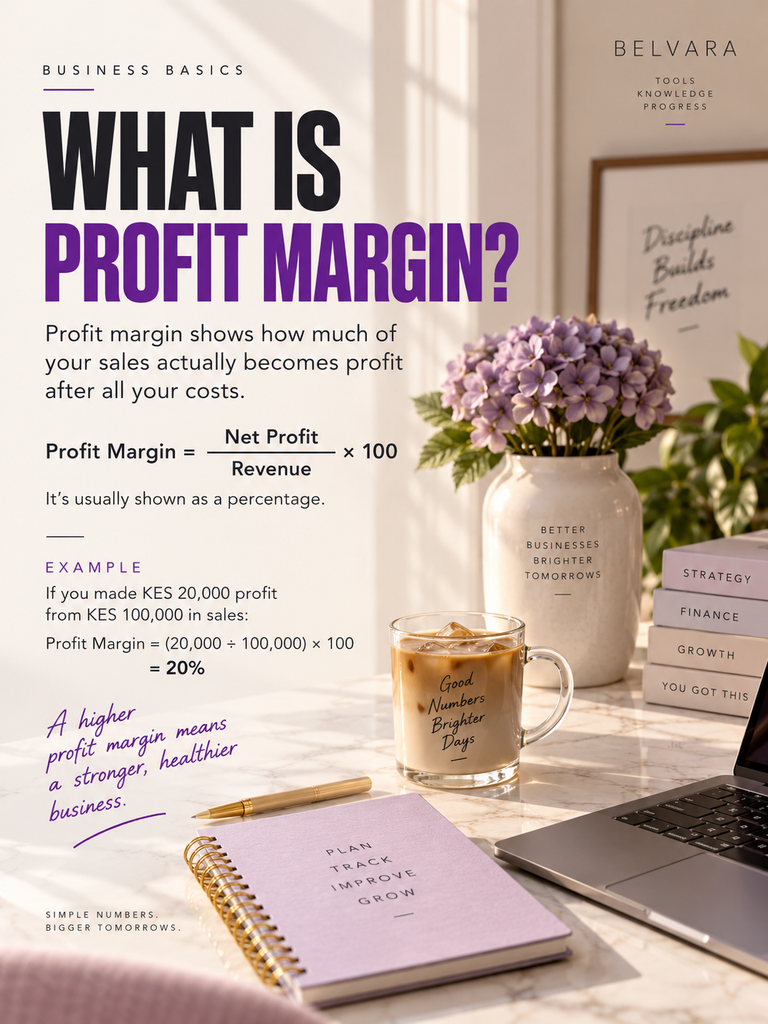
Profit margin is the percentage of revenue that remains as profit after certain costs and expenses are deducted.
The formula is simple:
Profit Margin % = Profit ÷ Revenue × 100
But the word profit matters.
There is more than one kind of profit margin.
The three most common are:
- gross profit margin
- operating profit margin
- net profit margin
Each one answers a different question.
Gross profit margin
How much of your revenue remains after the direct cost of what you sold?
Operating profit margin
How much remains after the normal cost of running the business?
Net profit margin
How much remains after the wider recognised costs and expenses of the period?
A margin without a label is half a number. Always ask which margin.
A simple profit margin example
Suppose your business makes:
KES 1,000,000 in revenue
and ends with:
KES 100,000 in net profit
Net profit margin:
KES 100,000 ÷ KES 1,000,000 × 100 = 10%
That means:
For every KES 100 in revenue, the business kept KES 10 as net profit.
The other KES 90 went to the costs and expenses of doing business.
That is what margin makes visible.
Revenue gives you the headline.
Margin shows you what survived underneath it.
Why profit margin matters more than revenue alone
Revenue can rise for many reasons:
- you sold more
- you opened another branch
- you spent more on ads
- you discounted heavily
- you added a new channel
- you hired more staff
- you accepted lower-margin customers
Some of those moves can be good.
Some can make the business look stronger while quietly weakening it.
Imagine this:
Month 1
- Revenue: KES 500,000
- Net profit: KES 75,000
- Net margin: 15%
Month 2
- Revenue: KES 1,000,000
- Net profit: KES 80,000
- Net margin: 8%
Revenue doubled.
Profit barely moved.
The business had to do twice as much work to create almost the same bottom line.
That is not automatically healthy growth. It may be a bigger business carrying weaker economics.
The three main profit margins
Profit margin is not one number.
You need to know which layer of the business you are looking at.
Gross profit margin
Gross Margin % = Gross Profit ÷ Revenue × 100
This shows how much revenue remains after direct cost.
For a product business:
Gross Profit = Revenue − COGS
Suppose:
- Revenue: KES 1,000,000
- COGS: KES 600,000
- Gross profit: KES 400,000
Gross margin:
40%
The business has KES 40 of gross profit for every KES 100 of revenue.
That KES 40 still has to help pay for the rest of the business.
Operating profit margin
Operating Margin % = Operating Profit ÷ Revenue × 100
Suppose the business has:
- Gross profit: KES 400,000
- Operating expenses: KES 250,000
Operating profit:
KES 150,000
Operating margin:
15%
Net profit margin
Net Profit Margin % = Net Profit ÷ Revenue × 100
Suppose the final net profit is:
KES 80,000
Net profit margin:
8%
The business kept KES 8 from every KES 100 of revenue.
Belvara view: Gross margin tells you whether the sale created room. Operating margin tells you whether the business used that room well. Net margin tells you what survived at the end.
One business can have three very different margins
| Item | Amount |
| Revenue | KES 1,000,000 |
| COGS | KES 600,000 |
| Gross profit | KES 400,000 |
| Operating expenses | KES 250,000 |
| Operating profit | KES 150,000 |
| Other costs and tax | KES 70,000 |
| Net profit | KES 80,000 |
The margins are:
- Gross margin: 40%
- Operating margin: 15%
- Net margin: 8%
A business owner could say:
“Our margin is 40%.”
That sounds strong.
But if they mean net margin, it is wrong.
The business is keeping 8% at the bottom line.
A beautiful gross margin can hide an ugly net margin. The costs between them are where the truth lives.
Profit margin vs markup
This is one of the easiest ways to price a product badly.
Markup uses cost as the base.
Margin uses selling price or revenue as the base.
Suppose:
- Cost: KES 1,000
- Selling price: KES 1,500
- Gross profit: KES 500
Markup:
50%
Gross margin:
33.3%
If you add 50% to cost and call it a 50% margin, you have already underpriced the product.
Profit margin vs profit
Profit is an amount.
Margin is a percentage.
Business A
- Revenue: KES 1,000,000
- Net profit: KES 100,000
- Net margin: 10%
Business B
- Revenue: KES 5,000,000
- Net profit: KES 250,000
- Net margin: 5%
Business B makes more total profit.
Business A keeps more from every shilling of revenue.
One tells you scale.
The other tells you efficiency.
You need both.
Profit margin vs cash flow
A profitable sale is not always a collected sale.
A business can show a strong margin and still be short of cash.
Suppose:
- Revenue: KES 1,000,000
- Net profit: KES 150,000
- Net margin: 15%
But customers still owe:
KES 500,000
The margin can be healthy.
Cash can still be tight.
Belvara view: Margin tells you whether the sale was worth making. Cash flow tells you whether the money arrived in time to keep making sales.
Revenue can rise while margin falls
Suppose your business grows revenue by 40%.
That sounds good.
But during the same period:
- supplier prices rise
- discounts increase
- delivery costs grow
- payroll expands
- ad costs rise
- customers buy more low-margin products
Revenue can still rise.
Margin can fall.
The business becomes bigger.
But every KES 100 of revenue now leaves less behind.
Growth is not automatically progress. Sometimes growth simply gives weak economics more room to spread.
Discounts can destroy margin faster than they reduce price
Suppose:
- Selling price: KES 2,000
- Cost: KES 1,200
Gross profit:
KES 800
Gross margin:
40%
Now offer a 20% discount.
New selling price:
KES 1,600
Cost stays:
KES 1,200
New gross profit:
KES 400
New gross margin:
25%
The customer received:
20% off
Your gross profit fell:
50%
The discount looks small on the price tag because the damage happens underneath it.
Supplier price increases can quietly eat margin
Suppose:
- Selling price: KES 2,000
- Cost: KES 1,200
- Gross margin: 40%
Your supplier raises the cost to:
KES 1,500
You keep the same selling price.
New gross profit:
KES 500
New gross margin:
25%
The customer sees no change.
Your sales report may look normal.
Your margin just lost 15 percentage points.
Your supplier can cut your margin without touching your selling price, your sales volume or your customer experience.
Landed cost can change the margin you thought you had
Suppose:
- Supplier cost: KES 1,000
- Freight: KES 150
- Duty and clearing: KES 150
- Local transport: KES 100
Relevant landed cost:
KES 1,400
Selling price:
KES 2,000
Using supplier cost only, gross margin appears to be:
50%
Using the fuller KES 1,400 cost, gross margin is:
30%
Belvara view: If your margin looks good only because part of the cost is missing, the margin is not good. The data is incomplete.
Product mix can change margin without changing revenue
Suppose you sell two products.
Product A
- Selling price: KES 1,000
- Gross margin: 50%
Product B
- Selling price: KES 1,000
- Gross margin: 20%
If customers start buying more Product B and less Product A, total revenue can stay exactly the same.
But gross profit falls.
The sales dashboard says:
No change.
The margin says:
Something changed.
Revenue can stay flat while the quality of the revenue gets worse.
Your best seller can have your worst margin
| Product | Revenue | Gross profit | Gross margin |
| Product A | KES 300,000 | KES 150,000 | 50% |
| Product B | KES 500,000 | KES 100,000 | 20% |
| Product C | KES 200,000 | KES 80,000 | 40% |
Product B is the best seller by revenue.
It creates less gross profit than Product A.
That does not automatically make Product B bad.
It may sell faster, bring repeat customers or support another product.
But revenue alone should not crown it the best-performing product.
Belvara view: Best-selling and best-performing are not the same title. Revenue alone should not award both.
Profit margin by branch
Branch A
- Revenue: KES 1,000,000
- Net profit: KES 120,000
- Net margin: 12%
Branch B
- Revenue: KES 1,500,000
- Net profit: KES 90,000
- Net margin: 6%
Branch B is bigger.
Branch A keeps more profit.
Possible reasons include:
- higher rent
- heavier discounts
- weaker product mix
- higher staff cost
- stock losses
- delivery costs
A branch can win the sales competition and still lose the business argument.
Profit margin by sales channel
The same product can have different economics depending on where it sells.
An online order may include:
- advertising
- payment fees
- packaging
- delivery support
A marketplace order may include:
- commission
- promotions
- settlement fees
A shop sale may carry:
- rent
- staff
- utilities
The channel with the most orders is not automatically the strongest channel.
Margin helps you look beyond volume.
Delivery can turn a good product into a weak order
Suppose:
- Selling price: KES 2,000
- Product cost: KES 1,000
- Gross profit: KES 1,000
- Gross margin: 50%
Then the business pays:
KES 500 delivery
If delivery sits outside COGS, the gross margin still looks like 50%.
But the order has much less room left.
A product can have a strong gross margin and still produce a weak order.
Payment fees look small until volume makes them expensive
Suppose a business processes:
KES 5,000,000 per month
A transaction cost of:
2%
equals:
KES 100,000
If monthly net profit is KES 300,000, that fee is one-third of the bottom line.
Small percentages become expensive when they sit on top of big revenue.
Payroll can grow faster than the business
Hiring is not automatically bad for margin.
But the extra cost has to create enough extra value.
Suppose:
- Revenue grows 10%
- Payroll grows 30%
If the extra staff do not create enough extra capacity, service, sales or efficiency, operating margin can fall.
Belvara view: More staff is not proof of growth. The question is whether the business became strong enough to carry the extra payroll.
Profit margin and inventory
Inventory affects margin through cost.
If stock costs are wrong, margin can be wrong.
If stock is lost, damaged or written off, profitability can suffer.
If slow-moving products are heavily discounted, margin can fall.
Stock sitting on a shelf is money waiting for a customer. Stock written off is money that never got one.
Profit margin and working capital
A business can have a strong margin and still struggle with working capital.
A wholesaler may be profitable but give customers 60 days to pay.
The margin tells you the business is profitable.
Working capital tells you whether the business can carry the wait.
Belvara helps you look at margin beside:
- receivables
- inventory
- supplier balances
- cash flow
so one healthy number does not hide pressure somewhere else.
Profit margin for a retail business
Suppose a retailer earns:
KES 1,500,000 revenue
COGS:
KES 900,000
Gross profit:
KES 600,000
Gross margin:
40%
Operating expenses:
KES 450,000
Operating profit:
KES 150,000
Operating margin:
10%
After other recognised costs and tax:
Net profit:
KES 90,000
Net margin:
6%
A busy shop can still have a thin bottom line. Foot traffic is not profit.
Profit margin for a wholesale business
Suppose:
- Revenue: KES 5,000,000
- COGS: KES 4,000,000
- Gross profit: KES 1,000,000
- Gross margin: 20%
- Operating expenses: KES 600,000
- Operating profit: KES 400,000
- Net profit: KES 250,000
- Net margin: 5%
That can be a healthy business.
But when margins are thin, small cost changes matter more.
Profit margin for a service business
Service businesses can fool themselves by ignoring labour.
Suppose:
- Revenue: KES 1,000,000
- Direct service cost: KES 400,000
- Gross profit: KES 600,000
- Gross margin: 60%
- Operating expenses: KES 350,000
- Net profit after other costs: KES 180,000
- Net margin: 18%
If staff time used to deliver the service is missing from direct cost, the gross margin may be overstated.
No stock does not mean no cost. Somebody still had to do the work.
Profit margin for restaurants
A restaurant may have:
- Revenue: KES 2,000,000
- Gross profit: KES 1,200,000
- Gross margin: 60%
- Net profit: KES 100,000
- Net margin: 5%
The business keeps only:
KES 5 from every KES 100 of revenue
after the wider costs are recognised.
Profit margin for SaaS businesses
A software company may have:
- Revenue: KES 5,000,000
- Cost of revenue: KES 1,000,000
- Gross profit: KES 4,000,000
- Gross margin: 80%
Then spend heavily on engineering, product, sales, marketing, support and administration.
A high gross margin gives the business room.
It does not stop the company from spending all of it.
What is a good profit margin?
There is no universal good margin.
It depends on:
- industry
- product
- business model
- scale
- competition
- risk
- growth stage
- capital needs
- cost structure
The better questions are:
- Is the margin improving?
- Is it sustainable?
- Is it enough for the risk?
- Does it support the operating costs?
- Is cash flow healthy too?
The goal is not the highest percentage. The goal is a margin that supports a healthy business.

How to improve profit margin
Review pricing
A product may simply be priced too low for its real cost.
Keep cost data current
Old supplier cost can make margin look healthier than it is.
Use landed cost where relevant
Do not price imported stock as if freight and clearing disappeared.
Reduce careless discounting
A discount should have a reason and a limit.
Improve product mix
Sell more of the products that create stronger economics where demand supports it.
Reduce stock loss
Damage, theft, expiry and write-offs all hurt profitability.
Review delivery and fulfilment
“Free” delivery still has a cost.
Review payment and channel fees
A small fee can become large at scale.
Control operating costs
Cut waste, not the parts of the business that create value.
Review weak branches and channels
High revenue should not protect a part of the business that consistently produces weak economics.
How Belvara helps you protect your profit margin
You should not have to wait until the end of the month to discover that margin changed.
Belvara helps bring the records behind your margin into one business view.
That includes:
- sales
- product cost
- COGS
- landed cost
- supplier changes
- discounts
- returns
- stock
- expenses
- payroll
- branches
- payment and delivery costs
The point is not to give you another percentage.
It is to give that percentage context.
See when cost is moving against you
If supplier cost or landed cost changes, your old selling price may no longer create the margin you expected.
Keeping cost and sales records connected makes that easier to catch.
See what discounting is doing
A promotion can increase sales while reducing the amount kept from each sale.
Belvara gives you the records needed to compare the sales lift with the profit pressure.
Compare products, branches and channels
You can look beyond “best selling” and ask:
- Which products create stronger gross profit?
- Which branch keeps more from its sales?
- Which channel adds expensive fees?
- Where are discounts or costs heavier?
Read margin beside cash and working capital
A strong margin does not guarantee strong cash flow.
Belvara helps you keep the wider picture close, including receivables, inventory, expenses and cash movement.
Belvara view: Knowing your margin tells you where you are. Understanding what moved it tells you where to act.
Do not wait for margin to become a month-end surprise
Margin problems often start before the report shows them clearly.
A supplier changes price today.
A discount campaign starts tomorrow.
A branch adds staff.
A delivery offer gets more expensive.
A low-margin product suddenly becomes the bestseller.
Each decision looks small on its own.
Together, they can move the business.
Using Belvara to keep your sales, costs, stock and expenses together makes it easier to investigate those changes while they are still manageable.
Belvara view: A falling margin is rarely one big mistake. It is often several small decisions quietly adding up.
Common profit margin mistakes
1. Looking only at revenue
Sales can rise while margin falls.
2. Saying “margin” without saying which margin
Gross, operating and net margin are different.
3. Confusing margin with markup
Markup uses cost.
Margin uses revenue.
4. Looking only at the percentage
A high margin on very low sales may still produce little total profit.
5. Looking only at total profit
Profit can increase while margin gets weaker.
6. Using old cost data
Your margin is only as accurate as the cost behind it.
7. Ignoring discounts
Price can fall much less than gross profit.
8. Ignoring product mix
More low-margin sales can pull the whole business down.
9. Ignoring branch and channel costs
Not every sale costs the same to generate.
10. Ignoring cash flow
Profit margin does not tell you when money arrives.
Belvara view: Margin is not useful because it is a percentage. It is useful because it forces the business to explain what happened to every shilling of revenue.
The takeaway
Profit margin tells you how much of your revenue remains as profit at a specific stage.
The basic formula is:
Profit Margin % = Profit ÷ Revenue × 100
The three common margins are:
- gross profit margin
- operating profit margin
- net profit margin
Revenue tells you how much business happened.
Profit tells you how much money remained.
Margin tells you how efficiently revenue became profit.
A business that doubles revenue while destroying margin has not automatically become stronger. It may have simply made the problem bigger.
The better question is not:
“Did sales go up?”
It is:
“What did we keep from those sales, and why?”
That is where margin becomes a management tool instead of another percentage on a report.
Frequently Asked Questions About Profit Margin
What is profit margin in simple terms?
Profit margin is the percentage of revenue that remains as profit after certain costs and expenses are deducted.
What is the profit margin formula?
Profit Margin % = Profit ÷ Revenue × 100
What are the main types of profit margin?
The three common types are gross profit margin, operating profit margin and net profit margin.
What is gross profit margin?
Gross profit margin is gross profit expressed as a percentage of revenue.
Gross Margin % = Gross Profit ÷ Revenue × 100
What is operating profit margin?
Operating profit margin is operating profit expressed as a percentage of revenue.
What is net profit margin?
Net profit margin is net profit expressed as a percentage of revenue.
Is profit margin the same as markup?
No. Markup is based on cost. Margin is based on revenue or selling price.
Is a 50% markup a 50% margin?
No. A 50% markup gives a gross margin of about 33.3%.
Is profit margin the same as profit?
No. Profit is an amount of money. Profit margin is a percentage.
Is profit margin the same as revenue?
No. Revenue tells you how much the business sold. Profit margin tells you how much profit remained relative to that revenue.
Is profit margin the same as cash flow?
No. Profit margin measures profitability. Cash flow measures money moving into and out of the business.
Can revenue increase while profit margin falls?
Yes. This can happen when costs grow faster than revenue or when the business sells more low-margin products.
Can profit margin rise while total profit falls?
Yes. A business can become more efficient while lower revenue causes total profit to fall.
What does a 10% net profit margin mean?
It means the business keeps about KES 10 of net profit for every KES 100 of revenue.
What is a good profit margin?
There is no universal good margin. It depends on the industry, business model, cost structure, risk and stage of growth.
Why does gross margin matter?
Gross margin shows how much revenue remains after direct cost to help pay for the rest of the business.
Why does net margin matter?
Net margin shows how much revenue remains as final profit after the wider recognised costs and expenses.
How do discounts affect profit margin?
Discounts reduce selling price while cost may stay the same. That can make margin fall quickly.
How do supplier price increases affect margin?
Higher supplier costs reduce gross profit and gross margin if selling prices do not rise enough to compensate.
How does product mix affect margin?
Selling more low-margin products can reduce the overall margin even when total revenue rises.
Can one branch have a different margin from another?
Yes. Branches can differ because of pricing, product mix, rent, payroll, stock loss and other operating costs.
Can different sales channels have different margins?
Yes. Marketplace fees, payment fees, advertising, delivery and other channel costs can change the economics of a sale.
How does Belvara help with profit margin?
Belvara helps you keep the business records behind margin together, including sales, COGS, landed cost, supplier changes, discounts, returns, stock, expenses, payroll, branches and other operating costs. That gives you better context when margin changes, so you can investigate what is putting pressure on it instead of only seeing the percentage.
What should I learn after profit margin?
The next useful concepts are gross margin, operating margin, net profit margin, contribution margin, break-even point and unit economics.
