

BELVARA BUSINESS EDUCATION
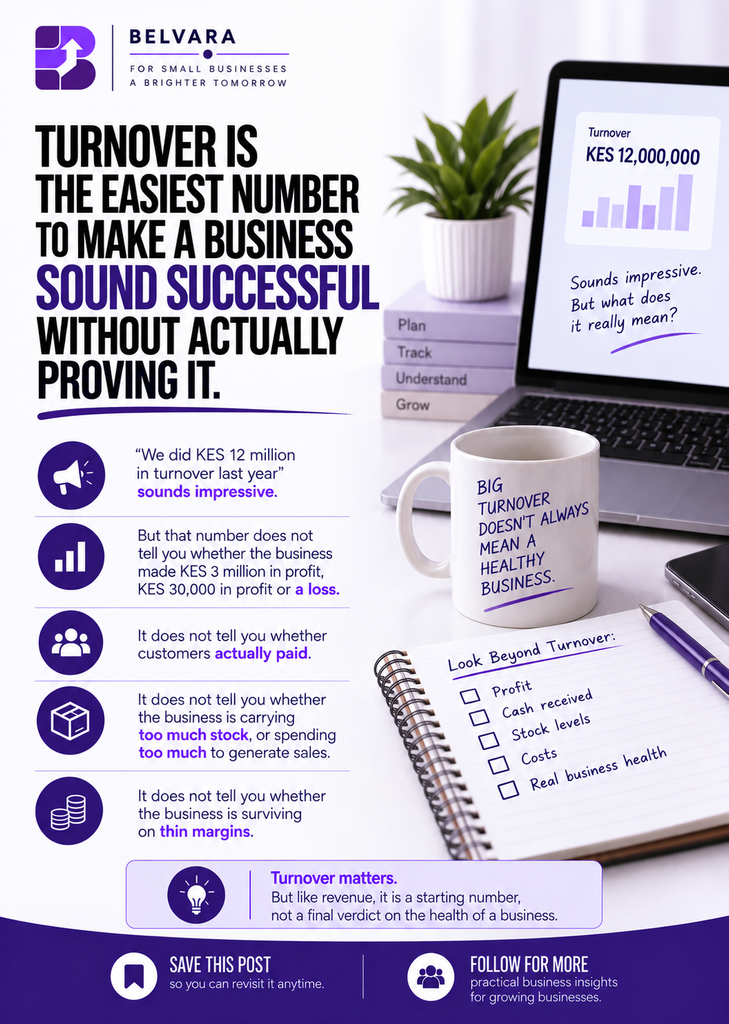
Turnover is one of the easiest numbers to use to make a business sound successful without proving that it is.
“We did KES 12 million in turnover last year” sounds impressive.
But that number does not tell you whether the business made KES 3 million in profit, KES 30,000 in profit or a loss.
It does not tell you whether customers actually paid.
It does not tell you whether the business is carrying too much stock, spending too much to generate sales or surviving on thin margins.
Turnover matters. But like revenue, it is a starting number, not a final verdict on the health of a business.
What is turnover?
In a business and accounting context, turnover usually means the total value of goods or services a business sells during a specific period, before most costs and expenses are deducted.
In many contexts, turnover and revenue are used to mean the same or nearly the same thing.
For example, if a retailer sells KES 800,000 worth of products during September, its monthly sales turnover may be KES 800,000.
If a consulting firm earns KES 5 million from client services during the year, that amount may be described as annual turnover.
The Office for National Statistics in the UK, for example, defines turnover as the total value of sales, including goods sold and services rendered.
Belvara view: Turnover tells you how much business passed through the front door. It does not tell you what survived after the bills came through the back.
That distinction is why Belvara treats turnover as one part of the operating picture rather than using it as shorthand for business success.
What is the formula for turnover?
For a simple product business:
Turnover = Units sold × Selling price
If a shop sells 500 products at an average selling price of KES 2,000:
Turnover = 500 × KES 2,000 = KES 1,000,000
For a service business:
Turnover = Number of services delivered × Price charged
If a cleaning company completes 80 jobs at an average price of KES 7,500:
Turnover = 80 × KES 7,500 = KES 600,000
For a business with several sales streams:
Total Turnover = Turnover from Revenue Stream A + B + C + …
Example:
- Retail sales: KES 500,000
- Online sales: KES 250,000
- Wholesale sales: KES 300,000
Total turnover = KES 1,050,000
The arithmetic is usually easy.
The harder question is which amounts actually belong in turnover.
Is turnover the same as revenue?
Often, yes.
In everyday business and many accounting contexts, the words turnover, sales revenue and revenue are frequently used to describe the top-line value generated from a business’s ordinary activities.
But they should not always be treated as perfect synonyms without checking the context.
“Revenue” is generally the broader accounting term.
“Turnover” is commonly used to describe the value of sales over a period, particularly in Commonwealth business language.
For a simple retailer with only one revenue stream:
Revenue = Turnover = Sales
may be a perfectly reasonable description.
For a more complex business, the wording may require more care.
If someone tells you a business has KES 50 million turnover, you still do not know whether it is a good business. You only know it sold a lot.
Turnover vs sales
For many businesses, turnover and sales are effectively the same number.
If a shop sells KES 2 million worth of products in a year, you may hear:
- annual sales of KES 2 million
- annual turnover of KES 2 million
- sales revenue of KES 2 million
The terminology changes.
The economic activity may not.
However, accounting, tax, statistical or contractual definitions may specify exactly what should be included or excluded, so businesses should follow the definition required for the specific report or filing they are preparing.
Turnover vs profit
This is the distinction every business owner needs to understand.
Turnover measures sales activity. Profit measures what remains after relevant costs and expenses are deducted.
Suppose a business has:
- Turnover: KES 1,000,000
- Cost of goods sold: KES 550,000
- Operating expenses: KES 350,000
Simplified profit:
KES 1,000,000 − KES 550,000 − KES 350,000 = KES 100,000
The business has KES 1 million turnover.
It made KES 100,000 profit.
Those are not remotely the same number.
Turnover is what the market gave you. Profit is what the business managed not to give back.
This is why turnover alone cannot tell you whether a business model works.
Turnover vs cash received
Turnover is also not the same thing as cash collected.
Imagine a wholesaler invoices customers for KES 800,000 this month.
Only KES 500,000 has been paid so far.
The business may have generated KES 800,000 in turnover, while only KES 500,000 has actually been collected.
The remaining amount may still be owed by customers.
The opposite can also happen.
A customer may pay before the business has fully delivered the goods or services.
Your M-Pesa statement can show money. Your turnover report should show business activity. Confusing the two is how bad records start looking believable.
Belvara separates orders, sales, amounts due and payments because one transaction can move through several stages before the business finally has cash it can use.
Turnover vs cash flow
Turnover measures the value of sales. Cash flow measures money moving into and out of the business.
A company can have high turnover and terrible cash flow.
For example, a wholesaler may sell KES 5 million in goods during a month but give customers 60 days to pay.
Suppliers, salaries, rent and transport may need to be paid long before those customers settle.
The business is selling.
But it is short on cash.
That is a working-capital problem, not necessarily a turnover problem.
More turnover can create a cash crisis if the business has to fund the sale long before the customer pays.
Turnover vs gross profit
Turnover tells you the total value of sales.
Gross profit tells you what remains after the direct costs of the goods or services sold are deducted.
Formula
Gross Profit = Turnover − Cost of Goods Sold
Suppose:
- Turnover: KES 800,000
- Cost of goods sold: KES 480,000
Gross profit:
KES 320,000
That KES 320,000 still needs to cover operating expenses.
A business with huge turnover and weak gross margin can be working extremely hard to create very little value.
Annual turnover vs monthly turnover
Turnover should always be tied to a period.
Monthly turnover
Monthly turnover is the value of sales generated during a month.
Example:
September turnover = KES 850,000
Quarterly turnover
Quarterly turnover is the value generated during a three-month period.
Example:
- July: KES 700,000
- August: KES 780,000
- September: KES 850,000
Quarterly turnover = KES 2,330,000
Annual turnover
Annual turnover is the value generated during a 12-month period or financial year.
If a company averages KES 1.2 million in monthly turnover:
Approximate annual turnover = KES 14.4 million
Annual turnover is often used when discussing:
- business size
- tax thresholds
- financing
- insurance
- tenders
- valuations
- supplier applications
- company performance
But a single annual figure can hide major seasonality.
A business doing KES 12 million per year may not make KES 1 million every month.
Gross turnover vs net turnover
The exact terminology can vary by accounting or tax context, but it is useful to understand the general distinction.
Gross turnover
Gross turnover generally refers to the total value of sales before certain deductions.
Net turnover
Net turnover may refer to sales after relevant deductions such as:
- returns
- refunds
- trade discounts
- certain allowances
- taxes collected on behalf of government where excluded by the applicable definition
Example:
- Gross sales: KES 1,000,000
- Returns: KES 40,000
- Refunds: KES 20,000
- Applicable sales discounts: KES 10,000
Simplified net sales:
KES 930,000
The exact treatment depends on the reporting framework and transaction.
If returns and refunds disappear from your reports, your turnover is not measuring performance. It is measuring optimism.
Does VAT count as turnover?
This depends on the definition being used.
For financial reporting and many business measurements, VAT collected from customers on behalf of the tax authority is generally separated from the business’s own sales revenue.
A business should not treat tax collected for remittance as if it were money earned for itself.
For Kenyan businesses, VAT rules also use the value of taxable supplies to determine registration obligations.
As of September 2026, the VAT Act generally requires a person making or expecting to make taxable supplies of KES 5 million or more in a twelve-month period to register for VAT, subject to the detailed rules and exceptions in the Act.
Businesses should use the definition required by the relevant tax law rather than assuming every use of the word “turnover” means the exact same figure.
How turnover works for different types of businesses
Product-based business
A retailer sells:
- 200 items at KES 1,500
- 100 items at KES 2,500
- 50 items at KES 4,000
Turnover:
KES 300,000 + KES 250,000 + KES 200,000 = KES 750,000
This is the value of the sales.
It says nothing yet about how much the stock cost.
Service-based business
A marketing agency completes:
- 5 retainers at KES 80,000 = KES 400,000
- 3 projects at KES 60,000 = KES 180,000
Total turnover:
KES 580,000
The agency still needs to account for staff, freelancers, software, media costs, office expenses and other costs before it can determine profit.
Subscription business
A software company has 1,000 customers paying KES 2,000 per month.
Monthly subscription turnover or revenue:
KES 2,000,000
Annualised at the same customer count and price:
KES 24,000,000
But cancellations, upgrades, discounts, failed payments and revenue-recognition rules can make the real picture more complex.
Restaurant
A restaurant may generate turnover from:
- dine-in
- takeaway
- delivery
- catering
- events
Suppose:
- Dine-in sales: KES 600,000
- Delivery: KES 200,000
- Catering: KES 300,000
Total turnover:
KES 1,100,000
The owner should still ask which channel produces the strongest margin.
Wholesaler
A wholesaler may generate very large turnover but operate on relatively thin margins.
Suppose:
- Turnover: KES 10,000,000
- Gross margin: 8%
Gross profit:
KES 800,000
A smaller service business with KES 2 million turnover and a much higher margin could potentially retain more profit.
Turnover measures size. It does not measure quality.
Marketplace
Turnover gets more complicated when a company facilitates sales for other businesses.
Suppose customers purchase KES 20 million worth of goods through a marketplace.
That KES 20 million might represent gross merchandise value (GMV).
If the marketplace earns a 7% commission:
Marketplace commission = KES 1.4 million
Depending on whether the platform is acting as principal or agent and the applicable accounting treatment, its recognised revenue may be the commission rather than the entire KES 20 million.
Processing KES 20 million does not make you a KES 20 million business if KES 18.6 million belongs to someone else.
Rental business
A rental company may describe rental receipts from ordinary business activity as turnover in some business contexts.
Suppose 20 pieces of equipment rent for KES 15,000 per month:
Monthly turnover = KES 300,000
However, particular tax regimes may treat rental income separately, so the legal or tax definition must be checked.
Agency or commission business
A property agency facilitates KES 100 million worth of property transactions but earns KES 3 million in commissions.
The property transaction value is not automatically the agency’s turnover.
Its own economic activity may be represented by the commission it earns.
Why comparing businesses by turnover can mislead you
Consider two companies.
Business A
- Annual turnover: KES 20 million
- Net profit: KES 600,000
- Net margin: 3%
Business B
- Annual turnover: KES 8 million
- Net profit: KES 1.2 million
- Net margin: 15%
Business A has 2.5 times the turnover.
Business B makes twice the profit.
Which one is “bigger”?
That depends on what you are measuring.
Which one is better?
You still need more information.
Belvara view: Turnover is great for measuring volume. It is terrible for pretending volume equals strength.
Why turnover can rise while the business gets weaker
Turnover can grow while profit, cash flow or financial resilience deteriorate.
This can happen because the business is:
- discounting too aggressively
- selling low-margin products
- spending heavily on customer acquisition
- subsidising delivery
- extending too much customer credit
- carrying too much inventory
- accepting expensive orders
- adding staff faster than revenue quality improves
- experiencing high refunds or returns
Example:
Year 1
- Turnover: KES 10 million
- Profit: KES 1.5 million
Year 2
- Turnover: KES 15 million
- Profit: KES 900,000
Turnover grew by 50%.
Profit fell by 40%.
You can grow the top line while shrinking the business underneath it.
What does turnover tell you?
Turnover is still extremely useful.
It can help a business understand:
- sales scale
- sales growth
- seasonality
- performance by branch
- performance by product
- performance by service
- performance by sales channel
- customer demand
- eligibility for certain tax regimes
- VAT registration thresholds
- financing or tender requirements
The mistake is not using turnover.
The mistake is asking turnover to answer questions it was never designed to answer.
What turnover does not tell you
Turnover alone does not tell you:
- gross profit
- net profit
- cash available
- gross margin
- net margin
- customer payment speed
- debt
- stock levels
- working capital
- operational efficiency
- whether growth is sustainable
If turnover is the only number you know, you are measuring motion, not performance.
What is Turnover Tax in Kenya?
Turnover Tax (TOT) is a specific Kenyan tax regime charged on qualifying business turnover. It is not another name for ordinary income tax on profit.
This distinction matters because the tax is based on gross business receipts rather than profit after deducting expenses.
As of September 2026, section 12C of Kenya’s Income Tax Act provides for Turnover Tax for a resident person whose turnover from business is more than KES 1 million but does not exceed, or is not expected to exceed, KES 25 million during a year of income.
The current statutory rate is 1.5% of the gross receipts of the business.
Simple Turnover Tax example
Suppose a qualifying business has monthly gross receipts of:
KES 500,000
At a 1.5% rate:
Turnover Tax = KES 500,000 × 1.5% = KES 7,500
The tax is calculated on the gross receipts.
The business does not first subtract rent, salaries, stock costs or other expenses to arrive at taxable profit under the TOT calculation.
Kenya’s Turnover Tax can still be payable when your profit is painfully small. The tax looks at qualifying turnover, not how happy you were with what remained.
That is one reason owners need to understand the difference between turnover and profit.
Who is subject to Turnover Tax in Kenya?
Under the current Income Tax Act, the regime generally applies to qualifying resident persons with business turnover:
- above KES 1 million; and
- not exceeding or expected to exceed KES 25 million in a year of income.
The law also allows a person who would otherwise be subject to Turnover Tax to elect not to be under section 12C by giving the required notice to the Commissioner, after which the other applicable provisions of the Income Tax Act apply.
The Act excludes certain categories from Turnover Tax, including:
- rental income
- management fees
- professional fees
- training fees
- income subject to final withholding tax
Because tax rules can change, businesses should confirm their current position with KRA or a qualified tax professional before relying on an article to make a filing decision.
When is Kenyan Turnover Tax filed and paid?
Under section 12C, the tax period is a calendar month.
A person subject to Turnover Tax is required to submit the return and pay the tax on or before the twentieth day of the month following the end of the tax period.
For example, tax for September would generally be due by 20 October, subject to the current rules applying to that taxpayer.
KRA provides registration, filing and payment through its tax systems.
Turnover Tax vs VAT in Kenya
These are separate taxes.
Being subject to Turnover Tax does not automatically mean VAT is irrelevant.
As of September 2026, the VAT Act generally requires a business that makes or expects to make taxable supplies of KES 5 million or more in any twelve-month period to register for VAT, subject to the Act’s detailed rules.
That means a qualifying business may need to think about both its Turnover Tax position and its VAT obligations.
One turnover number can trigger two completely different tax conversations. That is why “we make about KES 5 million” is not enough bookkeeping.
Why Turnover Tax can be painful for low-margin businesses
Because Turnover Tax is calculated on gross receipts, two businesses with identical turnover can feel the tax very differently.
Business A
- Monthly turnover: KES 1,000,000
- Profit before TOT: KES 300,000
TOT at 1.5%:
KES 15,000
Business B
- Monthly turnover: KES 1,000,000
- Profit before TOT: KES 50,000
TOT at 1.5%:
KES 15,000
Same turnover.
Same Turnover Tax.
Very different economics.
Belvara view: A tax based on turnover makes margin discipline non-negotiable. If you do not know what each sale leaves behind, you are pricing blind.
This does not mean Turnover Tax is automatically worse for every business. It means a business should understand its own economics and tax position rather than treating the simplicity of a gross-sales tax as proof that the tax cost is insignificant.
Turnover has other meanings too
This is where the word becomes confusing.
“Turnover” does not always refer to sales.
Two other common uses are:
- Inventory turnover
- Employee turnover
These are completely different metrics.
What is inventory turnover?
Inventory turnover measures how many times a business sells and replaces its inventory during a period.
A common formula is:
Inventory Turnover = Cost of Goods Sold ÷ Average Inventory
Suppose:
- Annual COGS: KES 6,000,000
- Average inventory: KES 1,500,000
Inventory turnover:
6,000,000 ÷ 1,500,000 = 4 times
The business turned over its average inventory about four times during the period.
This is not sales turnover.
It is a measure of how efficiently inventory moves.
A very low inventory turnover can suggest:
- slow-moving stock
- overbuying
- weak demand
- poor assortment
- obsolete stock
A very high turnover can sometimes indicate strong demand, but it can also mean the business is carrying too little inventory and risking stockouts.
Stock that never moves is not inventory strategy. It is cash wearing a product costume.
Belvara can make this relationship visible by connecting stock movement, sales and product-level financial performance rather than treating inventory as a static count.
What is employee turnover?
Employee turnover measures the rate at which employees leave an organisation and are replaced over a period.
A common formula is:
Employee Turnover Rate = Employees who left during the period ÷ Average number of employees × 100
Example:
- 5 employees leave during the year
- Average workforce: 50
Employee turnover rate = 10%
This has nothing to do with sales turnover.
Context matters every time the word is used.
Turnover ratio can also mean different things
In finance and operations, several ratios use the word “turnover,” including:
- inventory turnover
- accounts receivable turnover
- asset turnover
- employee turnover
- working-capital turnover
They all measure some form of movement, usage or cycling.
That is why a dashboard or report should never simply say “Turnover” if the reader could reasonably interpret it several ways.
How should a small business track turnover?
At minimum, a business owner should know:
- today’s sales
- monthly turnover
- year-to-date turnover
- annual turnover
- turnover by product or service
- turnover by channel
- turnover by branch
- turnover by customer segment where useful
- returns and refunds
- amounts collected
- amounts still outstanding
- gross profit
- profit margin
For businesses approaching tax or VAT thresholds, turnover tracking becomes even more important.
You should not discover in December that you crossed a statutory threshold in May because nobody was watching the cumulative figure.
Belvara view: Tax thresholds should trigger alerts, not surprises.
Why Belvara tracks more than one turnover number
Imagine a business reports KES 1.5 million monthly turnover.
Useful.
Now split it:
- Physical shop: KES 600,000
- Instagram and WhatsApp: KES 350,000
- Website: KES 250,000
- Wholesale: KES 300,000
Better.
Now connect those numbers to:
- gross margin
- refunds
- cost of goods sold
- delivery costs
- customer balances
- inventory movement
- branch performance
Now the turnover starts becoming operational intelligence.
Belvara is designed around that progression.
The goal is not to give an owner another dashboard with a large number in the middle.
The goal is to make the number explainable.
Belvara view: A dashboard that tells you turnover went up without telling you why is reporting history, not helping you run the business.
Common turnover mistakes business owners make
1. Calling turnover profit
They are not the same.
Turnover is the top line.
Profit is what remains.
2. Using M-Pesa or bank deposits as turnover
Deposits can contain money that is not sales revenue, including:
- owner capital
- loans
- transfers
- tax amounts
- customer deposits
- supplier refunds
Your bank account is not automatically your sales ledger.
3. Including marketplace GMV as the company’s own turnover
If money belongs to third-party sellers, the full transaction value may not represent the platform’s recognised revenue.
4. Ignoring refunds and returns
Gross sales can overstate the economic value of transactions that were later reversed.
5. Comparing turnover across unrelated businesses
A wholesaler, consulting firm and SaaS company can have completely different margins and cost structures.
KES 20 million turnover in each business does not represent the same economics.
6. Ignoring the period
“Turnover is KES 5 million” is incomplete.
Per month?
Per year?
Year to date?
Trailing 12 months?
The time period changes the meaning.
7. Ignoring tax thresholds
Turnover can affect tax and VAT obligations.
Businesses should monitor cumulative turnover rather than waiting for an accountant to reconstruct the number after year-end.
8. Tracking turnover without margin
KES 10 million of bad sales is still bad business.
Revenue quality matters.
Is higher turnover always better?
No.
Higher turnover is useful when the additional sales create enough value to justify the resources required to generate them.
Higher turnover can be harmful when growth comes from:
- unsustainable discounts
- negative or weak margins
- excessive advertising spend
- customer credit the business cannot finance
- delivery costs that exceed what customers pay
- increased returns
- excessive working-capital requirements
- operational mistakes caused by overcapacity
A healthy growth question is therefore not:
“How do we increase turnover?”
It is:
“How do we increase profitable, collectible turnover without breaking the business?”
That is a very different objective.
What should you look at after turnover?
Turnover becomes useful when connected to:
- gross profit
- gross margin
- net profit
- net profit margin
- cash flow
- customer receivables
- stock turnover
- cost of goods sold
- operating expenses
- working capital
Together, these metrics turn a sales number into a business story.
Turnover tells you how much happened.
Margin tells you how valuable it was.
Profit tells you what remained.
Cash flow tells you whether you can actually use the money.
The takeaway
Turnover usually refers to the value of sales a business generates during a specific period.
In many ordinary business contexts, it is used interchangeably with sales revenue.
But the word changes meaning depending on where you see it.
There is:
- business turnover
- gross and net turnover
- Kenyan Turnover Tax
- inventory turnover
- employee turnover
- other turnover ratios
That is why context matters.
The mistake is not talking about turnover.
The mistake is treating it as proof of success.
A business can have impressive turnover, exhausted staff, empty bank accounts and terrible profit. The top line will not warn you.
Belvara’s view is simple:
Turnover should tell you how much business you generated. The rest of your system should tell you whether that business was worth generating.
Frequently Asked Questions About Turnover
What is turnover in simple terms?
Turnover usually means the total value of goods or services a business sells during a specific period, before most costs and expenses are deducted.
Is turnover the same as revenue?
Often, yes. In many business contexts, turnover and revenue are used to describe the same or a very similar top-line sales figure. However, the exact definition can vary depending on accounting, tax or legal context.
Is turnover the same as sales?
For many simple businesses, yes. Sales turnover generally refers to the value of goods or services sold during the period.
Is turnover the same as profit?
No. Turnover measures sales. Profit is what remains after relevant costs and expenses are deducted.
What is the formula for turnover?
For a simple product business:
Turnover = Units sold × Selling price
For businesses with several revenue streams, turnover is generally the sum of the relevant sales generated during the period.
What is annual turnover?
Annual turnover is the value of sales generated during a 12-month period or financial year.
What is monthly turnover?
Monthly turnover is the value of sales generated during a single month.
Is turnover the same as cash received?
No. A business may make a sale before the customer pays, or receive money before it has fully earned it. Cash collection and turnover are related but different.
Does VAT count as turnover?
The treatment depends on the specific definition being used. VAT collected on behalf of the government is generally separated from the business’s own revenue for financial reporting. Tax legislation should be checked for the specific threshold or filing being considered.
What is Turnover Tax in Kenya?
Turnover Tax is a Kenyan tax regime for qualifying business turnover. As of September 2026, section 12C of the Income Tax Act generally applies to resident persons whose business turnover is above KES 1 million but does not exceed or is not expected to exceed KES 25 million in a year of income, subject to exclusions and elections provided by law.
What is the Turnover Tax rate in Kenya?
As of September 2026, the statutory Turnover Tax rate is 1.5% of gross receipts for a taxable person under section 12C.
When is Turnover Tax due in Kenya?
The tax period is a calendar month, and the return and payment are generally due on or before the twentieth day of the following month.
Is Turnover Tax calculated on profit?
No. Turnover Tax is calculated on qualifying gross receipts rather than profit after deducting business expenses.
Is Turnover Tax the same as VAT?
No. Turnover Tax and VAT are separate taxes with different rules and thresholds.
What is inventory turnover?
Inventory turnover measures how many times a business sells and replaces its average inventory during a period.
A common formula is:
Inventory Turnover = Cost of Goods Sold ÷ Average Inventory
What is employee turnover?
Employee turnover measures the proportion of employees who leave an organisation over a period.
Is higher turnover always better?
No. Higher turnover is beneficial only when the additional sales produce acceptable margins, cash collection and sustainable economics.
Why is turnover important?
Turnover helps measure sales scale, growth, seasonality and business activity. It can also affect tax, VAT, tender, financing and reporting requirements.
What should I track alongside turnover?
Track turnover alongside gross profit, profit margin, net profit, cash flow, receivables, inventory and operating expenses to understand whether the sales are actually creating value.
